If you’ve ever asked ChatGPT or Gemini for football betting analysis, you’ve probably noticed something: the answers sound confident. Plausible. Often well-written. But when you test the picks against the market, the results rarely justify the confidence in the prose.
There’s a reason for that, and it has nothing to do with how good ChatGPT or Gemini are at their actual job. The problem is structural — they were designed to predict the next word in a sentence, not the probability of a goal in a football match. Asking them to do the second is like asking a novelist to price an insurance contract. They can give you something that reads well; the maths underneath isn’t what they’re built for.
This is the question this post answers: when does a general-purpose AI chatbot actually help you bet on football, and when does it actively cost you money? Gecko Edge has tracked 8,439 AI-generated bets and recorded +398 points of profit across 66 competitions — using a fundamentally different architecture from the LLMs everyone else is asking for picks. Here’s the breakdown.
Gecko Edge has tracked 8,439 AI-generated bets and recorded +398pts of profit across 66 competitions. See how the model works →
How ChatGPT and Gemini Actually Work
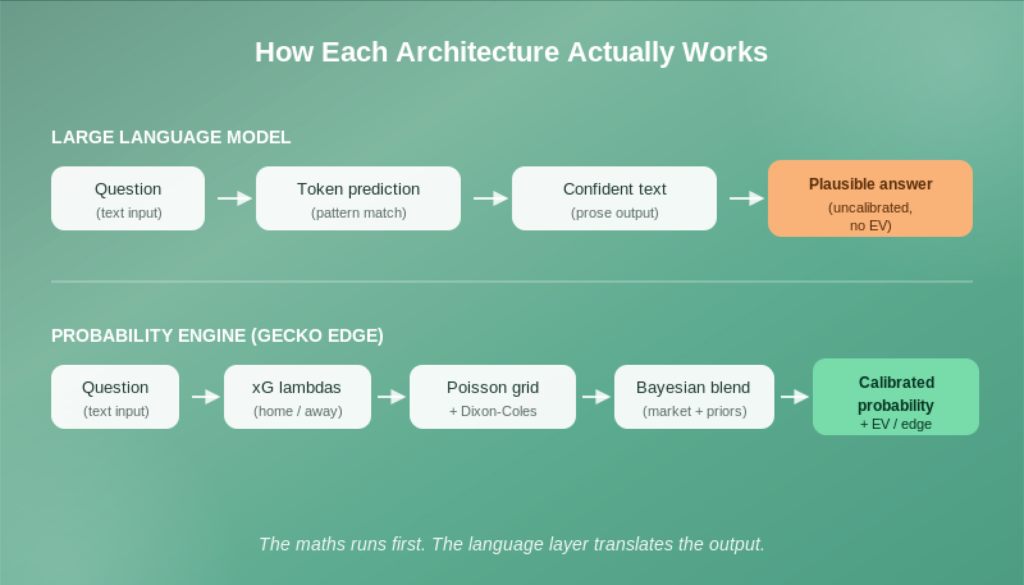
ChatGPT, Gemini, and similar models are Large Language Models (LLMs). Their core architecture is a transformer network trained on a vast corpus of text. Given an input — a question, a prompt, a partial sentence — they predict the next token (a word or word-fragment) based on patterns learned from that training data. They then predict the token after that, and the one after that, until the response is complete.
Within their design space, they’re genuinely impressive. They can summarise documents, draft emails, explain concepts, translate languages, and produce code. They do all of this by being extraordinarily good at language prediction.
What they’re not doing — at any point — is running a probability model. There’s no Bayesian calculation happening when ChatGPT tells you Manchester City will beat Brighton 3-1. There’s no Poisson grid. There’s no Dixon-Coles correction. There’s no expected value calculation against current market prices. The model is producing the words it predicts you want to read, weighted by patterns in its training corpus. It will produce them confidently regardless of whether the underlying claim is true.
Why LLM Architecture Fails for Probability Tasks
This isn’t a criticism of LLMs — it’s a description of what they are and aren’t designed to do. Three structural reasons LLMs struggle with football betting analysis:
They have no access to live data. ChatGPT and Gemini’s training data ends at a cutoff date. They don’t see today’s xG numbers, today’s injury reports, or today’s market prices. Recent versions can browse the web, but that’s a retrieval layer bolted on top — it doesn’t change the underlying architecture, and the model still produces text rather than calculations.
They confuse fluency with accuracy. When an LLM doesn’t know something, it doesn’t say ‘I don’t know.’ It produces a plausible-sounding answer based on patterns. This is sometimes called hallucination. For betting, this is fatal — a confident wrong answer costs you money in exactly the same way a confident right answer makes you money. Without a probability calibration step, you can’t distinguish them.
They don’t calculate expected value. The whole game of profitable betting is finding situations where the bookmaker’s implied probability is wrong. That calculation requires (a) an independently-modelled probability, (b) the current odds, and (c) the maths to compare them. LLMs do none of these. They produce a narrative about why a team should win; they don’t tell you whether 1.85 is a good price.
How Gecko Edge’s Architecture Differs
Gecko Edge is the opposite architecture. The maths runs first. A probability pipeline produces market-by-market probabilities for every fixture — using extended xG, Poisson goal grids with a Dixon-Coles correction, Bayesian blending against current market prices and empirical league rates, and a Divergence Flag that surfaces fixtures where model and market disagree most sharply. Only after the probabilities are calculated does a natural-language layer translate the output into plain English.
This matters in three ways:
- Probabilities first, language second. The number ‘Over 2.5 has 58% probability’ is calculated, not narrated. The text that appears in the app is a description of what the model computed, not a guess at what would sound right.
- Live data integrated. Pre-match xG models, live xG updates, current market prices, and real-time event data feed the pipeline continuously. No training cutoff lag.
- EV is the output. Every recommendation comes with a calculated expected value and edge percentage. You see why a bet is +EV, not just that the system suggested it.
Where ChatGPT and Gemini DO Add Value
This isn’t a ‘never use ChatGPT’ post. LLMs are genuinely useful for football research — just not for the parts they were never designed to handle. Where they help:
- Summarising news and context. Ask ChatGPT to summarise the last five Premier League fixtures involving Brighton’s away form and you’ll get a usable digest. Pair with current data and it’s a sound starting point.
- Explaining unfamiliar concepts. New to xG? Ask Gemini what xG is. The answer will be roughly accurate because the concept has been described thousands of times in its training data. Use LLMs for education, not predictions.
- Drafting and structuring analysis. If you write your own bet write-ups, an LLM can format and clean them up. The substance comes from you and your model; the LLM handles the prose.
- Generating prompts and hypotheses. ‘What factors should I consider when assessing a team’s home advantage in Serie A?’ is a reasonable LLM question. The answer is a starting framework, not a betting decision.
None of these are betting decisions in themselves. The LLM is a research assistant. The actual bet — the probability calculation, the EV check, the decision to stake — needs a different architecture.
A Worked Comparison: Same Question, Both Tools
Take a Premier League fixture — Manchester City at home to Brighton.
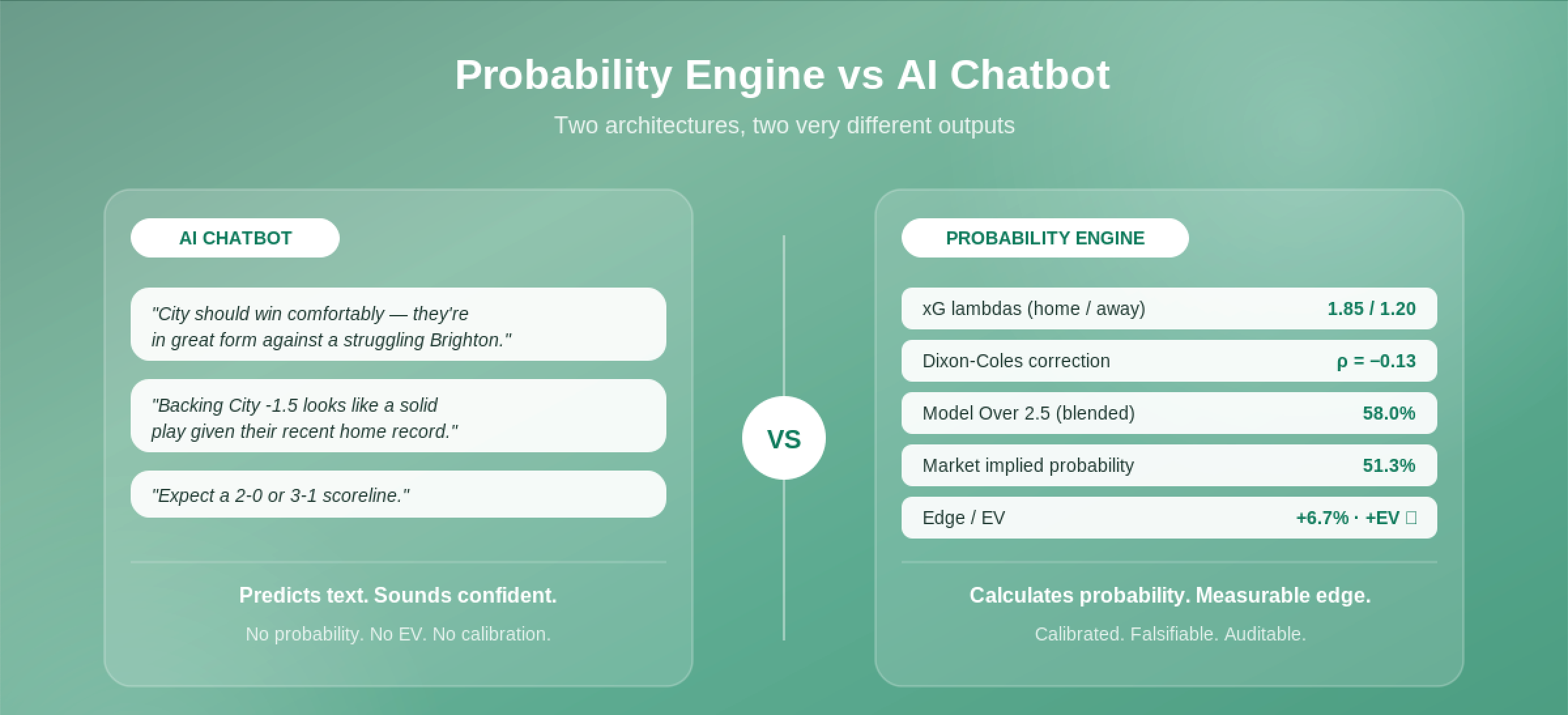
Ask ChatGPT: ‘Should I back Manchester City -1.5 against Brighton?’
Likely response: a fluent paragraph about City’s recent form, Brighton’s defensive struggles, head-to-head record, and a conclusion that ‘backing City -1.5 looks like a solid play.’ Confident, well-written, narratively coherent. No probability. No EV calculation. No comparison to the current line. If the same question were asked yesterday with completely different team news, the response would be similar.
Run the fixture through Gecko Edge: the pipeline calculates home and away xG lambdas, builds a Poisson goal grid, applies the Dixon-Coles correction, generates the City -1.5 probability (say, 51%), blends it against current market prices, and compares to the bookmaker’s offer (say, 1.95, implying 51.3%). Output: City -1.5 has effectively no edge at the current price. Recommendation: skip, look for a different market on the same fixture or move on.
Both tools answered the question. Only one produced the answer that protects your bankroll.
When to Use What
Use ChatGPT or Gemini when: you need to summarise news, learn a concept, brainstorm research angles, draft analysis, or get a quick refresher on unfamiliar terminology.
Use Gecko Edge (or any properly-built probability engine) when: you need a probability, an EV calculation, an edge percentage, or a specific recommendation grounded in live data and a transparent methodology.
The two tools aren’t substitutes. They serve different purposes. The mistake most bettors make is treating ChatGPT like a betting model when it’s actually a research assistant. The mistake the opposite direction — treating Gecko Edge like a news summary tool — is rarer because the use case is more obviously specific.
Why This Matters More in 2026
AI is moving into every product category. ‘AI football predictions’ as a category includes tools doing fundamentally different things under the same label. Some are LLMs producing text that sounds like betting advice. Some are probability engines producing actual probabilities. Some are hybrid systems combining the two correctly. The label tells you nothing about what’s happening underneath.
The question to ask any AI betting tool isn’t ‘does it use AI’ — every tool now claims that. The question is: where does the probability come from? If the answer is ‘the model predicts the next word’, that’s an LLM and it’s the wrong tool for the job. If the answer is a named methodology with calibrated probabilities and published track record, that’s a probability engine and it’s the right one.
Try Edge Peek Free
If you’ve been using ChatGPT or Gemini for football betting analysis and the results haven’t matched the confidence of the answers, the issue is structural — you’ve been using a research tool as a probability tool. Try a system built for the actual job.
Start with Edge Peek — analyse one match per day, no card required
Can I use ChatGPT for football betting predictions?
You can ask ChatGPT or Gemini for football analysis and get fluent, confident-sounding answers. The problem is structural — LLMs predict the next word in a sentence, not the probability of an outcome. They don’t run probability models, don’t access live data by default, and don’t calculate expected value. The output sounds like analysis, but it’s text prediction wearing analysis clothing.
Why do LLMs like ChatGPT and Gemini fail at football betting analysis?
Three structural reasons. They have training cutoffs and don’t see today’s xG, injury news, or market prices natively. They confuse fluency with accuracy — when an LLM doesn’t know something, it produces a plausible answer rather than saying “I don’t know” (hallucination). And they don’t calculate expected value — the maths required to compare a modelled probability against current odds isn’t part of the LLM architecture.
When is ChatGPT actually useful for football betting?
For research, not predictions. ChatGPT is genuinely useful for summarising news and context, explaining unfamiliar concepts like xG or Bayesian inference, drafting and structuring your own analysis, and generating research prompts or hypotheses. None of these are betting decisions in themselves — the LLM is a research assistant. The actual probability calculation and EV check needs a different architecture.
How does Gecko Edge’s architecture differ from ChatGPT?
Gecko Edge is a probability engine first, with a natural-language layer on top. The maths runs first — extended xG, Poisson grids with Dixon-Coles correction, Bayesian blending against market prices and league priors, Divergence Flag, +EV calculation. Only after the probabilities are calculated does the language layer translate the output into plain English. The opposite architecture from ChatGPT, which predicts language directly without ever calculating an underlying probability.
How can you tell if an AI betting tool is built on a probability engine or just an LLM wrapper?
Ask where the probabilities come from. If the tool can’t tell you, or the answer is “the model decides”, it’s an LLM wrapper. If the answer is a named methodology — Poisson grids, Bayesian blending, Monte Carlo simulation — it’s a probability engine. Also look for a published track record. Probability engines can publish results because their outputs are measurable; LLM wrappers struggle to publish meaningful track records because what they produce isn’t really a measurable prediction.