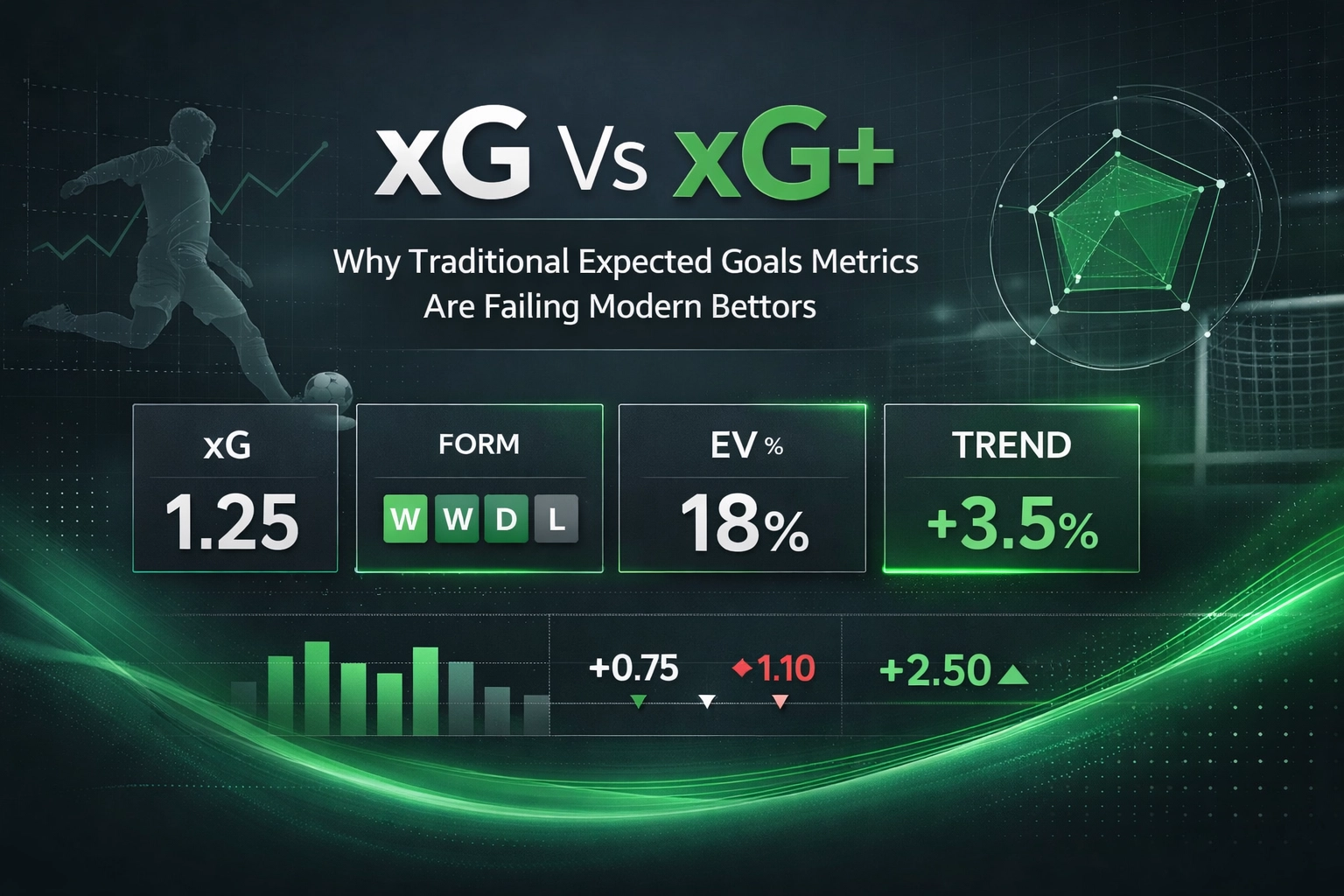
There was a time, not too long ago, when mentioning “Expected Goals” at the pub would get you a blank stare or a sarcastic comment about “maths geeks” ruining the beautiful game.
Today, xG is everywhere. It’s on the BBC, it’s in the post-match graphics, and it’s baked into every bookmaker’s pricing model. For the casual fan, it’s a neat way to see who “deserved” to win. For the serious bettor, it has become the bare minimum.
But here’s the problem. Because everyone is using it, the edge has disappeared. Traditional Expected Goals has become “stale” data. If you are still relying on the same numbers as the guy across the street, and the bookie taking your bet, you aren’t finding value. You’re just following the herd.
Gecko Edge has tracked 8,439 AI-generated bets and recorded +398pts of profit across 66 competitions. See how the model works →
At Gecko Edge, we look for what happens next. The market has caught up to Expected Goals. To stay ahead, we have to look at xG+, or what we call Sequence-Aware xG.
It’s the difference between seeing a snapshot and watching the whole movie.

The Fatal Flaw in Traditional xG
Traditional Expected Goals is a simple summation. If a team takes five shots in a match, the model assigns a probability to each shot based on historical data. If those shots are 0.1, 0.2, 0.05, 0.1, and 0.4, the total xG for that team is 0.85.
On paper, it makes sense. In reality, it’s deeply flawed because it treats every shot as an independent event.
Imagine a goal-mouth scramble. The striker hits the post (0.5 xG). The ball rebounds to the winger, who hits a defender on the line (0.4 xG). It bounces out to the edge of the box, and a midfielder blazes it over the bar (0.1 xG).
A traditional Expected Goals model sees those three events and adds them up: 0.5 + 0.4 + 0.1 = 1.0 xG.
The model thinks that team “mathematically” scored a goal. But they didn’t. They had one high-quality attacking sequence that resulted in three different attempts. They couldn’t have scored three goals in that moment; they could only have scored one.
When you sum up these “dependent” shots, you end up with an inflated sense of a team’s attacking prowess. This is where Gecko Edge starts to find the cracks in the market.
Enter xG+: The Power of Sequence Awareness
xG+ (or Sequence-Aware xG) doesn’t just look at the shots. It looks at the possession.
Instead of adding every shot together, xG+ evaluates the entire sequence of play. It asks: “What was the highest probability of a goal being scored during this specific attack?”
In our goal-mouth scramble example, a sequence-aware model wouldn’t give you 1.0 xG. It would likely give you 0.5 xG, the value of the single best chance in that sequence.
Why does this matter for your football betting strategy? Because traditional xG often rewards “messy” teams, those that take lots of low-quality shots in a single flurry. xG+ rewards efficiency and clinical build-up.

Why Modern Bettors are Getting Caught Out
If you’re looking for betting value picks, you need to know if a team’s performance is sustainable.
A team might finish a match with 2.5 xG. Traditional bettors see that and think, “Wow, they were dominant. I’ll back them next week.”
But if 1.5 of that xG came from two chaotic scrambles where the ball bounced around like a pinball, that team isn’t actually that good at creating chances. They just got lucky with how the ball fell in one or two moments.
When Gecko Edge processes this through our AI, we see the xG+ might only be 1.2. Suddenly, that “dominant” team looks much more average. The market prices them as favourites for the next game, but our data tells a different story. That’s where the value hides.
EV Betting Calculations and the Math of Reality
Expected Value (EV) betting is the holy grail for professional traders. It’s not about picking winners; it’s about finding prices that are “wrong” based on the true probability of an event.
If a bookmaker uses traditional xG to set their lines: which many of the sharp ones now do: they are susceptible to the “summation error” we just discussed. They might overprice a team that inflates their stats through high-volume, low-quality sequences.
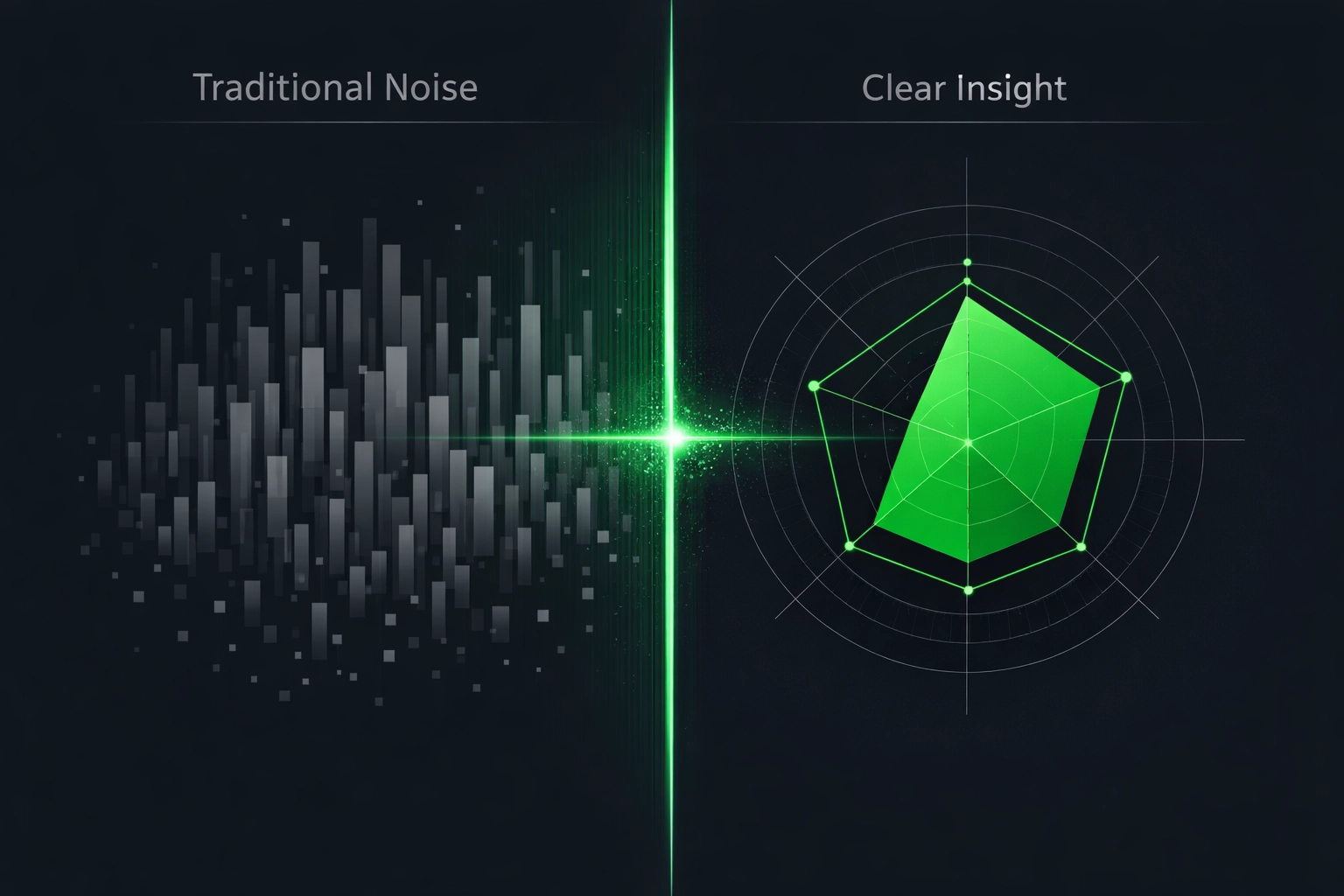
By using xG+, Gecko Edge refines the EV betting calculations. We reduce the noise.
In cross-validation tests across the Premier League, possession-aware metrics have consistently shown a lower prediction error than standard xG. By matching how attacks actually unfold, we get closer to the truth of the game.
The “At-Least-One” Aggregator
In technical terms, xG+ often uses an “at-least-one” aggregator.
Instead of:
- Shot A + Shot B + Shot C
It calculates:
- 1 – (Probability of not scoring Shot A × Probability of not scoring Shot B × Probability of not scoring Shot C)
This simple shift in logic changes everything. It acknowledges that once a goal is scored in a sequence, the sequence ends. It stops the “double-counting” of danger that plagues traditional xG football analysis.
How Gecko Edge Simplifies the Complexity
You shouldn’t need a degree in data science to place a smart bet. That’s why Gecko Edge exists.
We take these complex, sequence-aware models and translate them into actionable insights. We do the heavy lifting: analysing every possession, every pass leading to a shot, and every rebound: to give you a clear picture of which teams are actually dangerous and which are just loud.
Our platform is built for bettors, powered by AI. We don’t just give you more data; we give you better data.
In a world where everyone has the same basic tools, you need the sharpest blade in the drawer. Traditional xG is a blunt instrument. xG+ is a scalpel.
Ask, Analyse, Act: Your Path Forward
If you want to move from a casual bettor to a serious trader, you need to change how you view the pitch.
- Ask: Is this team’s xG coming from sustained pressure or isolated, messy sequences?
- Analyse: Look for the xG+ metrics. See if the “Sequence-Aware” value matches the “Summed” value. If there’s a big gap, you’ve found a potential market inefficiency.
- Act: Use the insights from Gecko Edge to place bets where the probability is in your favour, not the bookmaker’s.

The evolution of football metrics isn’t slowing down. The “stats revolution” is only just reaching its middle phase. As more data becomes available: tracking data, limb-tracking, real-time context: the gap between those using basic stats and those using advanced AI will only widen.
Don’t get left behind with the “sum-of-shots” crowd. The game is more fluid than a simple addition problem. It’s time your betting strategy reflected that.
Smarter betting starts here. It starts with seeing the whole sequence. It starts with Gecko Edge.
If you’re ready to dive deeper into the technical side of things, check out our betting glossary or explore our case studies to see how these metrics perform in the real world.
Q1: What is xG+ (extended expected goals)?
xG+ is an evolution of the standard expected goals metric that incorporates additional contextual data beyond shot location and angle. Traditional xG values a shot based on where it was taken from and how. xG+ extends this by factoring in pre-shot build-up quality, defensive pressure at the moment of the shot, goalkeeper positioning, and the broader sequence of play that created the chance. The result is a more granular measure of true scoring opportunity.
Q2: How is xG+ different from traditional xG?
Standard xG treats each shot in isolation, weighting it only by spatial and biomechanical factors. xG+ considers the full chain of play that led to the shot, the defensive context the shooter faced, and goalkeeper-specific data. A shot from 18 yards under heavy pressure against a well-positioned keeper might score 0.18 in standard xG but only 0.09 in xG+, reflecting the real difficulty. The extra context tightens the link between the metric and actual goal probability.
Q3: Why is traditional xG no longer enough for serious bettors?
Traditional xG was a major step forward when introduced but has become widely adopted by bookmakers and casual bettors alike. Its weaknesses are now well-known: it under-rates chances created by exceptional build-up, over-rates chances against poor defenders, and ignores goalkeeper-specific factors. Markets price using traditional xG inputs, so any edge built on the same metric is shrinking. Modellers who layer in xG+ data find inefficiencies the broader market hasn’t yet caught up to.
Q4: What does xG+ capture that traditional xG misses?
The three biggest gaps are pre-shot context (sequence quality, possession build-up), defensive context (pressure on the shooter, defender count in the shooting lane), and goalkeeper context (positioning, recent form, set position versus counter-attack). Standard xG treats each shot as an independent event; xG+ recognises that a shot generated by a 7-pass build-up against a settled defence has very different conversion expectations than the same shot from a fast break. Modelling at this granularity is where serious edge now sits.
Q5: How do bettors use xG+ to find value the market misses?
The most actionable approach is to model goal expectations using xG+ inputs independently, then compare to bookmaker lines that are still anchored to traditional xG data. Persistent gaps surface most often in markets like Asian Handicap goal lines, Over/Under totals, and Both Teams to Score, where the difference between standard and extended xG compounds into noticeable mispricing. Gecko Edge’s model treats xG+ as the foundation layer of its goal probability estimates rather than a supplementary signal.
What is xG+ (extended expected goals)?
xG+ is an evolution of the standard expected goals metric that incorporates additional contextual data beyond shot location and angle. Traditional xG values a shot based on where it was taken from and how. xG+ extends this by factoring in pre-shot build-up quality, defensive pressure at the moment of the shot, goalkeeper positioning, and the broader sequence of play that created the chance. The result is a more granular measure of true scoring opportunity.
How is xG+ different from traditional xG?
Standard xG treats each shot in isolation, weighting it only by spatial and biomechanical factors. xG+ considers the full chain of play that led to the shot, the defensive context the shooter faced, and goalkeeper-specific data. A shot from 18 yards under heavy pressure against a well-positioned keeper might score 0.18 in standard xG but only 0.09 in xG+, reflecting the real difficulty. The extra context tightens the link between the metric and actual goal probability.
Why is traditional xG no longer enough for serious bettors?
Traditional xG was a major step forward when introduced but has become widely adopted by bookmakers and casual bettors alike. Its weaknesses are now well-known: it under-rates chances created by exceptional build-up, over-rates chances against poor defenders, and ignores goalkeeper-specific factors. Markets price using traditional xG inputs, so any edge built on the same metric is shrinking. Modellers who layer in xG+ data find inefficiencies the broader market hasn’t yet caught up to.
What does xG+ capture that traditional xG misses?
The three biggest gaps are pre-shot context (sequence quality, possession build-up), defensive context (pressure on the shooter, defender count in the shooting lane), and goalkeeper context (positioning, recent form, set position versus counter-attack). Standard xG treats each shot as an independent event; xG+ recognises that a shot generated by a 7-pass build-up against a settled defence has very different conversion expectations than the same shot from a fast break. Modelling at this granularity is where serious edge now sits.
How do bettors use xG+ to find value the market misses?
The most actionable approach is to model goal expectations using xG+ inputs independently, then compare to bookmaker lines that are still anchored to traditional xG data. Persistent gaps surface most often in markets like Asian Handicap goal lines, Over/Under totals, and Both Teams to Score, where the difference between standard and extended xG compounds into noticeable mispricing. Gecko Edge’s model treats xG+ as the foundation layer of its goal probability estimates rather than a supplementary signal.

1 comment