There are two paradigms competing for the label of ‘AI football prediction’ in 2026, and they work in fundamentally different ways. One is the Bayesian probability model — the architecture that’s powered serious football analytics for two decades and underpins most professional betting syndicates. The other is the Large Language Model (LLM) — the breakthrough behind ChatGPT, Gemini, and the wider generative AI boom.
Both have legitimate uses. Both are ‘AI’ in the broad sense. But they’re built for different jobs, and confusing the two is the single most common mistake in the AI betting category. This post walks through what each architecture does, why each is good at different things, and how the strongest football betting tools combine the two without confusing them.
Gecko Edge runs a Bayesian probability engine with an LLM translation layer on top. The combination is what produced the published track record: 8,439 AI-generated bets, +398 points of profit, 66 competitions. Here’s why the architecture matters.
Gecko Edge has tracked 8,439 AI-generated bets and recorded +398pts of profit across 66 competitions. See how the model works →
What Bayesian Models Do
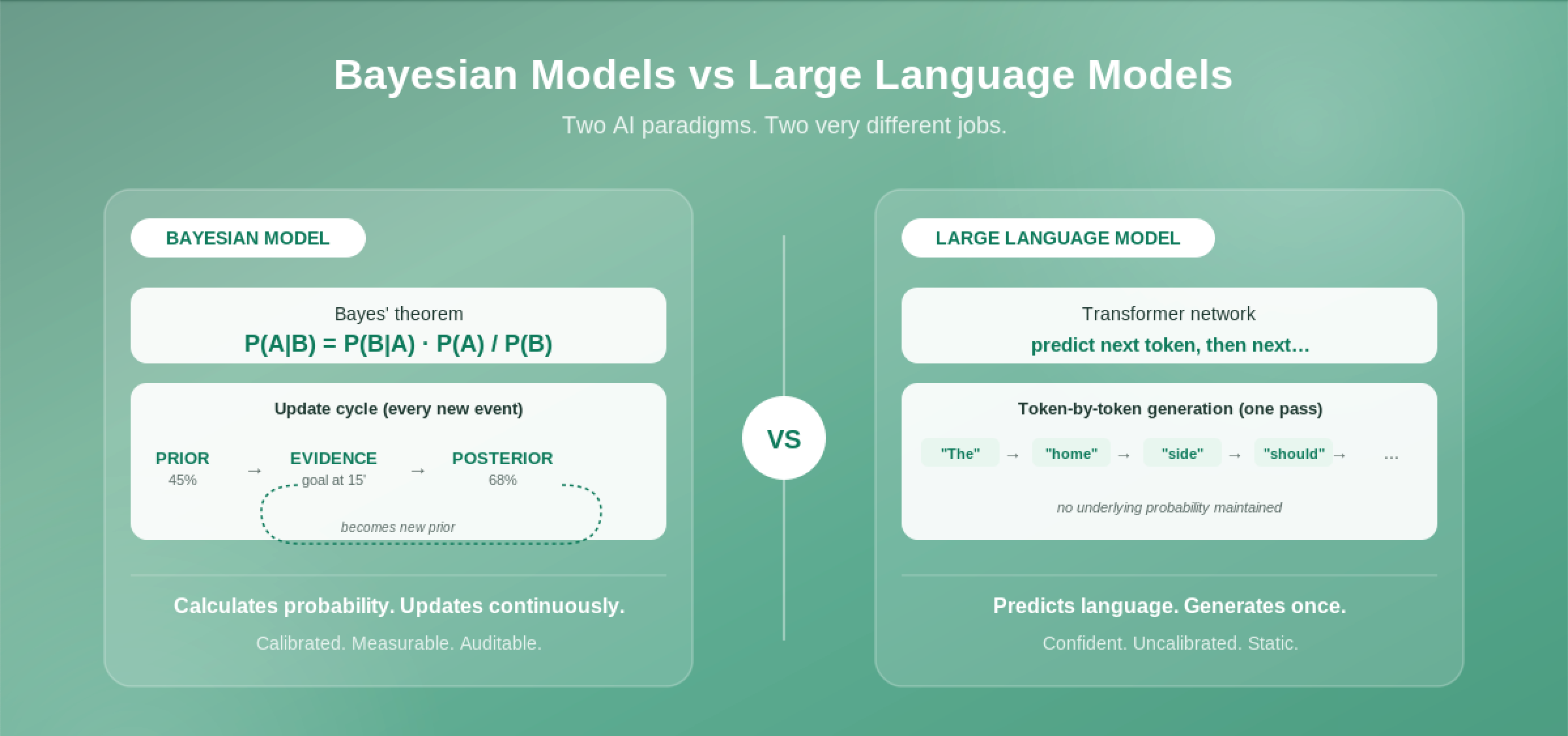
A Bayesian model is built around one simple idea: probabilities update as new evidence arrives. You start with a prior — a baseline probability for an outcome based on what you knew before the match. You combine it with a likelihood — how the current evidence (form, xG, market prices, injuries, weather) shifts that probability. The result is a posterior — your updated probability estimate, which becomes the prior for the next update.
For football prediction, the Bayesian framework lets you blend multiple independent sources into a single coherent probability:
- Model output. An xG-driven Poisson grid with Dixon-Coles correction produces baseline probabilities for every market — Match Result, BTTS, Over/Under, Asian Handicap, Correct Score.
- Market prices. Bookmaker odds aggregate enormous amounts of information — sharp money, late team news, injuries. Treating them as zero-information is naive; treating them as fully-correct is also naive. Bayesian blending uses them as one input among several.
- Empirical league rates. Historical base rates — how often Over 2.5 hits in Eredivisie versus Ligue 2 — anchor the model when fixture-specific data is sparse.
The weights given to each source can be calibrated, and they should differ between market types. Match Result markets, for example, typically weight market prices more heavily (markets aggregate match-outcome signal effectively); goal-line markets weight the model more heavily (pre-match modelling captures team scoring tendencies more reliably than the market does).
The output is calibrated — meaning a 60% probability really does correspond to outcomes occurring 60% of the time over a long sample. That calibration is what makes the probabilities usable for EV calculations and edge measurement.
What Large Language Models Do
An LLM is a transformer network trained on a vast text corpus. Given a prompt, it predicts the next token (word-fragment) based on patterns learned during training. It then predicts the next token, and so on, until the response is complete.
Within language tasks, LLMs are extraordinary. They can summarise documents, draft prose, explain concepts, translate languages, generate code, and answer questions across an enormous range of domains. The recent generation (GPT-5, Claude 4, Gemini 2.5) can also reason through multi-step problems, browse the web, and call external tools when wired up correctly.
What an LLM is not doing — at any point in its core architecture — is calculating probabilities the way a Bayesian model does. There’s no probability distribution being maintained, updated, and queried. There’s a token-by-token prediction process producing text that the model has learned tends to follow the input. The output is fluent; it’s not calibrated.
This is the source of LLM hallucination. When an LLM doesn’t know the answer to a factual question, it doesn’t pause and say ‘I don’t know.’ It produces the response its training has taught it would plausibly follow the prompt. For factual questions, that response is often right because the right answer is well-represented in training data. For predictive questions about novel events — like the outcome of a specific football match — the response is a confident narrative without underlying probability calibration.
Why Bayesian Wins for Probability Tasks
If you want to know the probability of an event, you need a system designed to calculate probabilities. That’s not what LLMs do. The structural advantages of a Bayesian model for football prediction:
Calibration. A well-built Bayesian model produces probabilities that match real-world frequencies. You can measure this — over 1,000 bets at +EV, the realised hit rate should track the model’s predicted probability. LLM outputs aren’t calibrated; you can ask the same model the same question with slightly different phrasing and get materially different confidence levels.
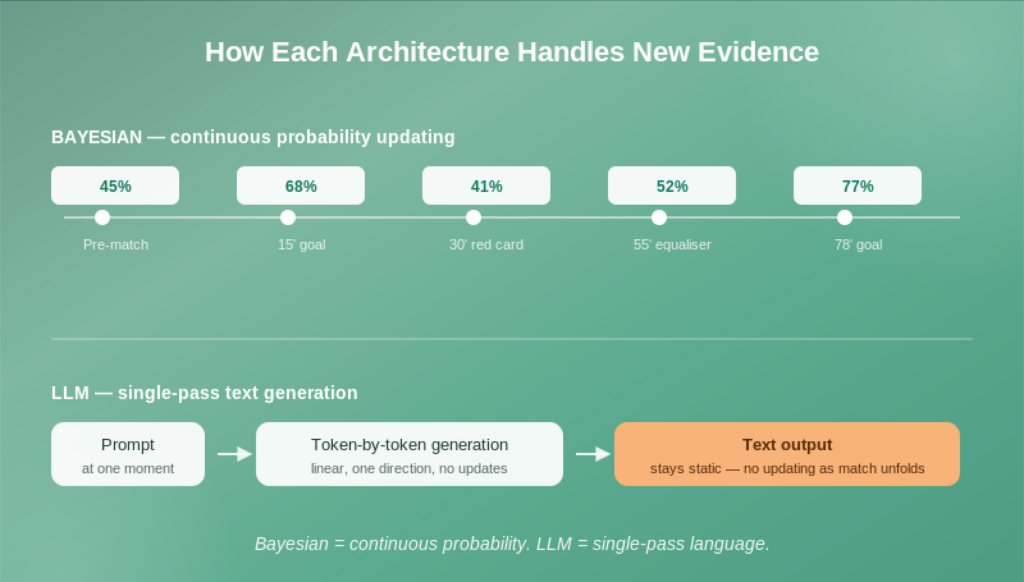
Evidence updating. A Bayesian model is designed for the situation that defines live football betting — new evidence arriving continuously. When a team goes 1-0 up, when a red card flashes, when xG accumulates in one direction, the model updates its probabilities accordingly. LLMs don’t update; they generate a response based on the input you give them at one moment.
Independent inputs combined coherently. Football probability has multiple sources — model output, market prices, league base rates. A Bayesian framework gives you a principled way to combine these into one number. LLMs don’t have a framework for combining independent quantitative inputs; they have a framework for combining textual inputs into a coherent narrative, which is different.
Falsifiable performance. Bayesian model performance is measurable. Track the model’s probabilities against realised outcomes; the calibration curve tells you whether it works. LLM ‘prediction’ performance is much harder to measure because the model didn’t actually produce a probability — it produced text suggesting one.
Why LLMs Win for Language Tasks
Equally honestly — Bayesian models lose to LLMs at almost everything that isn’t probability calculation. Where LLMs win:
- Translating numbers into language. Probabilities and edge percentages are useful for the bettor only if they’re communicable. An LLM can take a probability output and explain it in natural language — why this bet has edge, what factors drove the probability, how it compares to the market.
- Summarising research. ‘What’s been happening with Manchester City’s defensive shape over the last six matches?’ is a research question. LLMs handle this well by digesting news, match reports, and tactical analysis into a useful summary.
- Answering open-ended questions. ‘How should I think about home advantage in Serie A this season?’ isn’t a probability question — it’s a strategic question. LLMs are good at producing structured answers to strategic questions.
- Educational explanation. New to Bayesian methods? Ask an LLM. New to xG? Ask an LLM. Educational explanation is one of the most reliable LLM use cases.
How Gecko Edge Combines Both
The strongest architecture is one that uses each tool for what it’s good at: a Bayesian probability engine producing the calibrated numbers, and an LLM translation layer producing the natural-language output the user reads. This is the architecture Gecko Edge runs.
The probability pipeline runs first. Extended xG lambdas, Poisson grids, Dixon-Coles correction at ρ = −0.13, renormalisation, market probabilities, Bayesian blend against current market prices and time-weighted league priors, Divergence Flag, +EV and edge calculation. The output is a set of calibrated probabilities and edges for every market on every fixture.
The natural-language layer then translates the output. You ask the app a question — ‘Where’s the best value on tonight’s Premier League fixtures?’ — and the LLM-driven interface returns a plain-English summary of what the probability engine produced. The probability engine did the maths; the language layer makes the result accessible.
Crucially, the LLM never invents probabilities. It describes the ones the probability engine calculated. If the probability engine flagged Over 2.5 at +18% edge in a specific fixture, the language layer can explain why; it can’t manufacture an edge if the model didn’t find one. This is what separates a hybrid architecture from an LLM wrapper around football data.
Practical Implications for Bettors
The architecture distinction has practical consequences for anyone choosing an AI tool:
Ask where the probabilities come from. If the tool can’t tell you, or the answer is ‘the model decides’, it’s an LLM wrapper. If the answer is a named methodology — Poisson grids, Bayesian blending, Monte Carlo simulation, neural network calibrated against historical outcomes — it’s a probability engine.
Look for a published track record. Probability engines can publish results because their outputs are measurable. LLM wrappers struggle to publish meaningful track records because what they output isn’t really a prediction in a measurable sense — it’s text suggesting one.
Distinguish research from decisions. Use LLMs (free or paid) for research, summarisation, and education. Use probability engines for the actual probability-to-price comparison that determines whether a bet has edge.
Don’t trust confidence in prose. LLM output is confident by design — that’s how language prediction works. A confident-sounding paragraph about why City should win tells you nothing about the actual probability. A calibrated 51% probability with a published track record tells you everything.
A Worked Comparison
Take the same fixture in both paradigms.
LLM-only approach: Ask ChatGPT ‘who will win Brighton v Arsenal’. Get back a fluent 200-word paragraph weighing recent form, head-to-head, and tactical matchups. Conclusion: ‘Arsenal should win comfortably.’ Confidence: high. Probability: not stated. EV: not calculated. You’re left with prose, not a betting decision.
Bayesian probability engine approach: Run Brighton v Arsenal through the pipeline. Output: Arsenal Win 58%, Draw 24%, Brighton Win 18%; Over 2.5 = 52%; BTTS Yes = 64%; AH Arsenal -1.0 = 47%. Compare to current market prices, identify the markets where blended probabilities exceed implied probabilities by a meaningful margin, return +EV recommendations. Decision: back Over 2.5 at 1.95 (implied 51.3%) where blended probability of 58% gives ~13% edge.
Hybrid (Gecko Edge) approach: Same probability output as above, but you can also ask follow-up questions in natural language — ‘why is the Over 2.5 priced as the strongest edge?’ — and the language layer explains the underlying calculation. You get both the calibrated numbers and the explanation, without the language layer ever inventing probabilities the model didn’t produce.
The Future of AI in Betting
The next two years of AI betting will be defined by hybrid systems — probability engines (Bayesian, Monte Carlo, or hybrid statistical/ML pipelines) with LLM translation layers on top, the architecture choice that combines calibrated maths with accessible language. Pure-LLM tools will continue to exist; they’ll continue to feel confident; they’ll continue to underperform when judged on EV.
The bettors who understand the architectural distinction will choose tools accordingly. Use LLMs for what they’re good at — research, summarisation, education. Use probability engines for what they’re good at — calibrated probabilities, EV calculations, betting decisions. The mistake isn’t using either; it’s confusing them.
Try the Hybrid Architecture
Gecko Edge is a Bayesian probability engine with an LLM translation layer — built for calibrated probabilities, transparent edge calculations, and natural-language explanation. See our methodology page for the full pipeline, or try Edge Peek free to see the output on tonight’s fixtures.
Start with Edge Peek — no card required
What is a Bayesian model in football prediction?
A Bayesian model is built around the idea that probabilities update as new evidence arrives. You start with a prior (baseline probability based on what you knew before the match), combine it with a likelihood (how new evidence shifts that probability), and produce a posterior (your updated estimate). For football, the framework lets you blend model output, current market prices, and empirical league rates into a single coherent probability for every market.
How do Bayesian models differ from LLMs for football prediction?
Bayesian models calculate calibrated probabilities and update them as new evidence arrives. LLMs predict text — given a prompt, they output tokens one at a time based on patterns in their training data. Bayesian outputs are measurable (a 60% probability should produce outcomes 60% of the time over a long sample). LLM outputs are fluent but uncalibrated — asking the same model the same question with slight phrasing changes can produce materially different confidence levels.
Why is Bayesian modelling better for probability tasks specifically?
Four structural advantages. Calibration — Bayesian probabilities can be tested against real-world frequencies. Evidence updating — designed for the situation in live football where new evidence arrives continuously. Independent inputs combined coherently — model output, market prices, and league priors blend into one number through a principled framework. Falsifiable performance — Bayesian model accuracy is measurable in ways LLM “prediction” performance simply isn’t.
When are LLMs the right tool for football betting work?
For everything that isn’t probability calculation — translating numbers into language, summarising news and research, answering open-ended strategic questions, educational explanation. Use LLMs as research assistants, not as probability engines. The strongest architecture combines both: a Bayesian probability engine producing the calibrated numbers, plus an LLM translation layer producing accessible natural-language output. This is what Gecko Edge runs.
How can you tell if an AI betting tool uses Bayesian methods or just an LLM?
Ask where the probabilities come from. If the tool names a methodology — Poisson grids, Bayesian blending, Monte Carlo simulation, neural networks calibrated against historical outcomes — it’s a probability engine. If the answer is vague (“the model decides”, “our AI”), it’s likely an LLM wrapper. Also look for a published track record. Probability engines publish results because outputs are measurable; LLM wrappers struggle because what they output isn’t really a measurable prediction.