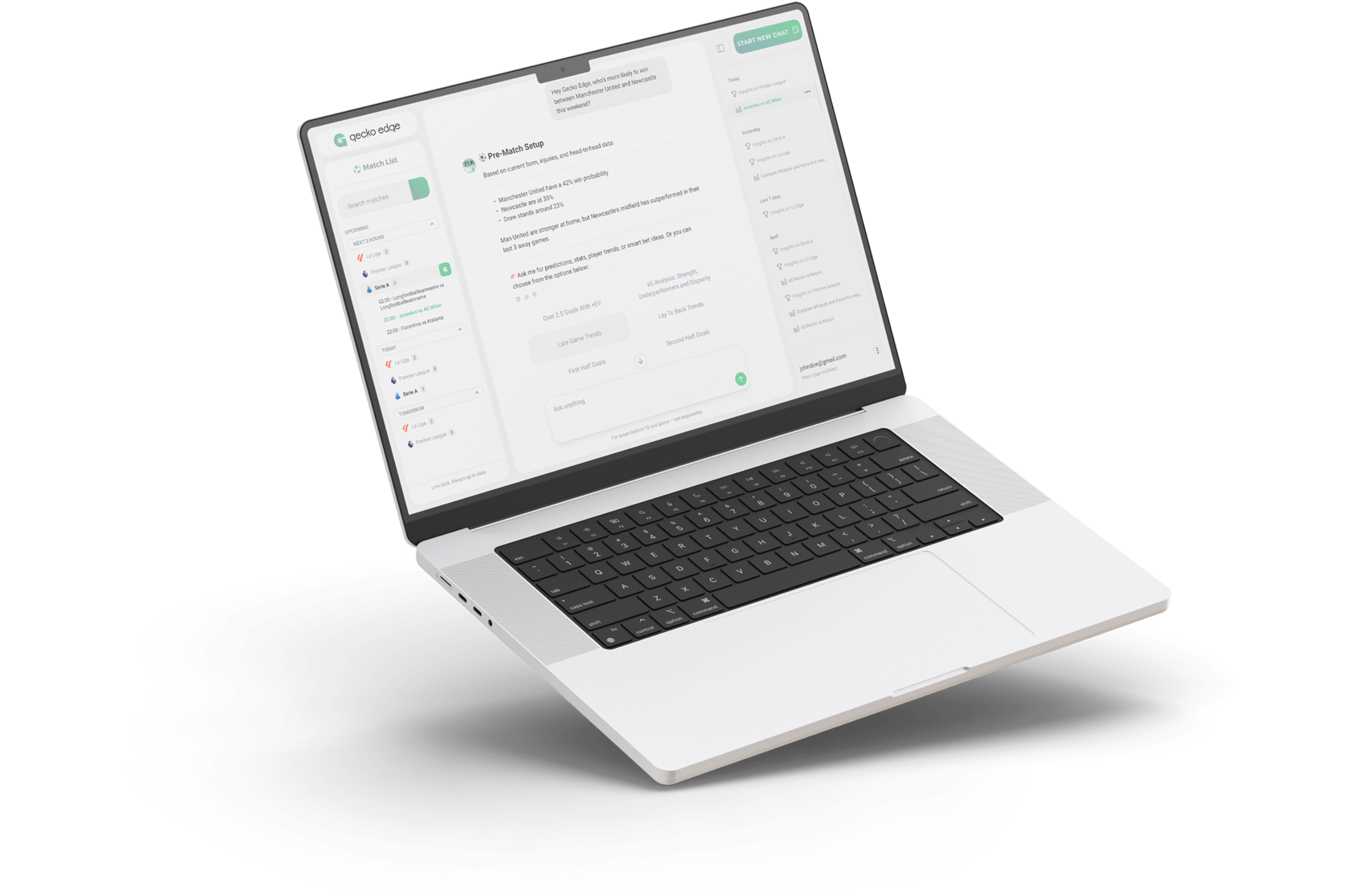
Learn how Gecko Edge spots market overreactions to injuries in niche football leagues, helping bettors find value when prices move too far, too fast.
Sometimes the market reacts fast; too fast.
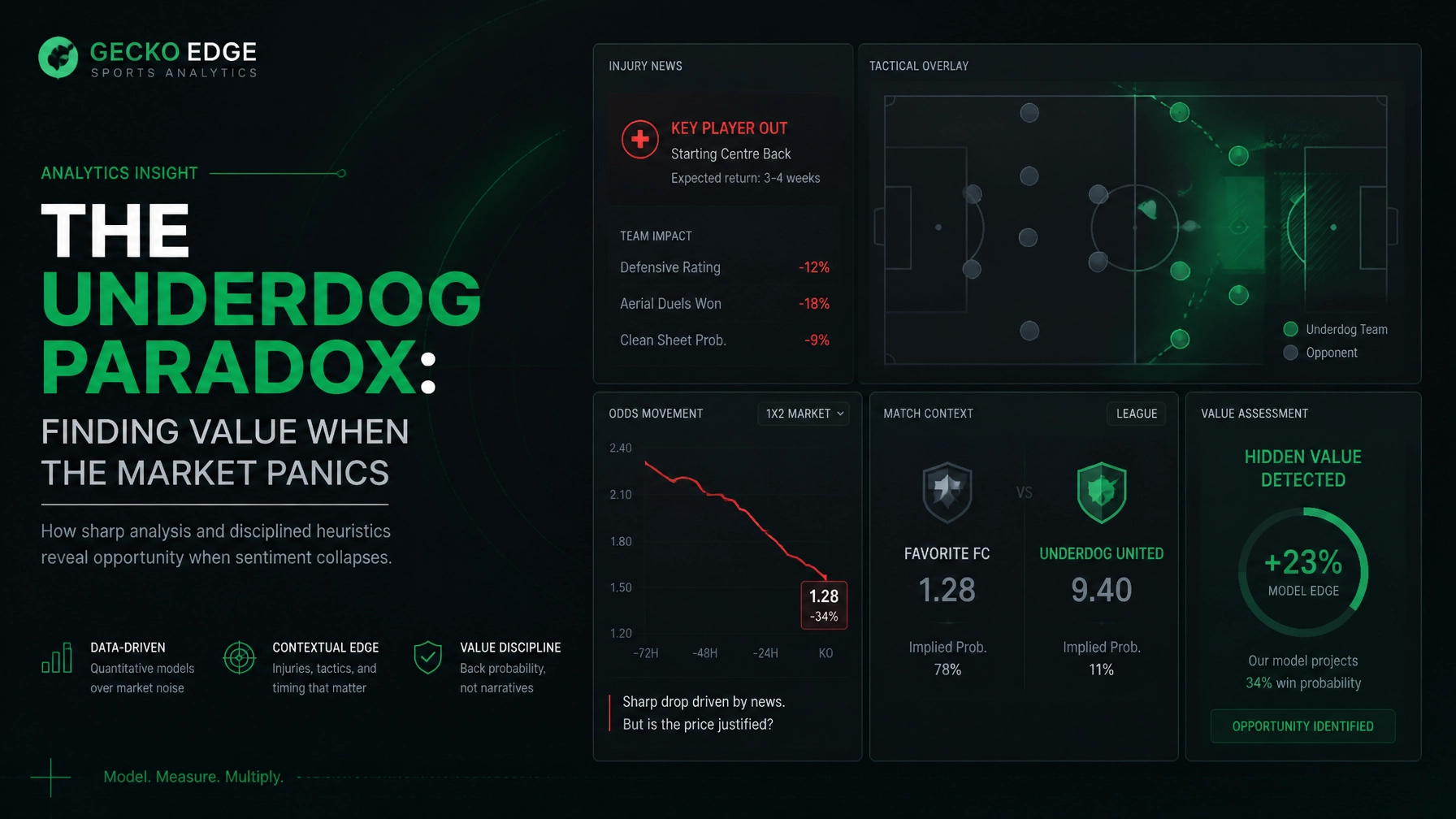
An injury lands. A striker is ruled out. A centre-back misses the team sheet. The price shifts within minutes and the underdog gets pushed further out than the match really justifies.
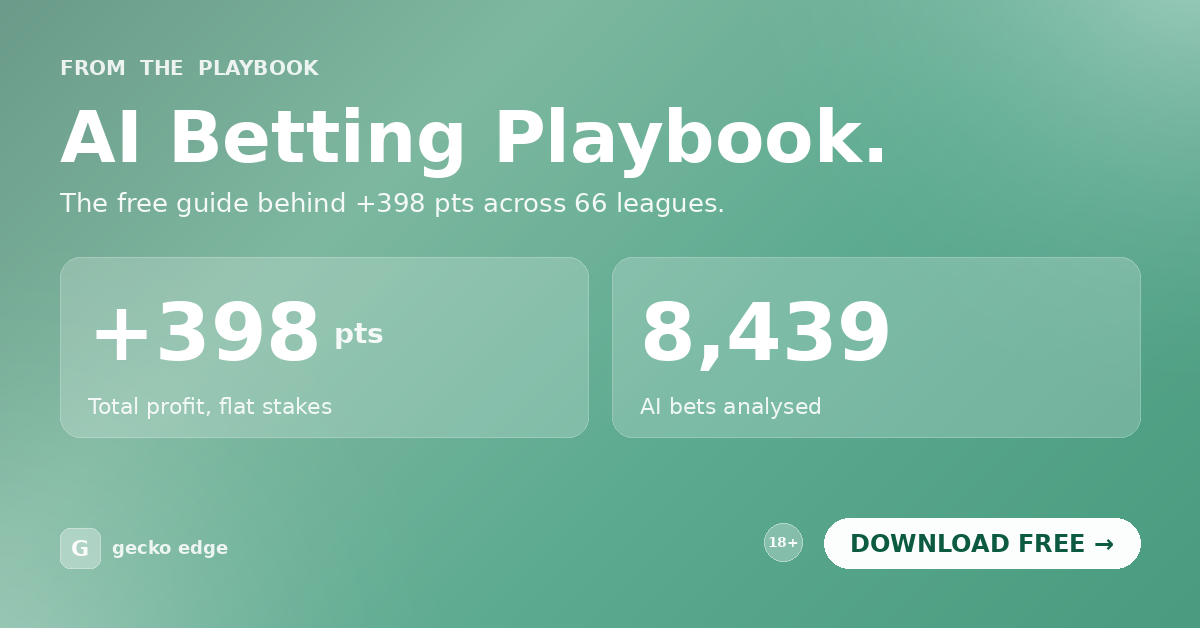
Gecko Edge has tracked 8,439 AI-generated bets and recorded +398pts of profit across 66 competitions. See how the model works →
That is where the paradox starts.
The team looks weaker on paper. The headline says the favourite has an edge. The market leans hard in one direction. But the number can still be wrong.
This is one of the quieter edges in football betting. It shows up most often in niche leagues, where information is messy, liquidity is thinner, and price moves can be driven by panic rather than proper context.
Gecko Edge is built to read that context properly. Not just the injury itself, but the knock-on effect. Who is missing. Who replaces them. How the team usually adapts. Whether the market has moved a little too far.
Smarter betting starts here.
Why injury news breaks markets in smaller leagues
In the biggest leagues, injury news is covered from every angle.
There are beat reporters. Tactical analysts. Expected line-up models. Market makers paying close attention from the first rumour to the confirmed eleven.
In niche leagues, it is different.
The information arrives late. It is often incomplete. Sometimes it is translated badly. Sometimes it is copied without detail. One account says a player is out. Another says he is doubtful. The market sees enough uncertainty and starts moving anyway.
That is where poor pricing begins.
The market is not always reacting to a real downgrade. Often, it is reacting to the fear of one.
A missing player matters less when:
- the replacement is tactically similar
- the system does not depend on one individual
- the opposition cannot exploit the absence
- the original line was already too aggressive
- public reaction is based on reputation, not actual output
In smaller leagues, that gap between reputation and reality can be wide.
A recognised name goes missing. The market panics. The underdog drifts. Value appears.
What most bettors get wrong about injuries
A player being unavailable does not automatically make the new price fair.
That sounds obvious. Yet this is where many bets go wrong.
Most people ask one question:
“Who is out?”
The better question is:
“What should this change, really?”
That means looking beyond headlines.
A striker may be the top scorer, but how many of his goals were penalties? How often does he actually drive chance creation? Is the team’s xG output built around him, or is he finishing work created by others?
A defender may look important, but is he genuinely stopping chances, or is he simply the most familiar name in the back line?
Sharp analysis strips away status and focuses on function.
That is the difference between reacting and pricing.

The real edge: overreaction in niche leagues
The biggest overreactions usually do not happen in the Premier League.
They happen where the market is thinner.
Lower divisions in Scandinavia. Regional competitions in South America. Smaller European leagues with uneven coverage. Places where one piece of team news can move a line sharply, even if the underlying impact is modest.
This matters because thin markets tend to overshoot.
Not always. But often enough.
An injury can cause a favourite to shorten too much or an underdog to drift beyond fair value. Once that happens, the bet is no longer about the injury. It is about the price.
And price is everything.
If a team should be 3.40 and the market pushes them to 4.10 because of a noisy injury update, that does not mean they suddenly became a good team.
It means the market may have handed you a number with room in it.
That is the entire point.
How Gecko Edge reads the situation properly
Gecko Edge does not treat all injuries as equal.
It looks at context first.
That includes:
Role, not just name
Some absences matter because of what the player does. Others matter because the market recognises the name.
Those are not the same thing.
A wide player with strong numbers in transitions may matter more than a better-known striker. A holding midfielder who protects space may be more important than a centre-half with a bigger profile.
Context cuts through noise.
Replacement quality
If the backup is competent and the tactical structure stays intact, the downgrade may be small.
Markets often miss this.
They price the missing player. They do not always price the replacement.
System resilience
Some teams are fragile. One absence changes everything.
Others are built on structure. They lose quality, but not identity.
That distinction matters, especially in leagues where squad depth is uneven.
Opponent fit
A missing defender matters more against a side that attacks his channel well.
A missing target man matters more if the team relies on direct service.
Not every weakness gets punished every week.
Market movement versus fair movement
This is where the edge lives.
The question is not whether the line moved.
The question is whether it moved too far.
Gecko Edge compares injury context, team strength, form, xG profile, and market behaviour to judge whether the adjustment makes sense or whether panic has created value on the other side.
When the underdog becomes the value side
This is the part many people struggle with.
A team can become weaker and still become a better bet.
That is not a contradiction. It is just pricing.
If the market over-corrects after an injury, the weaker side may now offer more value than before. Not because it is stronger. Not because the absence does not matter. But because the number now overstates that weakness.
This is the underdog paradox.
You are not backing bad teams blindly.
You are backing bad prices when they become too extreme.
That takes discipline. It also takes a bit of distance from the emotion of team news. The market often treats injury headlines like certainty. Sharp bettors treat them like inputs.
Nothing more.

A practical way to think about it
When injury news breaks in a niche league, work through it in this order:
- Check the actual player impact
Ignore reputation for a moment. Look at role, minutes, underlying numbers, and tactical use. - Assess the replacement
Is there a real drop-off, or just a less familiar name? - Study team structure
Does the side still function in the same shape and style? - Review the opponent
Can they actually exploit the missing piece? - Compare the line move to the likely true downgrade
Has the market adjusted sensibly, or has it lurched? - Decide based on price, not drama
That is where clear thinking beats noise.
This sounds simple.
In practice, it is not.
That is why tools matter. Speed matters too. In thinner markets, the best number does not hang around.
Why this matters more now
Football markets are faster than they used to be.
News spreads quicker. Prices react sooner. Copycat moves happen within seconds. In major leagues, that can make life harder for anyone looking for obvious mistakes.
But niche leagues still leave room.
Not because they are easy. They are not.
They leave room because information quality is inconsistent and confidence is often misplaced. The market still has blind spots there. Especially when injury news is messy and traders have to make quick assumptions.
That is exactly where calm, structured analysis has value.
Not loud opinions.
Not guesswork.
Just better reading of the same information.
What sharp bettors do differently
They do not chase every drift.
They do not assume every injury creates an angle.
They wait for the moment when the market confuses uncertainty with certainty.
That is a key difference.
A sharp bettor is not trying to sound clever after team news breaks. He is trying to answer one question with honesty:
“Has the price moved further than the truth?”
That mindset protects you from forcing bets. It also helps you find the ones that matter.
Some injuries deserve a big move.
Some barely deserve one at all.
The edge is knowing the difference.
Built for bettors, powered by AI
Gecko Edge helps bettors cut through the noise when markets react badly.
It brings together form data, xG modelling, market movement, team context, and betting logic in one place. That matters most in the spots where headlines distort prices and simple models fall short.
In niche leagues, those spots come up more often than people think.
And when they do, clear analysis beats panic.
Every time.
Final thought
The market does not need to be irrational for value to exist.
It just needs to be rushed.
That is often what injury news does in niche leagues. It creates urgency, strips away nuance, and pushes prices beyond what the real change deserves.
That is where the underdog paradox lives.
The side looks worse.
The number gets better.
And if you can separate those two facts clearly, you give yourself a chance to act when others are still reacting.
Gecko Edge is built for exactly that kind of decision.
Ask. Analyse. Act.
{“@type”:”BlogPosting”,”image”:”https://cdn.marblism.com/qAdo8BZDf5L.webp”,”author”:{“name”:”Gecko Edge”,”@type”:”Organization”},”@context”:”https://schema.org”,”headline”:”The Underdog Paradox: Finding Value When the Market Panics”,”publisher”:{“logo”:{“url”:”https://geckoedge.ai/logo.png”,”@type”:”ImageObject”},”name”:”Gecko Edge”,”@type”:”Organization”},”articleBody”:”In the high-stakes world of football trading, the most dangerous thing isn’t a lack of information—it’s the reaction to it. We’ve all seen it. News breaks on social media: a star striker in the Japanese J2 League is ruled out with a hamstring injury. Within minutes, the odds for his team start to drift. The public piles in, the ‘tipsters’ scream for a fade, and the bookmakers, wary of a one-sided liability, slash the price of the opposition. This is the birth of the Underdog Paradox. While the crowd sees a team in crisis, the seasoned bettor sees a market in a state of emotional overcorrection. At Gecko Edge, we’ve built our platform to slice through this noise, using data-driven analysis to identify when a market move has transcended logic and entered the realm of panic…”,”description”:”Learn how to identify and exploit market overreactions to football injuries in niche leagues. Discover the strategy behind the Underdog Paradox with Gecko Edge AI analysis.”,”datePublished”:”2026-06-05″,”mainEntityOfPage”:{“@id”:”https://geckoedge.ai/blog/underdog-paradox-market-value”,”@type”:”WebPage”}}