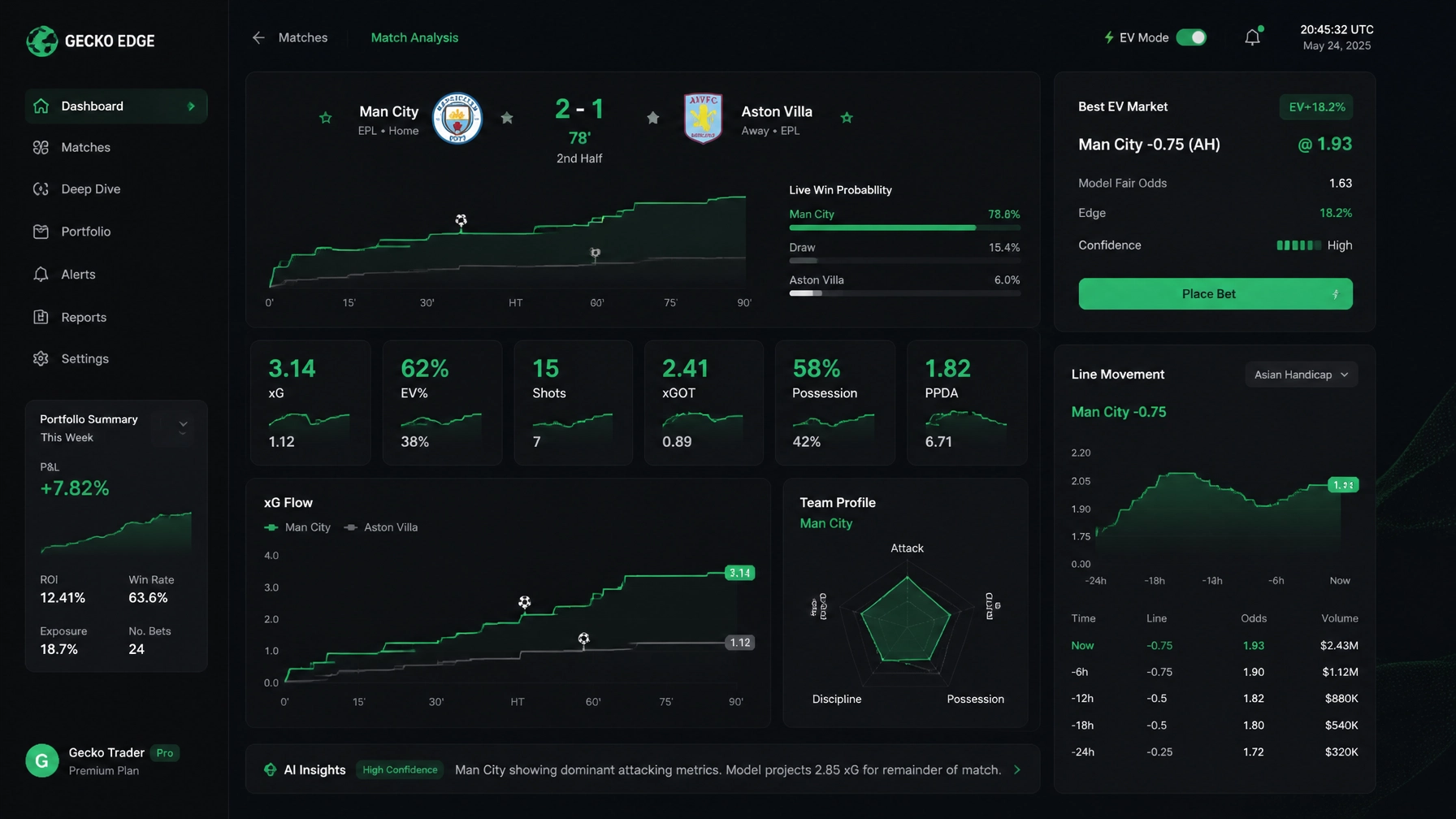
Expected Value; if you’ve spent any time watching a betting screen on a Saturday morning, you’ve seen the dance. A price for a home win in the Premier League starts at 2.10, drifts to 2.15, and then suddenly plunges to 1.95 thirty minutes before kick-off.
To the casual observer, it looks like chaos. To the unseasoned bettor, it looks like a mystery. But behind those flickering numbers is a highly sophisticated, automated world of algorithms and data feeds. The “man in the green visor” making manual adjustments is a relic of the past. Today, the market is driven by code: and where there is code, there are patterns.
At Gecko Edge, we spend our time dismantling these patterns. If you want to move beyond guesswork and treat betting as a strategy, you have to understand why those lines move and, more importantly, where the machines leave money on the table.
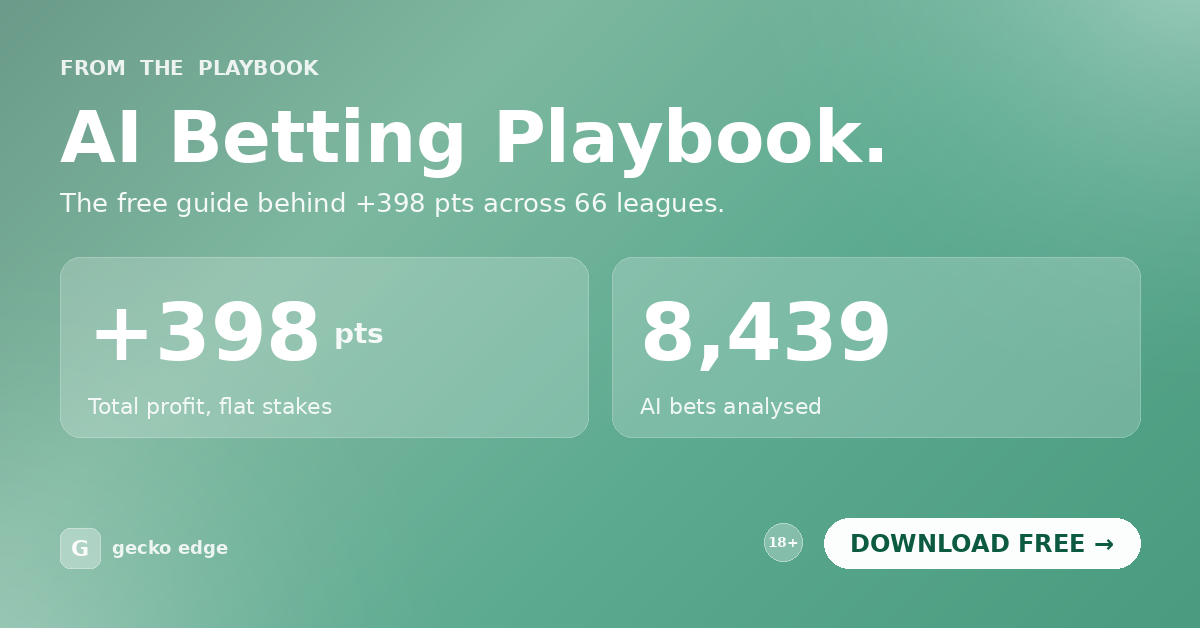
Gecko Edge has tracked 8,439 AI-generated bets and recorded +398pts of profit across 66 competitions. See how the model works →
The Engine Room: How Modern Odds are Created
The vast majority of football odds you see today aren’t set by individual bookmakers. Instead, they rely on massive data providers and automated pricing engines. These systems ingest thousands of data points: historical performance, player fitness, weather conditions, and even travel schedules: to spit out an “opening price” in milliseconds.
These models are incredibly efficient at processing “hard data.” They know exactly how many goals a team averages at home and how their xG (Expected Goals) fluctuates when their star playmaker is sidelined. This is why the opening lines are often very close to the “true” probability.
However, these models aren’t perfect. They are built on historical data, meaning they are inherently backward-looking. This is where Gecko Edge provides a vital bridge. By using context-aware AI, our platform helps you see through the raw numbers to find the nuance the primary algorithms might have missed.
Why the Lines Dance: Decoding Market Movement
Once a price is live, it stops being a static number and becomes a living market. There are three main reasons why a line moves:
- Information Flow: This is the most obvious. A team sheet is announced, and the star striker is on the bench. The automated systems pick this up from data feeds and adjust the odds instantly.
- Liability Management: If a bookmaker takes too much money on one side, they will shorten the price on that outcome and lengthen it on the other to encourage balanced betting. They don’t necessarily think the probability has changed; they just want to reduce their risk.
- The Sharp Effect: This is the “Steam.” When professional betting syndicates or “sharps” place large wagers, the market reacts. If the sharps think a price is wrong, they will bet it until it’s “right.”
Understanding the difference between “public money” (casual bettors backing the favourite) and “sharp money” (professionals finding value) is the key to identifying Expected Value (EV).

The Ghost in the Machine: Where Algorithms Falter
If the market is so automated and efficient, you might wonder how anyone can make a profit. The secret lies in the limitations of automation.
Algorithms are brilliant at volume, but they struggle with context. A machine might see that a team has lost three games in a row and price them accordingly. It might not “realise” that those three losses were against the top three teams in the league, or that they were incredibly unlucky in terms of xG.
This is particularly true in lower leagues or less-covered markets like Japanese unders or South American value plays. In these areas, the data feeds are often thinner, and the bookmakers’ models are less refined. This creates “pricing gaps.”
By using the Gecko Edge AI Betting Playbook, you can learn to spot these discrepancies. Our tools are designed to think like a bettor: analysing the context that a standard bookmaker’s algorithm might ignore.
Finding the EV: The Maths of Expected Value
Expected Value isn’t about picking winners; it’s about finding prices that are higher than they should be. It’s the difference between the “Implied Probability” of the odds and the “True Probability” of the event.
The formula is simple:
EV = (Probability of Winning * Amount Won per Bet) – (Probability of Losing * Stake)
If the result is positive, you have found a +EV bet. Over hundreds of matches, betting on +EV positions is the only way to ensure long-term profitability.
At Gecko Edge, we automate this calculation for you. Our real-time insights compare live market data against our proprietary predictive models, flagging matches where the bookmakers have mispriced the outcome.

Closing Line Value (CLV): The Ultimate Benchmark
One of the most important concepts for any serious trader is Closing Line Value. The closing line: the price of a match just before it starts: is generally considered the most efficient price because it has incorporated all available information and betting volume.
If you consistently place bets at odds that are higher than the closing line, you are a winning bettor in the long run. Even if that specific bet loses, the process was correct. This is how you move from gut feelings to data-driven confidence.
Gecko Edge helps you beat the closing line by providing early signals and in-play intelligence. Our platform monitors market trends across hundreds of leagues, giving you the heads-up before the “steam” moves the price and the value disappears.
Real-Time Intelligence: Acting on the Gaps
In-play betting is where the automated models are under the most pressure. As the clock ticks down, the models must account for time decay, scoreline changes, and match momentum. This is a high-speed environment where human error: and algorithmic delay: frequently occurs.
Have you ever noticed a price stay “frozen” for a few seconds after a red card or a goal? That’s the system catching up. Gecko Edge thrives in these moments. Our in-play intelligence provides context-aware analysis that helps you make split-second decisions based on data, not adrenaline.
Whether you are looking for late goals in a high-pressure match or spotting an oversaturated market in the Brazilian second division, having an AI partner ensures you aren’t just betting: you are executing a strategy.

Conclusion: Smarter Betting Starts Here
The world of football betting has changed. The machines are in control of the lines, but they aren’t infallible. They are bound by their programming and their reliance on historical data.
To find the edge, you need to be smarter than the average casual bettor and more agile than the bookmaker’s algorithm. You need to understand the “why” behind the movement and have the tools to calculate EV on the fly.
Gecko Edge was built by bettors, for bettors. We aren’t here to give you “tips” or “locks.” We are here to give you the data, the analysis, and the strategic support you need to treat betting with the professional precision it deserves.
Ready to stop guessing and start analysing? Explore our Betting Glossary to sharpen your knowledge, or dive straight into our latest analysis on the Gecko Edge blog.
Smarter betting starts here. Ask. Analyse. Act.

{“@type”:”BlogPosting”,”image”:”https://cdn.marblism.com/rGBM64yGMia.webp”,”author”:{“name”:”Gecko Edge”,”@type”:”Organization”},”@context”:”https://schema.org”,”headline”:”Automated Odds Secrets Revealed: Why Your Betting Lines Move (and Where the EV Hides)”,”publisher”:{“logo”:{“url”:”https://geckoedge.ai/logo.png”,”@type”:”ImageObject”},”name”:”Gecko Edge”,”@type”:”Organization”},”articleBody”:”If you’ve spent any time watching a betting screen on a Saturday morning, you’ve seen the dance. A price for a home win in the Premier League starts at 2.10, drifts to 2.15, and then suddenly plunges to 1.95 thirty minutes before kick-off. To the casual observer, it looks like chaos. To the unseasoned bettor, it looks like a mystery. But behind those flickering numbers is a highly sophisticated, automated world of algorithms and data feeds… (rest of the article content continues here)”,”description”:”Discover the mechanics behind automated football odds movement and learn how to identify Expected Value (EV) using Gecko Edge’s AI-powered insights.”,”datePublished”:”2026-06-20″}