Building a football betting model is a rite of passage for any serious bettor. You spend weeks cleaning data, tweaking variables, and running backtests. On paper, your spreadsheet looks like a money-printing machine. But then you start putting actual skin in the game, and the results don’t follow. The line goes down, the bankroll thins, and you’re left wondering where the “edge” went.
The truth is, there’s a massive gap between a model that predicts football matches and a model that makes a profit. Most people build the former while hoping for the latter.
At Gecko Edge, we’ve seen thousands of strategies. We’ve built the tools to analyse and refine them because we know exactly where the common pitfalls lie. If your model is stalling, it’s likely due to one of these ten reasons.
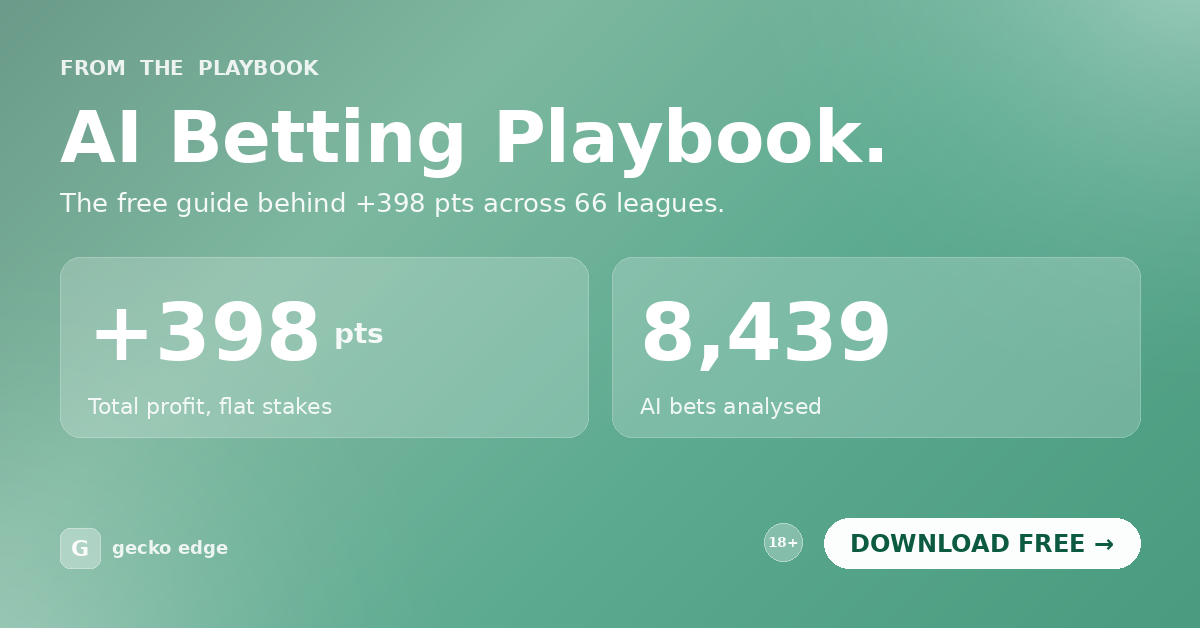
Gecko Edge has tracked 8,439 AI-generated bets and recorded +398pts of profit across 66 competitions. See how the model works →
1. You’re Optimising for Accuracy, Not Value
This is the most common mistake. Many modellers celebrate when their model hits a 65% strike rate on match outcomes. But accuracy means nothing if you aren’t beating the price. If the bookmaker has implied a 70% probability through their odds, your 65% “accuracy” is actually a losing bet.
The Fix: Stop asking “Who will win?” and start asking “Is the probability of this outcome higher than what the odds suggest?” You need to optimise for Expected Value (EV). Your model should be a value-finder, not a score-predictor. Gecko Edge simplifies this by providing instant EV calculations on demand, helping you shift your focus from “being right” to “finding the edge.”
2. You’ve Fallen Into the Overfitting Trap
Overfitting is when your model learns the “noise” in historical data rather than the actual “signal.” If you include too many variables: like weather on a Tuesday in Stoke or the referee’s middle name: your model will look perfect on past data but fail miserably on future matches. It’s memorising the past, not predicting the future.

The Fix: Keep it simple. Use features that have a logical, causal link to performance (like xG, shot quality, or ball progression). Always use a “hold-out” set of data that the model has never seen to test its true performance. If it works on the training data but fails on the test data, you’ve overfitted.
3. The Market Is Smarter Than Your Spreadsheet
The betting market, especially in major leagues like the Premier League, is incredibly efficient. Millions of pounds move the lines, reflecting almost all available public information. If your model says there’s a massive 20% edge on a Manchester City win, it’s far more likely that your model is missing something than the entire global market being wrong.
The Fix: Use the closing odds as a benchmark. The closing line is the most accurate representation of a match’s true probability. If your model consistently disagrees with the closing line and you keep losing, the market is teaching you a lesson. Gecko Edge uses real-time market trends to help you understand where the smart money is moving, ensuring you aren’t betting against a wall of efficiency.
4. You’re Ignoring the ‘Human’ Context
A spreadsheet sees “Team A vs Team B.” It doesn’t see that Team A’s star striker has a family emergency, or that the manager has just lost the dressing room. Traditional models are blind to the “narrative” and context that actually shifts footballing performance.

The Fix: Use context-aware AI. This is exactly why we built Gecko Edge. Our platform doesn’t just crunch numbers; it understands the nuance of the sport. It looks at situational data: like a team playing their third game in six days: to provide a layer of intelligence that a standard Poisson distribution model simply cannot reach.
5. Your Sample Size Is Too Small
Variance is a cruel mistress. You might have 50 bets that show a 10% ROI, and you think you’ve cracked the code. Then the next 50 bets wipe you out. In football betting, 100 bets is a coin flip. You need thousands of data points to prove that your “edge” isn’t just a lucky streak.
The Fix: Be patient and backtest extensively across hundreds of leagues. Don’t just look at the last month of results. Gecko Edge supports hundreds of leagues worldwide, from the bright lights of the Champions League to the lower divisions in South America, giving you the comprehensive data needed to validate your strategy over a significant sample size.
6. Stale Data Is Killing Your Edge
The betting market moves in seconds. If your model relies on data that is updated once a day, you’re betting on “ghosts.” By the time you place your bet, the value has usually been sucked out of the price by faster, more reactive bots and professional syndicates.

The Fix: Move to real-time analysis. You need a tool that reacts to live events, lineup changes, and in-play shifts. Gecko Edge provides in-play intelligence for live betting decisions, allowing you to act on data-driven insights while the match is actually happening, rather than relying on pre-match assumptions that are no longer valid.
7. Ignoring Closing Line Value (CLV)
If you bet at 2.00 and the price closes at 1.80, you have “beaten the closing line.” If you do this consistently, you will be profitable over the long term, regardless of the result of that specific match. If your model finds winners but you’re consistently betting at prices lower than the closing line, you are essentially gambling on luck, not edge.
The Fix: Track your CLV religiously. Every bet you place should be compared to the final price before kick-off. If you aren’t beating the close, you need to adjust your entry timing. Use Gecko Edge‘s market trend analysis to spot when a price is at its peak before the value disappears.
8. Poor Bankroll Management
Even a perfect model will go bust if the staking plan is wrong. Many bettors use the Kelly Criterion to maximise growth, but without a perfectly calibrated model, Kelly will lead to ruin. Chasing losses or “doubling up” on a “sure thing” are the hallmarks of a failing strategy.
The Fix: Treat your betting like a fund manager treats an index. Use flat staking or a very conservative proportional staking plan (e.g., 1-2% of bankroll). Discipline is the difference between a hobby and a business. Gecko Edge is built for bettors who treat this as a strategy, helping you maintain a calm, data-led approach even during a losing streak.
9. Lack of Multi-Market Coverage
Most people stick to the Match Odds (1X2) market. But because it’s the most popular market, it’s also the hardest to beat. If your model only looks at who wins, you’re ignoring 90% of the potential value in a match.

The Fix: Diversify your markets. Look for edges in BTTS (Both Teams to Score), Asian Handicaps, or Draw No Bet. These markets often have more “slack” for a smart model to exploit. Gecko Edge offers multi-market coverage, giving you the flexibility to pivot your strategy where the real value resides.
10. You’re Trying to Do It All Manually
In 2026, the “gut feeling” bettor is extinct, and the “spreadsheet-only” bettor is struggling. The volume of data is too high, and the markets are too fast for manual updates and human eyes to catch everything. If you’re manually checking lineups and refreshing odds pages, you’ve already lost.
The Fix: Automate your insights. Use an AI partner that does the heavy lifting for you. Gecko Edge acts as your 24/7 analyst, scanning thousands of matches daily to bring you the best opportunities. It allows you to save and refine your betting strategies over time, turning your ideas into a systematic, profitable engine.
Smarter Betting Starts Here
Fixing a failing betting model isn’t about finding a “secret” stat. It’s about moving from guesswork to strategy. It’s about understanding that football is chaotic, but data is clear: if you have the right tools to interpret it.
Stop fighting the markets with a blunt instrument. Whether you’re a seasoned trader looking to refine your edge or a newcomer who wants to bet smarter, Gecko Edge provides the expert-level analysis you need to turn the tide.
Analyse, Ask, Act. It’s time to move beyond the spreadsheet.
{“@type”:”BlogPosting”,”image”:”https://cdn.marblism.com/UEyHJ7EWUag.webp”,”author”:{“name”:”Gecko Edge”,”@type”:”Organization”},”@context”:”https://schema.org”,”headline”:”10 Reasons Your Betting Model Isn’t Making a Profit (And How to Fix It)”,”publisher”:{“logo”:{“url”:”https://geckoedge.ai/logo.png”,”@type”:”ImageObject”},”name”:”Gecko Edge”,”@type”:”Organization”},”description”:”Discover why your football betting model is failing to generate profit and learn 10 actionable steps to fix it using AI and data-driven strategies.”,”datePublished”:”2026-06-20″,”mainEntityOfPage”:{“@id”:”https://geckoedge.ai/blog/10-reasons-betting-model-not-profitable”,”@type”:”WebPage”}}