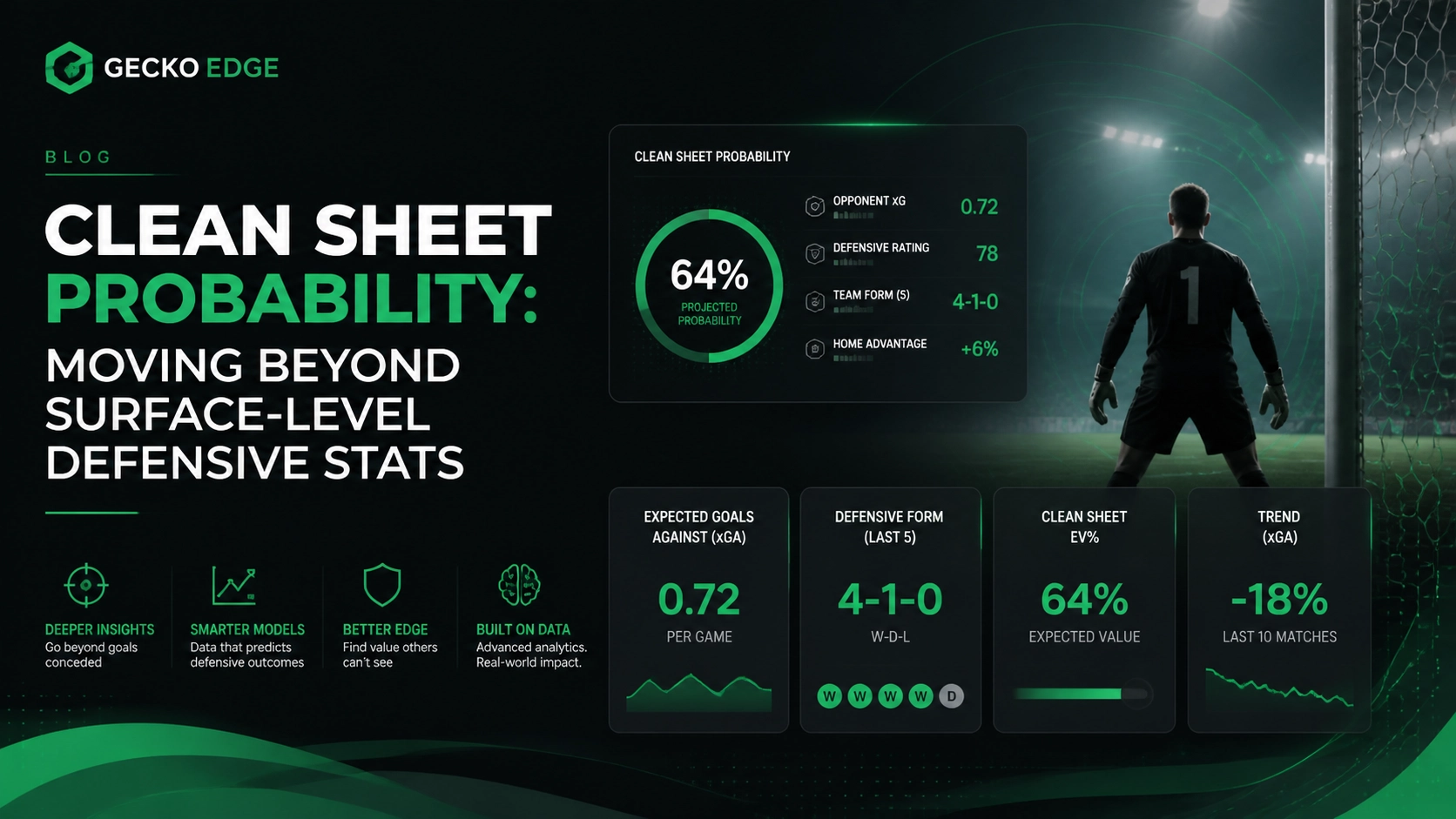
In the world of football betting, the “Clean Sheet” is often treated as a badge of honour. For a casual fan, it’s a sign of a job well done. For a bettor, it’s often the foundation of a “To Win to Nil” or “Under 2.5 Goals” strategy. But if you are still looking at the “Goals Against” column or counting how many times a team kept a zero on the scoreboard over the last five weeks, you are already behind the curve.
At Gecko Edge, we know that surface-level stats are lagging indicators. They tell you what happened, but they are remarkably poor at telling you what will happen. If a goalkeeper makes ten miraculous saves to preserve a clean sheet, the history books show a “0.” But the reality is that the defence was a sieve.
To find real value, we need to peel back the layers and look at the underlying mechanics of preventing goals.
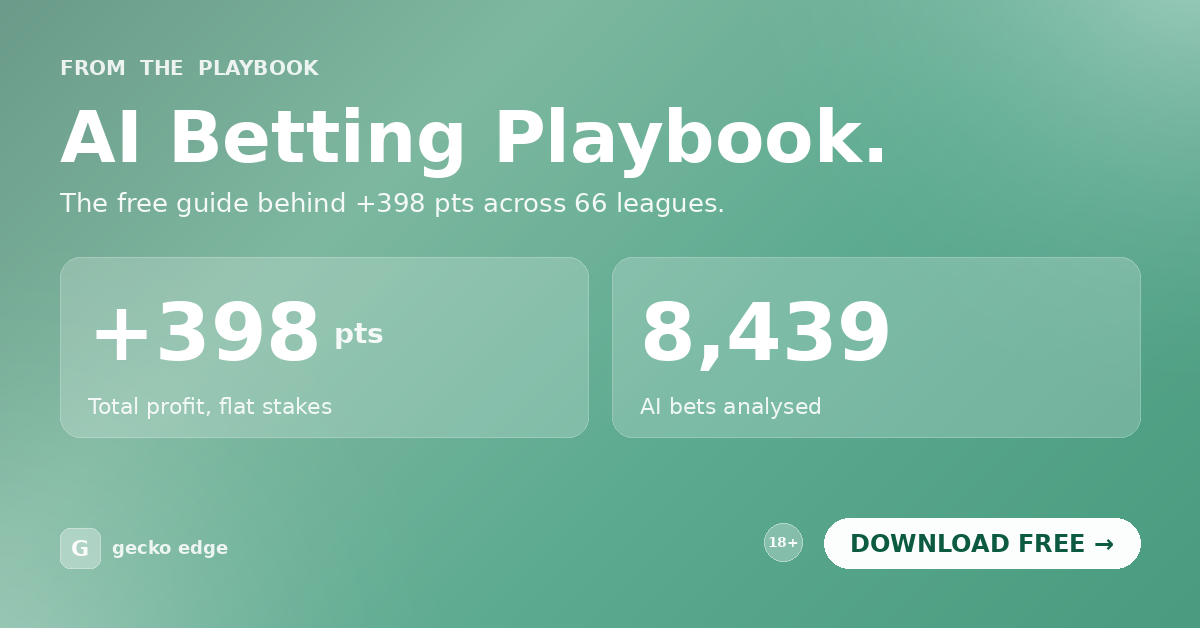
Gecko Edge has tracked 8,439 AI-generated bets and recorded +398pts of profit across 66 competitions. See how the model works →
The Mirage of the Zero
Traditional defensive statistics are binary. Either a team conceded, or they didn’t. This creates a “mirage” that can lead bettors into traps. A team might go three games without conceding a goal, leading the market to price their next clean sheet at short odds.
However, if those three games were against bottom-table sides who failed to register a single shot on target, does that clean sheet record actually reflect defensive prowess? Conversely, if a top-tier side concedes a fluke 30-yard screamer in an otherwise dominant performance, their defensive “form” looks worse on paper than it was on the pitch.
We don’t look for zeros. We look for the process that leads to them. Gecko Edge was built to identify these discrepancies, separating luck from structural defensive stability.

Enter xGC: The Foundation of Modern Defence
If you’ve spent any time in professional betting circles, you’ve heard of xG (Expected Goals). But for those focusing on the defensive side of the ball, xGC (Expected Goals Conceded) is the metric that matters.
xGC calculates the quality of chances a team allows. It doesn’t care if the ball hit the back of the net; it cares about where the shot was taken from, the angle, the pressure from the defender, and the type of assist.
When we analyse clean sheet probability at Gecko Edge, we compare a team’s actual goals conceded against their xGC.
- Over-performing teams: If a team has conceded 5 goals but has an xGC of 12.5, they are riding their luck. Their clean sheet probability for the next match is likely much lower than the market suggests.
- Under-performing teams: If a team has conceded 15 goals from an xGC of 10.0, they’ve been unlucky or have a temporary goalkeeping issue. The market will often undervalue their chance of a clean sheet in the coming weeks.
Smarter betting starts here: by identifying the teams that are defending well but haven’t been rewarded with a “0” yet.
Defensive Intensity and Pressure Metrics
Beyond shots and xGC, we have to look at how a team actually behaves when they don’t have the ball. At Gecko Edge, our AI models digest complex data points that many manual bettors ignore.
1. High-Press Efficiency
A team that wins the ball back high up the pitch often prevents a dangerous attack from ever forming. We track things like PPDA (Passes Per Defensive Action). A lower PPDA suggests a high-intensity press. If a team’s press starts to fail, their clean sheet probability drops significantly, even if they haven’t conceded many goals yet.
2. Deep Completions Allowed
How many passes is the opposition completing within 20 yards of the goal? If this number is rising, the “Clean Sheet” is a ticking time bomb. It doesn’t matter how well the centre-backs are playing; if the opposition is constantly in the “danger zone,” a goal is inevitable.
3. Ball Recoveries and Interceptions
These are the “quiet” stats. A defender who intercepts a cross before it reaches a striker is doing more for a clean sheet than a goalkeeper making a diving save. We reward structural positioning over last-ditch tackles.

The Gecko Edge Approach: Processing the Noise
The reason most bettors stick to surface stats is that advanced metrics are hard to keep track of across twenty different leagues. That is where our AI comes in. Gecko Edge processes thousands of these data points in real-time, removing the emotional bias that comes with watching a game.
Our models don’t get “impressed” by a goal-line clearance. They look at why the ball was on the line in the first place. By weighting xGC, defensive pressure, and even tactical shifts (like a change in formation or a key injury to a defensive midfielder), we arrive at a clean sheet probability that is far more accurate than the “last 5 games” average.
Applying the Knowledge: The “To Win to Nil” Market
One of the best ways to exploit advanced defensive data is the “To Win to Nil” market. This is often where the most significant price discrepancies exist.
Imagine a top-four side playing a mid-table team away from home. The top-four side hasn’t kept a clean sheet in four games, so the “To Win to Nil” price is generous. However, the Gecko Edge data shows that their xGC in those four games was incredibly low: they conceded on the only shot on target they faced in each match.
Simultaneously, the mid-table side has a high PPDA and a very low rate of deep completions. They aren’t getting into the box.
The value isn’t in the “Win” market; it’s in the “To Win to Nil” market. You are betting on the regression to the mean. The top-four side is due a clean sheet, and the data proves it.

Home and Away: The Tactical Split
It’s a cliché that teams are more defensive away from home, but the data often tells a more nuanced story. Some teams actually have a higher clean sheet probability away because they sit deep and “park the bus,” whereas at home, they feel pressured to attack, leaving themselves open to counter-attacks.
At Gecko Edge, we split defensive metrics by venue and opposition style. A team might be great at keeping clean sheets against “possession-heavy” sides but struggle against “direct” teams that play long balls. Understanding these match-ups is the difference between a professional bettor and a weekend hobbyist.
Ask, Analyse, Act
To move beyond surface-level stats, you need a system. You can’t do this manually for every fixture. Here is how we suggest you approach your next defensive-focused bet:
- Ask: Is this team’s clean sheet record a result of good defending or poor opposition finishing?
- Analyse: Check the xGC and defensive intensity metrics. Are they allowing too many deep completions? Use tools like Gecko Edge to see the underlying numbers that the bookmakers might have mispriced.
- Act: If the data shows a disconnect between the “Goal” column and the “Expected Goal” column, that is where your value lies.
Final Thoughts: Built For Bettors, Powered By AI
Betting on clean sheets is about more than just hoping the goalkeeper has a good day. It is about understanding the structural integrity of a football team. By moving beyond the surface and embracing advanced metrics like xGC and defensive pressure, you stop gambling and start trading with an edge.
The data is out there. The noise is loud. Our job at Gecko Edge is to silence the noise and show you the reality of the pitch. Smarter betting isn’t about knowing more; it’s about knowing better.
Ready to see what the numbers actually say? Explore our Predictive Football Models and take your strategy to the next level.