Predictive Football Models; the atmosphere of a live football match is electric. For most, that energy is the draw. For the serious bettor, it is the primary obstacle.
When the whistle blows, logic often exits the room. You see a flurry of corners and your gut tells you a goal is coming. You see a red card and assume the underdog will crumble. Bookmakers rely on this emotional reactivity. They thrive on the “feel” of the game because “feel” is notoriously difficult to quantify and even harder to replicate profitably.
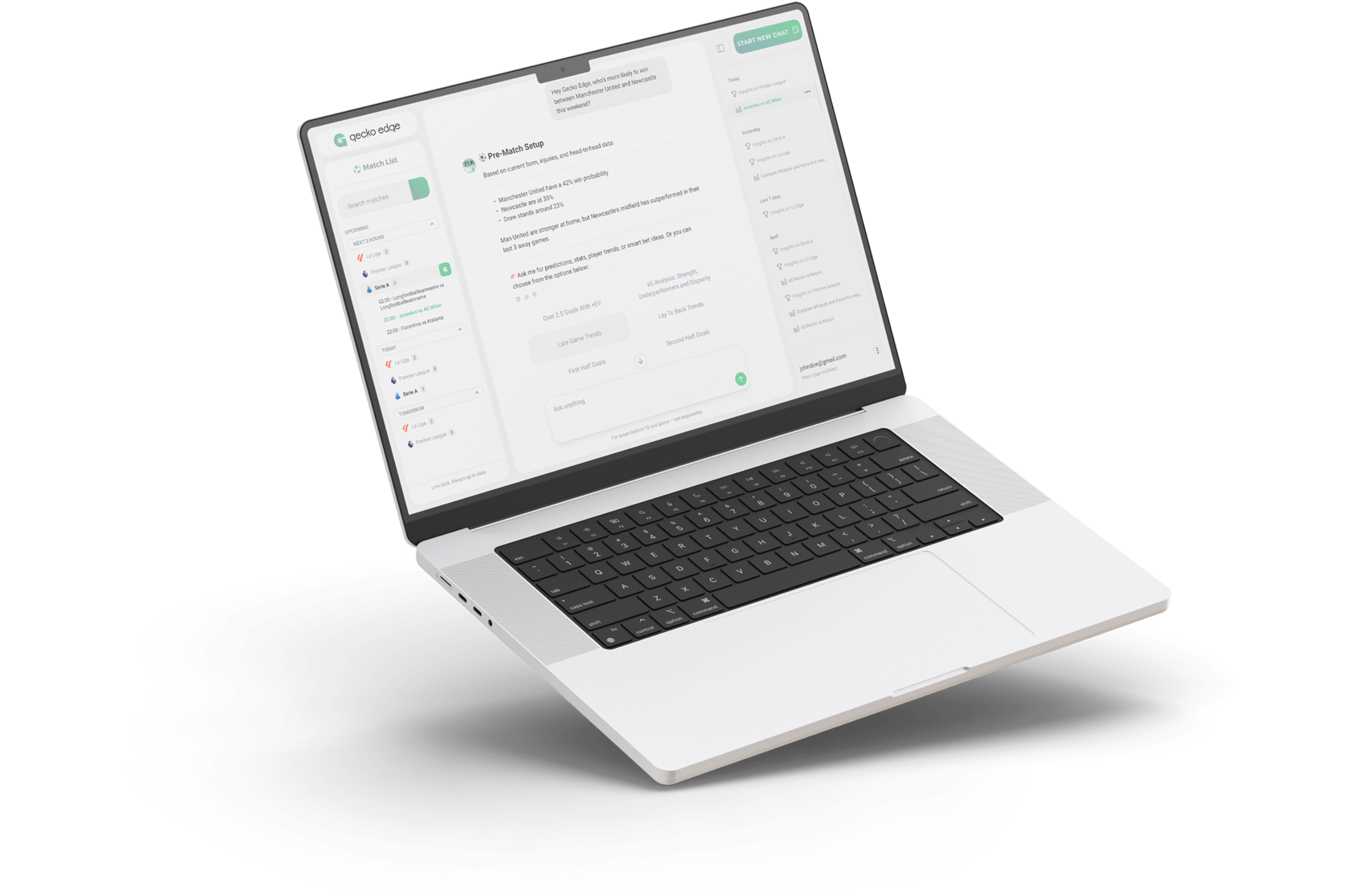
This is where the landscape is shifting. At Gecko Edge, we believe that smarter betting starts with removing the noise. Predictive football models are no longer just tools for pre-match analysis. They are the engine for a new way of executing in-play strategies.
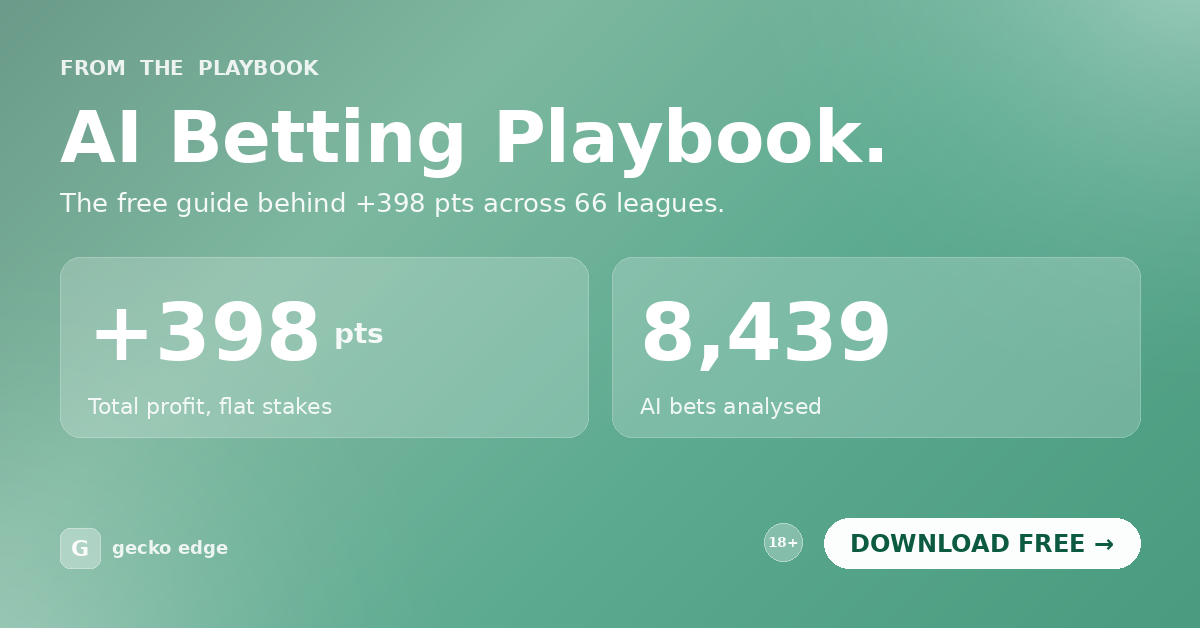
Gecko Edge has tracked 8,439 AI-generated bets and recorded +398pts of profit across 66 competitions. See how the model works →
If you want to move from guessing to calculating, you need to understand how these models work and why they are the only way to find a true edge in a volatile live market.
The Problem with Intuition in a Live Environment
Human intuition is a fantastic tool for survival, but it is a terrible tool for probability. In a live match, your brain is bombarded with visual cues. A dangerous cross, a near-miss, a vocal home crowd: all of these create a “recency bias.” You overvalue what just happened and undervalue the long-term statistical reality of the situation.
Predictive models do the opposite. They don’t care about the roar of the crowd. They care about the data points that actually lead to goals. While you are watching the game, a well-calibrated model is processing thousands of variables in real-time. It compares the current state of play against historical outcomes to provide a “true” probability.
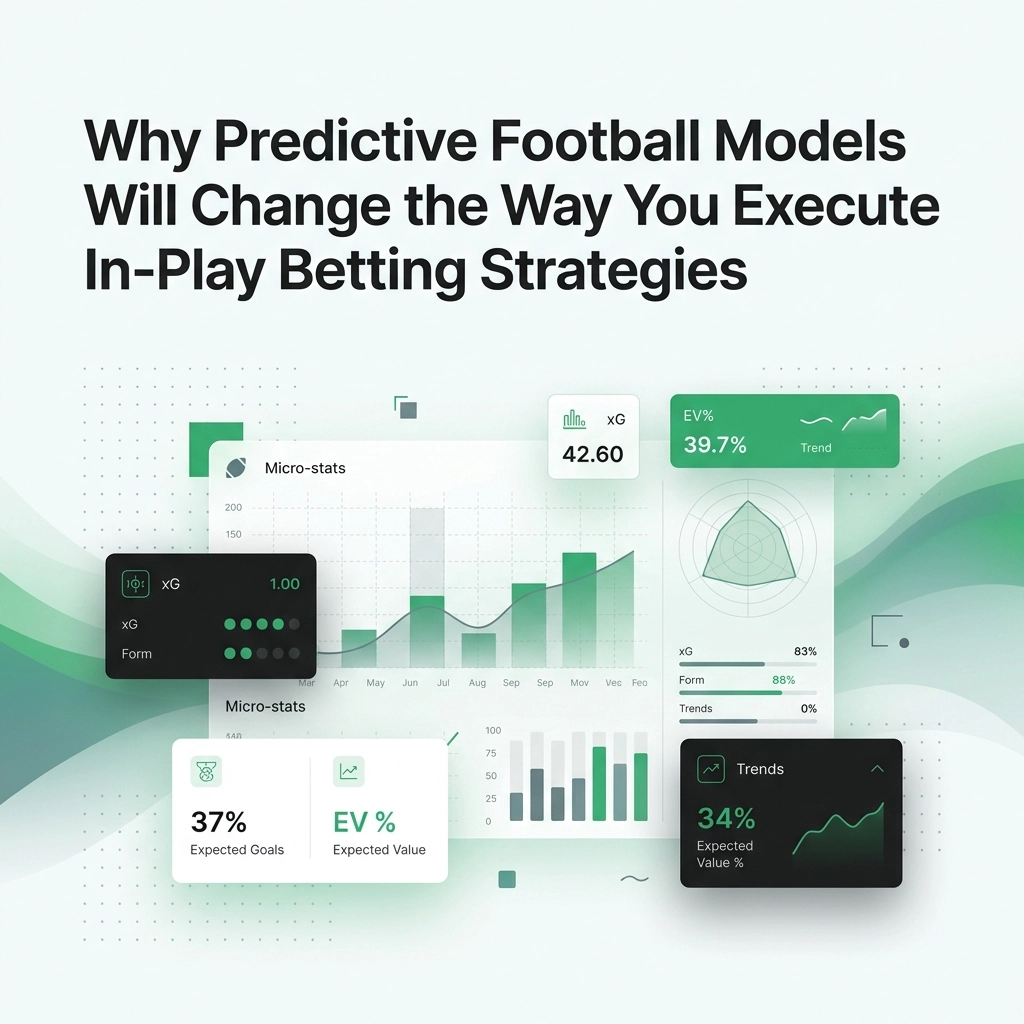
When you bet based on a model, you aren’t betting on what you think will happen. You are betting on the difference between the bookmaker’s price and the actual likelihood of an event. This is the foundation of EV (Expected Value) betting. Without a model, you are simply throwing darts in the dark.

Calibration: Seeing Beyond the Scoreline
The most significant advantage of using a model like those we develop at Gecko Edge is calibration. A model is calibrated when its predicted probabilities align with real-world outcomes over a large sample size.
Consider Expected Goals (xG). Most fans now understand the basics: a shot from the six-yard box is worth more than a desperate strike from thirty yards. But a predictive model goes deeper. It looks at shot conversion rates, home and away form consistency, and even the “danger level” of non-shooting actions.
In an in-play scenario, the scoreline often lies. A team might be 1-0 up but have an xG of 0.2, having scored a lucky deflection. Meanwhile, the trailing team might have an xG of 1.5, having hit the woodwork twice. Your eyes see a team winning; the model sees a team under immense pressure that is likely to concede.
By identifying these discrepancies, you can find value in markets like “Next Goal” or “Asian Handicap” before the bookmaker’s odds fully adjust to the underlying performance.
Exploiting the Bookmaker’s Reaction Time
Bookmakers are incredibly efficient, but they are also reactive. When a major event happens: a goal, a red card, a key injury: their algorithms adjust the odds instantly. However, these adjustments are often based on broad historical averages for those events.
A predictive model allows you to be proactive. Because it captures the specific “flow” of a particular match, it can signal that the odds have overcorrected.
For instance, if a favourite goes a goal down early, the “Live Win” odds will drift significantly. A model can tell you if that team’s performance metrics still suggest a 70% chance of a comeback, while the bookie is now pricing them at a 55% chance. That gap is your profit margin.
Automated tools can now scan these pre-match predictions and alert you the second the live odds diverge from the model’s probability. This is the essence of “Built For Bettors, Powered By AI.” It turns a chaotic 90-minute window into a series of calculated entries and exits.

The Mechanics: Why Machine Learning Wins
You might wonder why a simple spreadsheet isn’t enough. The reason is complexity. Football is a non-linear game.
At Gecko Edge, we utilise advanced ensemble methods like gradient-boosted trees (specifically XGBoost and CatBoost). These sounds like technical jargon, but the principle is simple: instead of one “expert” looking at the data, you have thousands of small models learning from each other’s mistakes.
These models process:
- Team Ratings: Dynamic strengths that evolve with every minute played.
- Contextual Data: How teams behave when they are winning vs. losing.
- In-Play Indicators: Possession quality, final third entries, and defensive pressure.
This level of analysis is impossible for a human to perform during the heat of a match. Machine learning models process this data with millisecond precision, ensuring that your strategy is grounded in math, not emotion. If you’re interested in the foundations of this approach, our AI betting education section breaks down these concepts further.
Emotional Insulation and Risk Management
The biggest enemy of a bettor isn’t the bookmaker; it’s the bettor themselves. Chasing losses or “revenge betting” after a late 90th-minute equaliser is a quick path to a zero balance.
Predictive models provide emotional insulation. They enforce a level of discipline that is hard to maintain manually. By establishing “confidence thresholds,” you can decide to only place a wager when the model’s prediction exceeds the bookmaker’s odds by a specific percentage (e.g., a 5% edge).
If the model doesn’t see an edge, you don’t bet. It’s that simple.
This selective approach is what separates the professional from the amateur. Amateurs bet every game they watch. Professionals bet the numbers. This strategic restraint directly improves long-term profitability. For those looking to refine this, we’ve highlighted 7 mistakes you’re making with EV betting calculations that every bettor should read.

Ask, Analyse, Act
To implement a model-driven in-play strategy, we suggest a simple three-step process: Ask, Analyse, Act.
- Ask: What is the current market offering? Look at the live odds for a specific outcome.
- Analyse: What does the model say? Compare the bookie’s implied probability with the model’s calculated probability.
- Act: If the gap meets your edge requirements, execute the trade. If not, wait for the next opportunity.
This cycle removes the “what if” from your Sunday afternoon. It turns betting into a process of data verification.
The Evolution of the Modern Bettor
The era of the “expert pundit” is over. The future belongs to the bettor who can leverage technology to process information faster and more accurately than the market.
Predictive football models aren’t a “magic wand” that guarantees a win every time. Football will always have its anomalies: that’s why we love the sport. However, over a season of hundreds of matches, the person with the better data will always outperform the person with the better “gut.”
At Gecko Edge, we are committed to providing the tools and insights necessary for this transition. Whether you are looking for AI betting tips or studying our case studies, the goal remains the same: clarity, precision, and a sustained edge.
The game is changing. The question is, are you changing with it?

Final Thoughts
In-play betting is often described as a sprint, but with a predictive model, it becomes a game of chess. You aren’t reacting to the ball; you are reacting to the probabilities.
By grounding your strategy in machine learning and rigorous calibration, you move away from the gambling mindset and toward a professional trading approach. It requires patience and a shift in perspective, but the results speak for themselves.
If you’re ready to take your strategy to the next level, explore our knowledge base to master the terminology and logic behind our AI-driven approach.
Smarter betting starts here. Let the data lead the way.
Why does human intuition fail in live football betting?
Live matches bombard you with visual cues — a dangerous cross, a near-miss, a vocal home crowd. Your brain develops recency bias, overweighting what just happened versus the longer-term statistical reality. Bookmakers rely on this emotional reactivity because ‘feel’ is hard to quantify but easy to charge a margin against. A predictive model doesn’t care about the roar of the crowd; it cares about the data points that historically lead to goals.
How does a calibrated model see beyond the live scoreline?
Scorelines often lie in football. A team can be 1-0 up with an xG of 0.2 (lucky deflection) while the trailing team has an xG of 1.5 (hit the woodwork twice). Your eyes see a team winning; the calibrated model sees a team under pressure that’s likely to concede. Calibrated probabilities align with real-world outcomes over large samples, which is what lets you find ‘Next Goal’ or Asian Handicap value before bookmaker odds adjust.
How can you exploit a bookmaker’s reaction time on live events?
Bookmakers adjust odds instantly when events happen, but those adjustments use broad historical averages. A predictive model captures the specific flow of this match. When a favourite goes a goal down early, the live win odds drift heavily. If your model says they still have a 70% chance of comeback but the market is pricing 55%, you have a measurable edge. Automated tools can scan these divergences and flag them the second they appear.
What does machine learning add over simple probability models in-play?
Football is non-linear — a red card, a substitution, a tempo shift all interact in ways simple models miss. Ensemble methods like XGBoost and CatBoost run thousands of small models that learn from each other, processing team ratings, contextual behaviour (winning vs losing), and in-play indicators (possession quality, defensive pressure) with millisecond precision. The complexity isn’t decoration — it’s what lets the model find edge in conditions a human couldn’t analyse fast enough.
How do confidence thresholds turn a model into a discipline tool?
The biggest enemy of a bettor is the bettor themselves — chasing losses, revenge betting after late equalisers. A predictive model with a confidence threshold enforces discipline: only place a bet when the model’s prediction exceeds the bookmaker’s odds by a specific edge (e.g. 5%). If the threshold isn’t met, you don’t bet. This selective approach is what separates the professional from the amateur — amateurs bet every game; professionals bet the numbers.