



Predictive Football Models; betting on football used to be about who had the best “gut feeling.” You’d look at the table, see a team on a winning streak, and put your money down. But the game has changed. The markets are sharper, the bookmakers are faster, and the old ways of “eye-testing” matches are no longer enough.
To stay ahead, you need a system. Not just a strategy, but a mathematical framework that removes emotion and focuses purely on probability. At Gecko Edge, we believe that smarter betting starts with understanding the mechanics of these models.
You don’t need a PhD in statistics to understand how a predictive football models work. You just need to understand the logic. Here is how you build a winning system, explained simply.
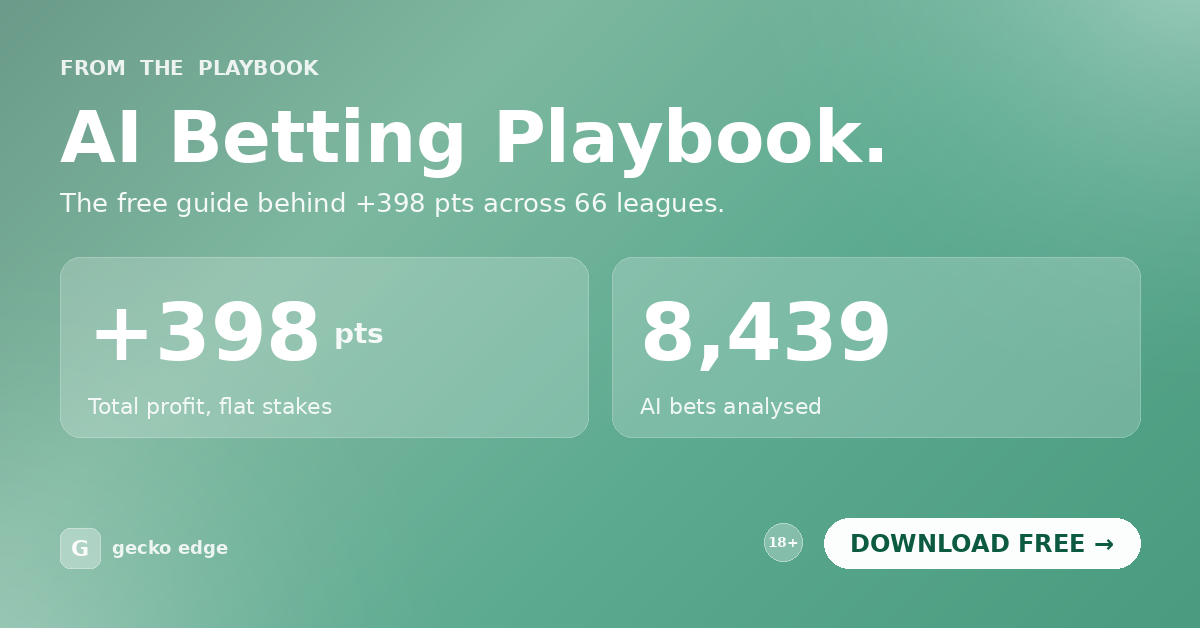
Gecko Edge has tracked 8,439 AI-generated bets and recorded +398pts of profit across 66 competitions. See how the model works →
The Foundation: The Poisson Distribution
If you want to model football, you start with the Poisson distribution. Think of it as the mathematical backbone of almost every football model in existence.
In simple terms, Poisson is a way to calculate the probability of a number of events occurring in a fixed interval of time. In football, those “events” are goals. By taking a team’s average goals scored and conceded (often called “Attacking Strength” and “Defensive Strength”), you can calculate the likelihood of any specific scoreline.
If Team A averages 1.5 goals per game and Team B averages 1.0, the Poisson model tells you the percentage chance of a 0-0, a 1-0, or a 2-1 result.
However, the basic Poisson model has a flaw. It assumes goals are independent events. We know they aren’t. A red card, a late goal that forces a team to push forward, or even the psychological pressure of a derby match can change the “randomness” of the game. This is where professional modelling begins to separate itself from amateur spreadsheets.

Refining the Math: Dixon and Coles
The basic Poisson model often struggles with low-scoring games. It tends to under-predict the frequency of 0-0 or 1-0 results. This is where the Dixon and Coles model comes in.
This model adjusts the math to account for the fact that certain scorelines happen more often than pure probability suggests. It also introduces the concept of “time-weighting.” A result from six months ago isn’t as relevant as a result from last week. By applying exponential decay to your data, your model prioritises recent form without completely ignoring historical context.
When we built Gecko Edge, we looked at these statistical foundations and realised that while they are powerful, they are only the starting line. To win in today’s markets, you need to go beyond standard distributions.
The AI Shift: Machine Learning and Ensemble Methods
Traditional stats look at what happened. Machine learning looks at why it happened.
At Gecko Edge, we utilise advanced machine learning ensemble methods like XGBoost and CatBoost. These aren’t just fancy buzzwords. They are tools that allow us to process thousands of variables simultaneously.
Instead of just looking at goals, these models look at:
- Expected Goals (xG) data (which you can learn more about in our ultimate guide to xG stats).
- Player availability and injury impact.
- Travel distance for away teams.
- Tactical shifts and manager changes.
The power of an ensemble model is that it doesn’t rely on one single “truth.” It runs multiple algorithms and combines their outputs to find the most accurate probability. It’s like having ten professional analysts in a room and taking the average of their best work.

Feature Engineering: Feeding the Machine
A model is only as good as the data you feed it. This is called “Feature Engineering.”
If you feed a model “Team Name” and “Last Result,” it won’t tell you much. If you feed it “Elo Ratings,” “Berrar Ratings,” and “Rolling xG Differentials,” the model begins to see patterns that the human eye misses.
For example, a team might have lost three games in a row, but their xG performance suggests they were incredibly unlucky. A standard statistical model might see a “losing streak.” An AI-driven model, like those we develop at Gecko Edge, sees an undervalued team ready for a rebound. That is where the value lies.
Monte Carlo Simulations: Playing the Match 15,000 Times
Predicting a match isn’t about saying “Team A will win.” It’s about saying “Team A wins this match 45% of the time.”
To get to that number, we use Monte Carlo simulations. Once the model has the parameters for both teams, we “play” the match 15,000 times in a digital environment.
Some simulations end in a 4-0 blowout. Others end in a 0-1 upset. By looking at the distribution of all 15,000 outcomes, we get a highly accurate “True Price” for the match. If our simulation says the draw should be priced at 3.50, and the bookmaker is offering 4.00, we have found an edge.

Why We Built Gecko Edge
Building these systems from scratch is a full-time job. It requires data scraping, server management, coding in Python or R, and constant back-testing. Most people don’t have the time or the technical background to do that.
That’s why we created Gecko Edge. We wanted to give bettors the power of professional-grade predictive football models without the complexity. Our platform is built for bettors and powered by AI, providing you with the outputs of these complex models in a simple, actionable format.
We don’t just give you a “tip.” We give you the data-driven probability. We show you where the value is. We help you act like a professional, not a gambler.
How to Start Using Models Today
If you’re ready to move away from guesswork and towards a systematic approach, here is how you should think:
- Ask: What is the model telling me that the public doesn’t see?
- Analyse: Compare the model’s “True Price” against the market price.
- Act: Only place a bet when you have a clear, mathematical edge.
The goal isn’t to be right every time. The goal is to be mathematically correct over the long run. Even the best models in the world have losing weeks. But over hundreds of matches, the math always wins.
Final Thoughts: Mastery Through Technology
The “3-minute” explanation of predictive football models boils down to this: Data + Math + Machine Learning = Edge.
You don’t need to be a mathematician to benefit from this technology. You just need to be disciplined enough to trust the numbers. At Gecko Edge, we are constantly refining our algorithms, adding new features, and ensuring our users have the most accurate predictions possible.
If you want to see how these models perform in the real world, check out our blog for more insights, or head over to our Knowledge Base to deepen your understanding of the professional betting world.
The era of the “gut feeling” is over. Smarter betting starts here.

Quick Summary for the Busy Bettor
- Poisson Distribution: The basic math of goal probability.
- Dixon-Coles: Adjusting for real-world football quirks and recent form.
- Machine Learning: Using AI to find hidden patterns in data.
- Monte Carlo: Simulating matches thousands of times to find the “True Price.”
- Value: Only betting when the market price is higher than your model’s price.
Ready to take your betting to the next level? Explore about Gecko Edge and see how we can help you build your winning system.
What is the Poisson distribution and how does it apply to football?
Poisson is a probability distribution that calculates the likelihood of a number of events occurring in a fixed interval. In football, those events are goals. Given a team’s average goals scored and conceded — often called Attacking Strength and Defensive Strength — Poisson tells you the probability of any specific scoreline. It’s the mathematical backbone of almost every football model in existence.
Why does pure Poisson fail for football prediction?
Poisson assumes goals are independent events. In real football matches, they aren’t — red cards, late goals forcing tactical shifts, derby-match psychology, and game state all introduce correlation between scoring events. As a result, basic Poisson under-predicts low-scoring outcomes like 0-0 and 1-0, and overestimates the spread of likely scorelines. Serious models start with Poisson and then correct it.
What is the Dixon-Coles correction and what does it fix?
The Dixon-Coles model adjusts the Poisson distribution to account for the dependency between home and away scoring at low scorelines. It applies a multiplier to the 0-0, 1-0, 0-1, and 1-1 cells using a single correlation parameter. Dixon-Coles also introduces time-weighting via exponential decay, so recent results carry more influence than older ones without ignoring historical context entirely.
How do Monte Carlo simulations find the ‘true price’ of a match?
Once a model has the parameters for both teams, Monte Carlo simulation ‘plays’ the match thousands of times — typically 10,000-15,000 runs — in a digital environment. Each simulation produces a different outcome based on the probability distributions. By aggregating across all the simulations, you get a precise probability for each market: match result, total goals, Asian Handicap lines, correct score. The distribution gives a highly accurate true price.
What is feature engineering in a football prediction model?
Feature engineering is the process of turning raw data into the variables a model actually uses. Feeding a model ‘Team Name’ and ‘Last Result’ produces weak predictions. Feeding it Elo ratings, Berrar ratings, rolling xG differentials, defensive actions per 90, injury-adjusted strength, and tactical-style indicators gives the model material to find genuine patterns. A model is only as good as the features it learns from.