Asian Handicaps; most bettors see a football match as a three-way puzzle: Win, Lose, or Draw. It is the classic 1X2 market. It is also where most people lose their money. The draw is the bookmaker’s greatest ally and the bettor’s silent killer. It adds a layer of variance that turns a calculated prediction into a coin flip.
If you want to move from “gambling” to professional trading, you have to eliminate that noise. This is where Asian Handicap betting becomes your most effective tool.
At Gecko Edge, we look at markets through the lens of probability and risk mitigation.
We don’t just want to know who will win; we want to know how to protect our stake when the unexpected happens.
Asian Handicaps aren’t just a different way to bet. They are a way to manage your exposure.
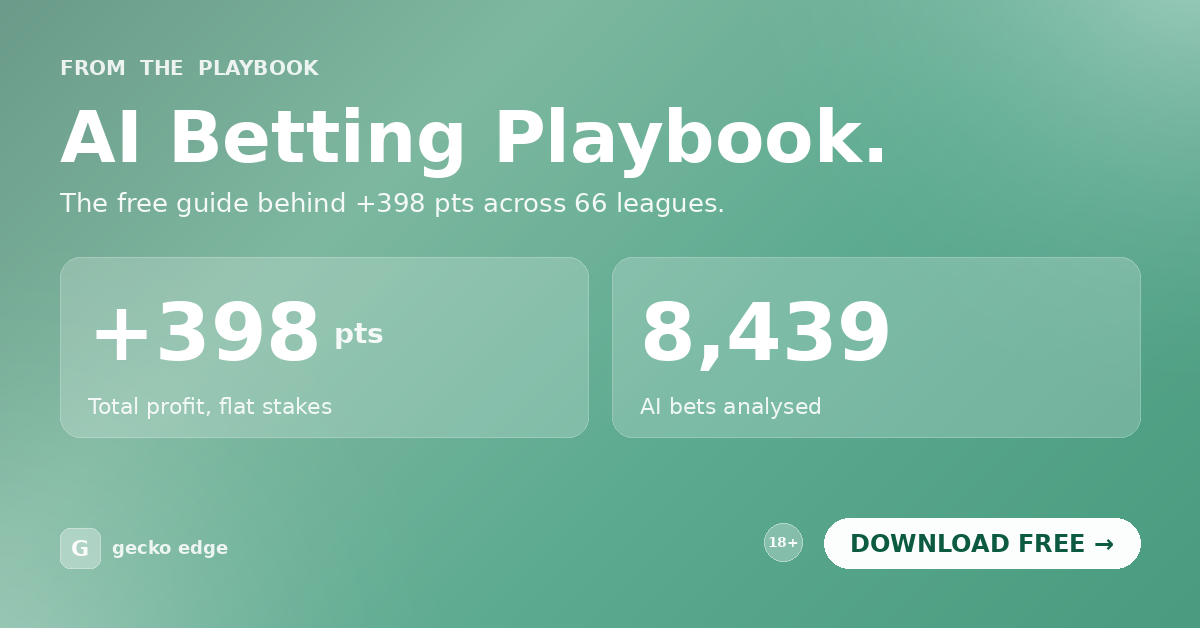
Gecko Edge has tracked 8,439 AI-generated bets and recorded +398pts of profit across 66 competitions. See how the model works →
The Problem with the 1X2 Market
In a traditional 1X2 market, you have a 33.3% theoretical chance of success on any single outcome. Of course, the real probabilities are weighted by team strength, but the structural risk remains the same: if you back a team to win and they draw, you lose 100% of your stake.
Professional betting is not about hitting home runs every time. It is about capital preservation. When we built Gecko Edge, the goal was to find ways to exploit market inefficiencies while keeping the downside capped.
Traditional markets offer no such safety net.
Asian Handicaps change the geometry of the bet. By removing the draw or splitting the stake, you turn a three-way market into a two-way market. You are no longer just betting on an outcome; you are betting on a margin of performance.
The Safety Net: Understanding the “Push”
The most basic form of risk management in Asian Handicaps is the whole-line handicap, such as 0.0, -1.0, or +2.0.
Take the 0.0 Asian Handicap, often referred to as “Draw No Bet”. If the team you back wins, you win. If they lose, you lose. But if the match ends in a draw, your entire stake is returned. It is a “Push”.
Think about the psychological and financial impact of that. In a 1X2 market, a 90th-minute equaliser from the underdog is a catastrophe. In a 0.0 Asian Handicap market, it is simply a “reset.” You live to fight another day. Your bankroll remains intact, and you can move on to the next high-EV opportunity identified by our AI football predictions.

Split Handicaps: The Ultimate Precision Tool
If whole lines are a safety net, split handicaps (quarter-lines like -0.25 or -0.75) are a scalpel. They allow you to hedge your position within a single bet.
When you place a bet on a -0.25 handicap, you are actually splitting your stake into two separate bets:
- Half of your stake on the 0.0 line (Draw No Bet).
- Half of your stake on the -0.5 line (Straight Win).
If your team wins, both halves win. If they lose, both halves lose. But if they draw? You lose half your stake (the -0.5 part) and get the other half back (the 0.0 part).
This is “Half-Loss” management.
It is the difference between a bad day at the office and a total collapse. By choosing a -0.25 line over a straight win, you are effectively buying insurance against the draw. You accept a slightly lower price in exchange for a 50% refund if the game finishes level.
Why AI Prefers Asian Lines
At Gecko Edge, our algorithms don’t just look at who is “better”.
They calculate the expected margin of victory. The “maths” behind the madness involves simulating a match thousands of times to see the distribution of scorelines.
If the AI determines that a team has a 60% chance of winning but a very high probability of a low-scoring game, the straight win might be risky. However, the -0.75 Asian Handicap might represent massive value.
Why? Because a one-goal win still nets you a “Half-Win” (you win on the -0.5 part and push on the -1.0 part).
Most casual bettors ignore these nuances. They want the big odds of a -1.5 handicap. They want the glory. We want the margin. Professionalism in this industry is found in the decimals. You can explore more about these terms in our betting glossary.

The Mathematics of Lower Margins
One of the less discussed benefits of Asian Handicap betting is the “Overround”.
Bookmakers build a profit margin into every market. In the 1X2 market, that margin is often 5% to 7% because there are three outcomes to balance.
In Asian Handicap markets, the competition between bookmakers is much higher, and the two-way nature of the bet makes it easier for them to balance their books. This results in lower margins, often as low as 2% or 3%.
Over 1,000 bets, that 3% difference in the “house edge” is the difference between being a profitable trader and a losing punter. By focusing on Asian lines, you are mathematically giving yourself a head start. You are playing on a fairer field.
Hedging in Real-Time: In-Play Strategies
Risk management isn’t just about what you do before kick-off. It’s about how you react as the data changes. Asian Handicaps are the perfect vehicle for in-play hedging.
Imagine you have backed a favourite at -1.0 pre-match. They go 1-0 up early in the second half. At this point, your bet is in a “Push” position.
If the game ends now, you get your money back.
If the underlying data: the “Live Intel” provided by Gecko Edge: suggests the favourite is starting to sit back and the underdog is creating chances, you have a choice.
You can let it ride, or you can use the Asian lines to hedge. You could take the +0.5 or +0.75 line on the underdog in-play.
By doing this, you can create a “Middle”.
If the favourite holds onto the 1-0 lead, you push your main bet and potentially win your hedge. If the underdog equalises, you lose your main bet but win your hedge. It is about using the technology to stay one step ahead of the volatility.

The Discipline of the Long Game
Smarter betting starts with an honest look at your bankroll. If you see your betting account as a “gambling fund”, you will eventually lose it.
If you see it as a capital investment, you will protect it.
Asian Handicaps force you to think analytically. They require you to ask: “What is my downside?”
- 1X2: Downside is 100% loss on 2 out of 3 outcomes.
- Asian Handicap -0.5: Downside is 100% loss on a draw or loss.
- Asian Handicap 0.0: Downside is 100% loss only on a loss.
- Asian Handicap +0.25: Downside is a 50% loss on a draw, and 0% loss on a win.
When you look at the numbers this way, the “Art of the Hedge” becomes clear.
You aren’t just trying to be right; you are trying to be “not wrong” as efficiently as possible.
Building Your Strategy with Gecko Edge
The transition to using Asian Handicaps can feel daunting if you’re used to simple wins and losses. But the rewards: both financial and psychological: are immense. You stop fearing the late equaliser. You stop tilting when a dominant team fails to find the second goal.
Our mission at Gecko Edge is to provide the clarity you need to navigate these markets.
Through our AI-driven education, we help you understand not just the “what,” but the “why.”
We provide the data; you provide the discipline.
Summary: Ask, Analyse, Act
To master the Asian Handicap hedge, follow this simple framework:
- Ask: What is the most likely “failed” outcome? (e.g., Is a draw likely?)
- Analyse: Look at the Asian lines. Which one provides the best protection for the likely failure while still offering value?
- Act: Place your trade on the line that balances EV with bankroll protection.
Betting doesn’t have to be a gamble. With the right tools and a data-driven mindset, it becomes a game of calculated risks and managed outcomes.
Smarter Betting Starts Here.

If you are looking to refine your approach, check out our Knowledge Base for more deep dives into professional trading strategies. Always remember to bet within your means and review our responsible betting disclaimer.
How does the Asian Handicap ‘Push’ outcome protect your stake?
A whole-line handicap like 0.0 (Draw No Bet) settles as a push when the match ends level — your entire stake is returned. In a 1X2 market, a 90th-minute equaliser from the underdog is a complete stake loss. In a 0.0 AH market, it’s a reset; your bankroll remains intact and you move to the next opportunity. This single mechanic transforms how a bettor weathers variance over hundreds of bets.
What’s a split Asian Handicap and how does it manage risk?
Quarter lines like -0.25 or -0.75 split your stake across two adjacent half-goal handicaps. On -0.25, half your stake sits on 0.0 (Draw No Bet) and half on -0.5 (straight win). A draw produces a half-loss (loss on the -0.5 part, push on the 0.0 part) rather than total loss. This is ‘half-loss management’ — buying insurance against draws in exchange for slightly lower odds.
Why do bookmakers offer lower margins on Asian Handicap markets?
The overround — the bookmaker’s profit margin — is built across the number of possible outcomes. 1X2 markets have three outcomes, allowing margins of 5-7%. AH markets have two outcomes and face stronger competition between bookmakers because professionals dominate the volume. Margins drop to 2-3%. Over 1,000 bets, the 3% difference is the gap between long-term profitability and slowly bleeding to the house edge.
How can you hedge a pre-match Asian Handicap bet in-play?
A favourite backed at -1.0 pre-match goes 1-0 up in the second half — the bet is currently in push position. If live data suggests the favourite is sitting back and the underdog is creating chances, take a +0.5 or +0.75 line on the underdog in-play. If the favourite holds the lead, your main bet pushes and the hedge may win. If the underdog equalises, you lose the main and win the hedge. Creating a ‘middle’ turns volatility into managed outcome.
What’s the downside profile of different Asian Handicap lines?
1X2 home win: 100% loss on draw or away win. AH -0.5: 100% loss on draw or loss. AH 0.0 (DNB): 100% loss only on a loss; push on draw. AH +0.25: 50% loss on draw, 0% loss on win. Each line shifts the downside-protection versus odds-paid trade-off. Professional bettors choose the line that balances expected value with bankroll protection rather than chasing the highest odds.

2 comments