Asian Handicap; the betting market is a living thing. It breathes, reacts, and sometimes panics. If you’ve spent any time watching a screen on a Saturday afternoon, you’ve seen it happen. A key player pulls up in the warm-up. A sudden downpour turns a slick pitch into a swamp. Or perhaps, a “sharp” syndicate drops a heavy stake on an underdog.
The numbers start to move. Odds slash. Lines shift from -0.5 to -0.75 in the blink of an eye. For most casual bettors, this is where the mistakes happen. They chase the price. They suffer from FOMO (Fear Of Missing Out). They take a line that no longer holds value.
At Gecko Edge, we view market volatility differently. We don’t see chaos; we see opportunity. But to capture that opportunity, you need a method. You need to know how to choose the best Asian Handicap betting lines when the world around you is moving at a hundred miles per hour.
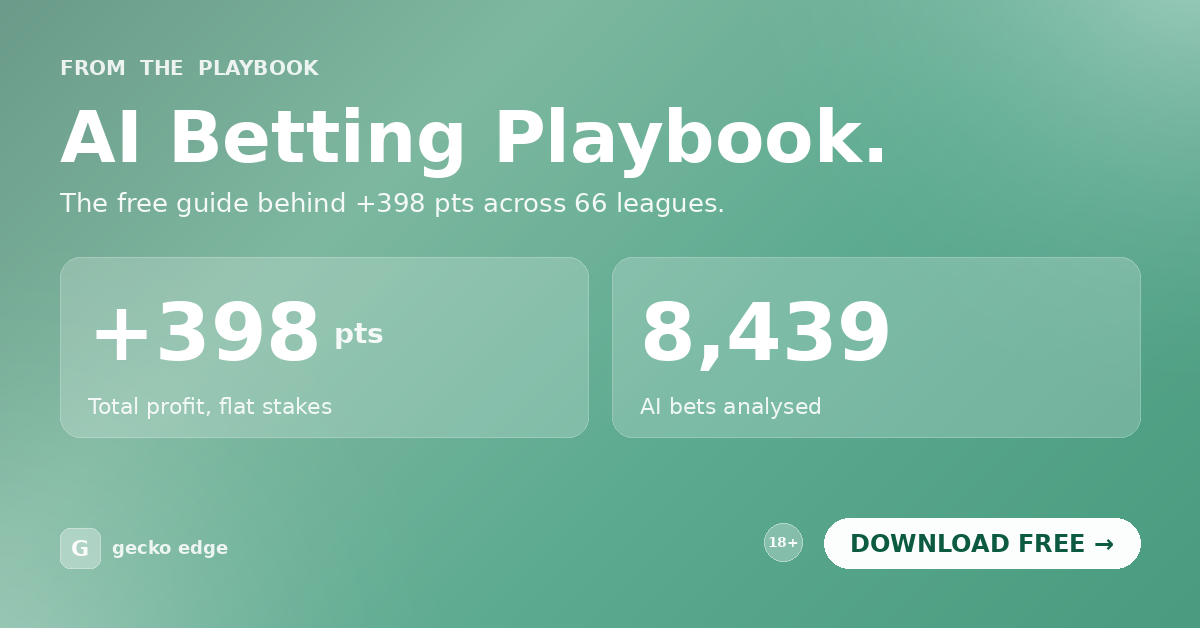
Gecko Edge has tracked 8,439 AI-generated bets and recorded +398pts of profit across 66 competitions. See how the model works →
The Asian Handicap Advantage
Before we dive into the speed of the market, we should clarify why we focus on Asian Handicap betting at all. In a standard 1X2 market, you have three outcomes: Home, Draw, or Away. The bookmaker’s margin is spread across three results.
The Asian Handicap reduces the game to two outcomes by removing the draw. By doing so, it offers better liquidity and tighter margins. It is the professional’s choice. It allows for a “safety net.” If you back a team at -0.25 and they draw, you only lose half your stake. If you back them at +0.75 and they lose by one goal, you only lose half.
This nuance is your greatest weapon when markets are volatile. It’s not just about who wins; it’s about how much protection you can buy while maintaining a mathematical edge. To get a deeper grip on the basics, you might want to look at our ultimate guide to Asian Handicap betting.
Phase 1: Ask : The Importance of Pre-Game Baselines
You cannot judge a market move if you don’t know where the market started.
Professional betting is about preparation. Before the lineups are announced, you should already have a “fair price” in your head. This is your anchor. If the market moves away from your anchor, you ask why.
Is it “noise” or “signal”?
“Noise” is a celebrity pundit mentioning a minor injury that doesn’t actually impact the team’s Expected Goals (xG) output. “Signal” is the starting XI missing both first-choice fullbacks in a system that relies on wing-back progression.

When the market moves fast, you don’t have time to run a full analysis. You rely on the work you did three hours ago. If your baseline for Manchester City was -1.75 and the market suddenly shifts to -1.25 due to a “leak” about squad rotation, you have a decision to make. Is the rotation actually worth half a goal? Usually, it isn’t. The market overreacts. That’s where you strike.
Phase 2: Analyse : Decoding In-Play Betting Strategies
The real test of speed happens once the whistle blows. In-play betting strategies require a different mental gear.
As the clock ticks, the Asian Handicap lines are in a constant state of decay. If a favourite is -1.0 at kick-off and hasn’t scored by the 30th minute, that line will inevitably drop to -0.75 or -0.5.
To choose the best line here, you must look beyond the scoreline. You need to look at the “Game State.”
- Is the favourite dominating possession but failing to find the final ball?
- Is the underdog sitting deep, inviting pressure, and looking tired?
- Are the xG numbers trending upward despite the 0-0 score?
We often talk about the 80th-minute pivot. This is a crucial window in Asian Handicap betting. When a team is trailing by one goal late in the game, they throw everything forward. The market often overvalues the chance of an equaliser, but it misses the heightened probability of a counter-attack goal that covers a -1.5 line.

Navigating Betting Market Trends
Market trends are driven by two forces: information and money.
In the modern era, information travels instantly. This means the “window” of value is smaller than ever. To beat the bookies, you need to understand the concept of the Closing Line Value (CLV). If you bet on a team at -0.5 and the line closes at -0.75, you have won. You’ve beaten the market. Over 1,000 bets, that difference is the gap between a hobbyist and a professional.
When the market moves fast, don’t just look at the odds. Look at the “spread.” If the spread is widening, it means the bookmakers are uncertain. They are protecting themselves. If the spread is tight but the line is moving rapidly, it means a lot of smart money is entering the market.
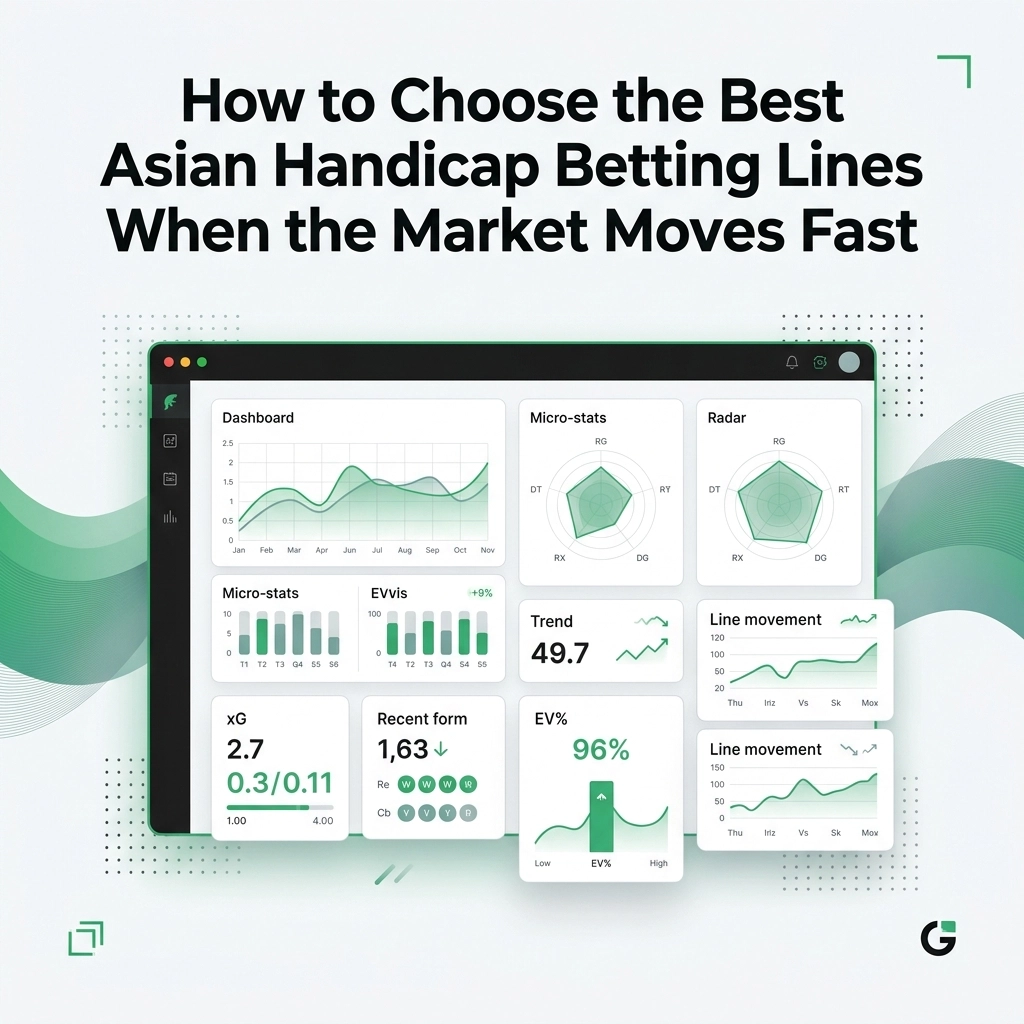
At Gecko Edge, we use AI to track these movements in real-time. We compare current betting market trends against historical data to see if a move is justified by performance metrics or if it’s simply a result of public sentiment.
The Quarter-Line Strategy
If you are unsure about a fast-moving market, the “Quarter-Lines” are your best friend.
Lines like -0.25, -0.75, +1.25, and +1.75 are the hallmarks of a disciplined bettor. When the market is volatile: perhaps during a rainy Champions League knockout tie: the difference between a -0.5 and a -0.75 is massive.
If you take -0.5 and the team wins by one goal, you win the full bet. If you take -0.75 and they win by one goal, you only win half. However, the -0.75 often comes with much better odds. In a fast market, bettors often “settle” for the round numbers (-0.5 or -1.0) because they are easier to understand. The value is frequently hidden in the quarters.

Phase 3: Act : Execution Under Pressure
Knowing the right line is only half the battle. Executing the bet before the price disappears is the other half.
- Multiple Books: You must have accounts with several bookmakers. In a fast market, one bookie might lag behind the others by 30 seconds. That 30-second window is where you find your edge.
- Avoid the “Red Screen”: Many in-play bettors wait too long. If you see a dangerous attack happening, the market will suspend. You need to anticipate the move.
- Trust the Model: If you’ve built a solid framework, trust it. Don’t let a sudden goal or a red card make you abandon your strategy.
For those who feel they are constantly one step behind, understanding why you can’t beat modern books without predictive models is an eye-opening exercise. The house is using AI. To compete, you should be too.
The Psychology of the Fast Market
Finally, we must talk about the mind.
When markets move, your heart rate increases. You feel the urge to click “Place Bet” before the odds drop another two ticks. This is a physiological response.
The best bettors are the ones who can remain calm. They don’t mind missing a bet. If the value has vanished, they walk away. There is always another game. There is always another Saturday.

Choosing the best Asian Handicap line is a exercise in discipline. It’s about asking the right questions, analysing the data through a sharp lens, and acting with surgical precision.
Smarter Betting Starts Here
The world of football betting is no longer about gut feelings and “knowing the game.” It’s about data, timing, and technology.
At Gecko Edge, we’ve built our systems to handle the speed of the modern market. We don’t chase lines; we anticipate them. Whether you are looking for the safety of a +1.0 Asian Handicap or the aggressive value of a -2.25 line, the principles remain the same:
Prepare. Observe. Execute.
The market will always move. Your job isn’t to stop it: it’s to be ready when it does.
Built For Bettors, Powered By AI. That is the Gecko Edge.