It is the first of March. For most people, it is just the start of spring. For us, it is the beginning of the “Home Stretch.”
The league tables are starting to fragment. You have the title contenders, the European hopefuls, the desperate pack fighting relegation, and the “comfortable” middle. This is the time of year where the “Motivation Factor” becomes the most talked-about metric in football betting. You’ll hear it in every pub and see it on every social media thread: “They need it more,” or “They’re already on the beach.”
But here is the thing about motivation: it is subjective, it is noisy, and it is often priced into the market incorrectly. At Gecko Edge, we don’t ignore motivation, but we don’t let it cloud the data either. The secret to finding value in the final ten games of the season isn’t just knowing who needs the points; it is using AI to understand if they are actually capable of getting them.
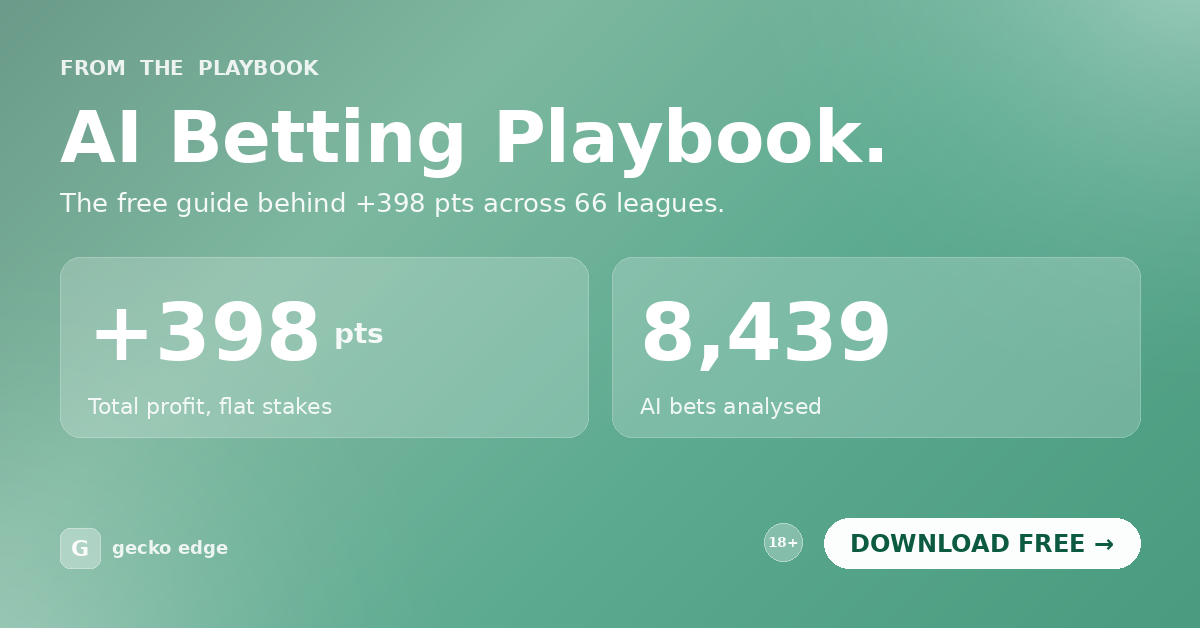
Gecko Edge has tracked 8,439 AI-generated bets and recorded +398pts of profit across 66 competitions. See how the model works →
The Myth of the “Must-Win” Game
We’ve all seen it. A team sitting in 18th place is playing a team in 10th. The 10th-place team has nothing to play for: they can’t get relegated, and Europe is a pipe dream. The market gravitates toward the underdog because of the “desperation” narrative.
The problem? Desperation doesn’t suddenly make a striker more clinical or a defender faster. In fact, late-season pressure often leads to tactical rigidity and individual errors. When the market overvalues a team simply because they “need” a win, the real value often lies on the other side of the pitch.
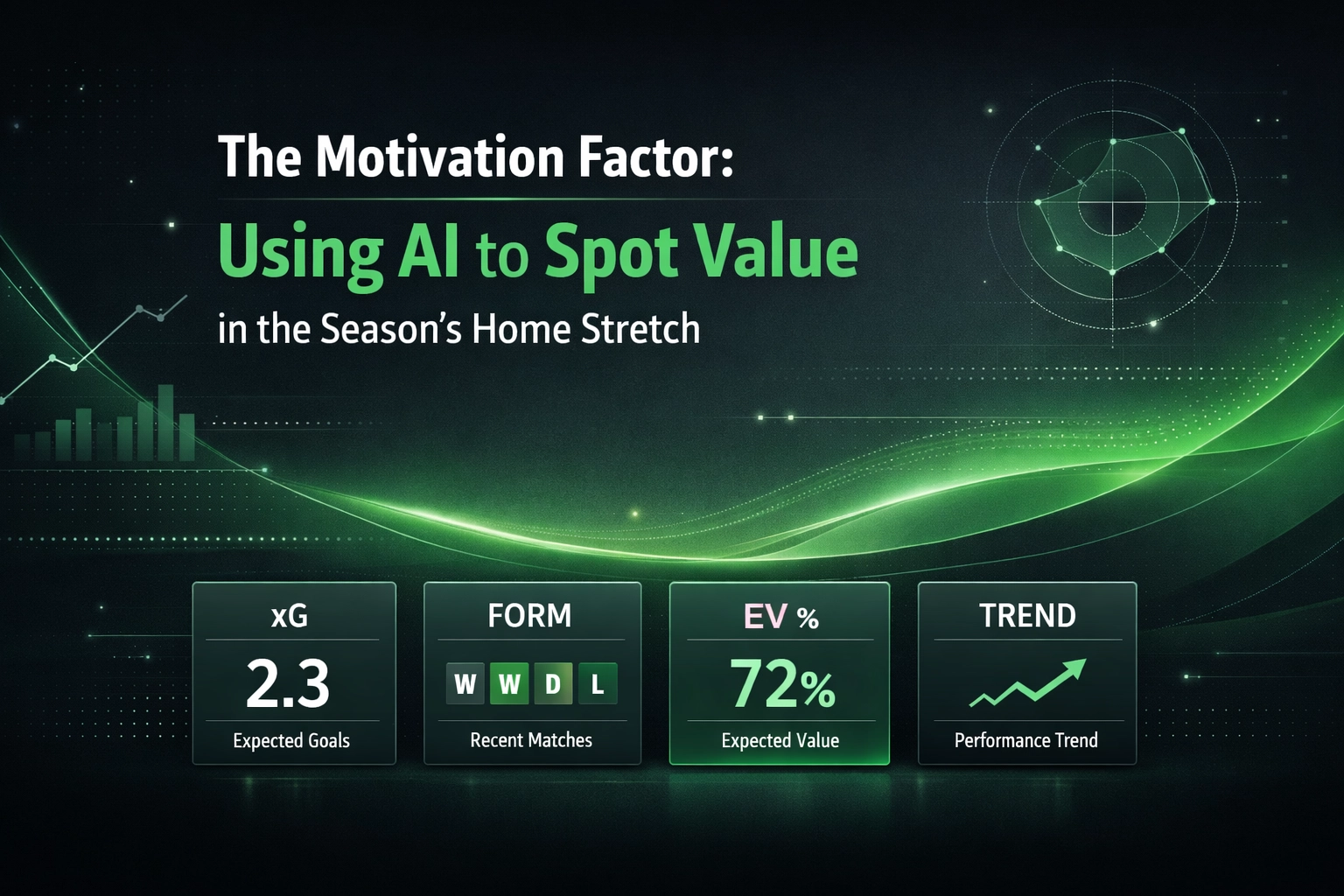
This is where Gecko Edge excels. Our predictive football models look past the league table. While the average punter is betting on “heart” and “grit,” our algorithms are looking at whether that 18th-place team is actually improving their underlying metrics. Are they creating more chances (xG), or are they just huffing and puffing without any real threat?

Filtering the Noise with AI
The human brain is wired to find patterns in stories. We love a “Great Escape” narrative. But stories don’t win bets; probability does.
In the home stretch, the noise becomes deafening. Managers give emotive press conferences, fans create hostile atmospheres, and the media hypes up every fixture as a “six-pointer.” AI acts as a high-pass filter for this noise.
By using the best AI football predictions, we can see the cold, hard reality of performance. If a team in the relegation zone has a declining xG over their last five matches but the market is backing them because of “motivation,” we see a massive value opportunity to bet against them.
Conversely, the “on the beach” teams are often unfairly dismissed. A team with no pressure can play some of their best football of the season. They play with freedom, try new things, and can often blow away a “motivated” but nervous opponent. Our models at Gecko Edge track these shifts in real-time, identifying when a team’s performance levels remain high despite having “nothing to play for.”
The Relegation Scrap: Desperation vs. Data
When a team is fighting for survival, the intensity naturally increases. But intensity isn’t always productive. Often, it leads to a “long ball and hope” strategy that is easily defended by disciplined teams.

Using our Gecko Edge playbook, we look for teams in the scrap that are maintaining their tactical composure. If the data shows a team is still sticking to a high-press or high-possession game despite the pressure, they are far more likely to find the points they need than a team that has descended into tactical chaos.
AI allows us to quantify “composure.” We look at pass completion rates in the final third and defensive positioning under pressure. If these metrics hold steady, the “motivation” is a bonus. If they crumble, the “motivation” is just a path to a losing bet.
Spotting the Late-Game Surge
The home stretch also changes how games are played in the final twenty minutes. A draw is often useless for a team chasing promotion or avoiding the drop. This leads to extremely volatile end-game scenarios where teams throw everything forward.
We’ve found that finding value in added time betting becomes significantly more lucrative in March and April. Our AI models analyze live game-state context. If a team “needs” a win and the game is tied at the 75th minute, the probability of a late goal increases exponentially compared to a mid-season fixture. The “motivation factor” here is real, but it must be backed by data that shows the team has the fitness and the bench depth to capitalise on that urgency.

Predictive Models vs. Market Sentiment
The market is a reflection of collective human emotion. In the final weeks of the season, that emotion is at an all-time high. This creates “Market Bias.”
If a top-four team loses a couple of games, the “bottler” narrative takes over. The price for their next game might drift, offering value. AI doesn’t care about the “bottler” tag. It looks at the 8439 data points we’ve analysed to see if the performance dip was due to bad luck, injury, or a genuine decline in quality.
Our EV (Expected Value) betting approach is built for this. We aren’t trying to predict the future with 100% certainty: no one can. We are looking for discrepancies between the true probability (calculated by AI) and the market price (driven by narrative).
In the home stretch, these discrepancies are wider than at any other point in the season.
The Gecko Edge Approach to the Final 10
So, how do you actually apply this? How do you move from a casual observer to a sharp bettor as the season closes?
- Ignore the League Table for a Moment: Look at the performance data from the last 4-6 weeks. A team’s position is a result of their whole season; their current performance is what matters for next Saturday.
- Watch the “Must-Win” Price: If a team’s price is shorter than it was three months ago for a similar fixture, ask yourself: has the team improved, or is the market just pricing in their “need” for points?
- Use Game-State Analysis: In play, look for those late momentum shifts. Desperate teams leave gaps. Teams with nothing to play for might stop tracking back. AI picks up on these subtle shifts in player tracking and ball progression before the human eye does.
- Be Wary of the “Dead Rubber”: When two mid-table teams play, goals often fly in. Without the suffocating pressure of points, players take more risks. This is a great time to look at Over 2.5 goals strategies.
Final Thoughts
The home stretch is the most exciting time of the year, but it’s also the most dangerous for bettors who rely on gut feeling. Motivation is a powerful force, but it’s just one variable in a complex equation.
At Gecko Edge, we believe that smarter betting starts with better data. By using predictive football models to filter out the noise of the “motivation narrative,” we can find the real value hidden in plain sight.
Whether it’s a relegation battle in the Premier League or a promotion scrap in the Championship, don’t just follow the story. Follow the numbers. Let the AI handle the complexity while you focus on the strategy.
The season is far from over. There is still plenty of value to be found if you know where to look. Stay sharp, stay analytical, and let’s finish the season strong.
Built For Bettors, Powered By AI. Smarter Betting Starts Here.