



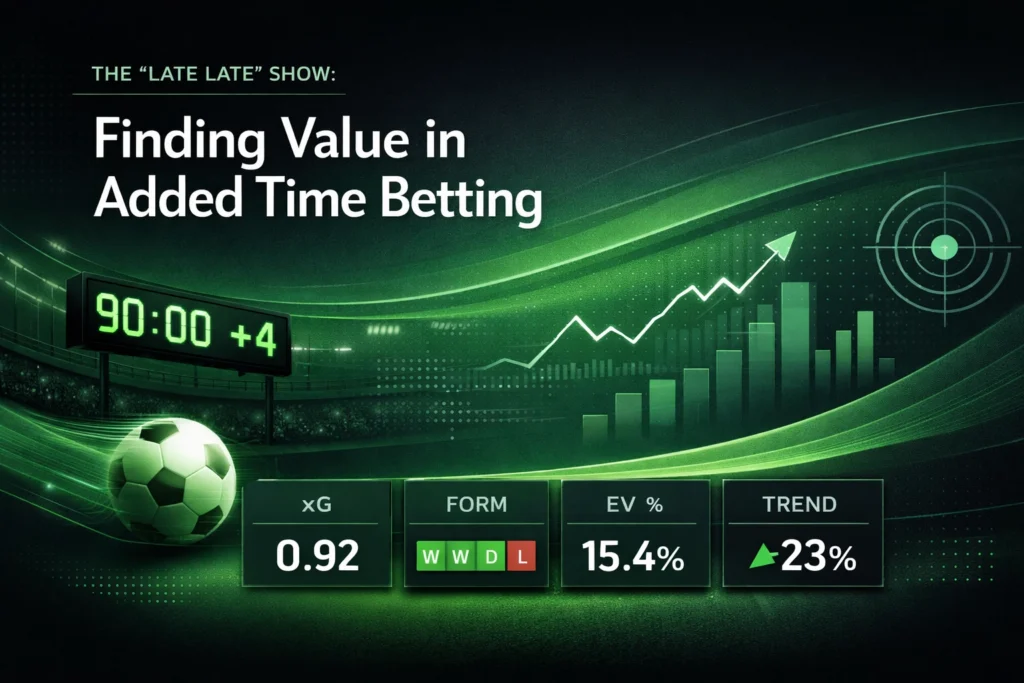
Added Time; there is a specific kind of silence that settles over a stadium around the 85th minute. It is the sound of anticipation, desperation and, for many bettors, pure anxiety. We have all been there. You have a bet that is cruising toward a win, only for a 94th-minute scuff into the bottom corner to ruin your afternoon.
Most people call this bad luck. They call it “Fergie Time” or just the “cruel nature of the game.” But if you are looking at the pitch through the lens of data, the final ten minutes plus added time isn’t a period of random chaos. It is a distinct phase of the match with its own rules, its own physics, and, most importantly, its own value.
At Gecko Edge, we don’t view the final whistle as a deadline to fear. We view the lead-up to it as an opportunity. When the crowd starts biting their nails, that is exactly when the most significant price discrepancies appear in the in-play markets.
The Psychology of the Dying Minutes
Football is a game of ninety minutes, but it is rarely played at a consistent tempo. As the clock ticks toward the red, the tactical rigidity of the first half evaporates. Tired legs lead to mental lapses. Managers throw tall centre-backs upfront. Teams that were content to pass sideways suddenly start launching the ball into the mixer.
This shift in behaviour creates a goldmine for in-play betting, provided you can separate the noise from the signal. The average bettor reacts emotionally to the “feel” of the game. They see a team attacking and assume a goal is coming. However, “pressure” doesn’t always equal “production.”
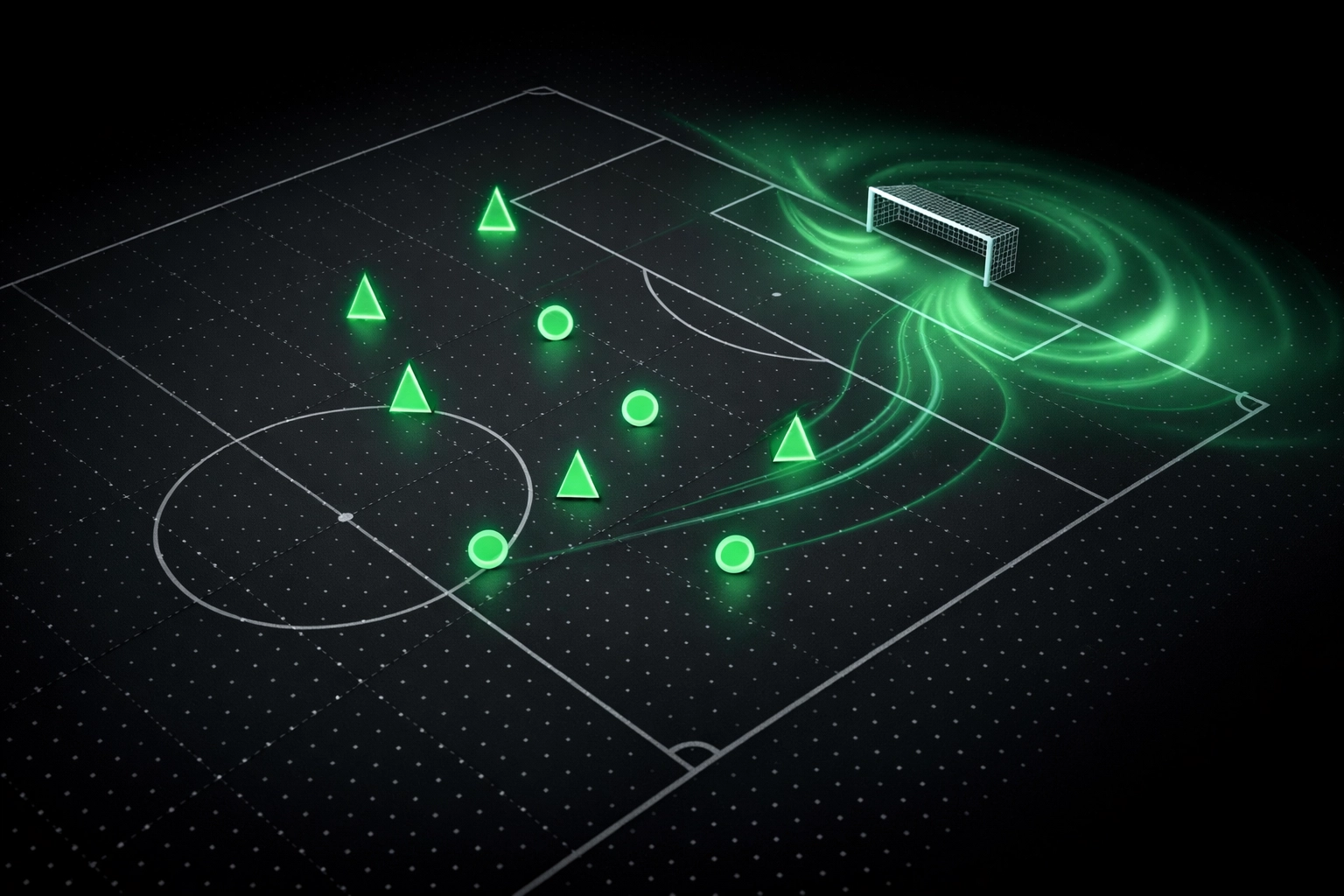
To find value here, you have to ask yourself: Is this team actually creating quality chances, or are they just panicking? This is where in-play intelligence becomes your most valuable asset. While the casual fan sees a flurry of corners, Gecko Edge sees the quality of those chances and the defensive stability of the opposition.
Why Your Pre-Match Data Won’t Save You Now
Many bettors rely heavily on pre-match models. They look at season averages, expected goals (xG) over the last ten games, and head-to-head records. All of that is useful for setting a baseline, but by the 80th minute, much of that data is obsolete.
Pre-match stats don’t account for the fact that a team is playing with ten men, or that their star playmaker was subbed off with a hamstring tweak in the 60th minute. They don’t account for the weather turning foul or the referee adding eight minutes of stoppage time due to a lengthy VAR check.
In the final stretch, the only data that matters is what is happening right now.
This is why we built Gecko Edge to focus on real-time intelligence. We look at live momentum shifts. If a trailing home side has spent the last five minutes camped in the opposition’s final third, the probability of a goal increases exponentially beyond what any pre-match model could predict. Conversely, if a team is “pushing” but failing to register a shot on target, the “Late Goal” market is likely overpriced.
Spotting the “Push” with In-Play Intelligence
The “Push” is that moment when a team decides to risk everything for a result. You see it in the data before you see it on the scoreboard.
When a team enters “Push” mode, their defensive line moves ten yards higher. Their full-backs stop overlapping and start staying in the box. The number of long balls increases. For a professional bettor, these are the triggers.
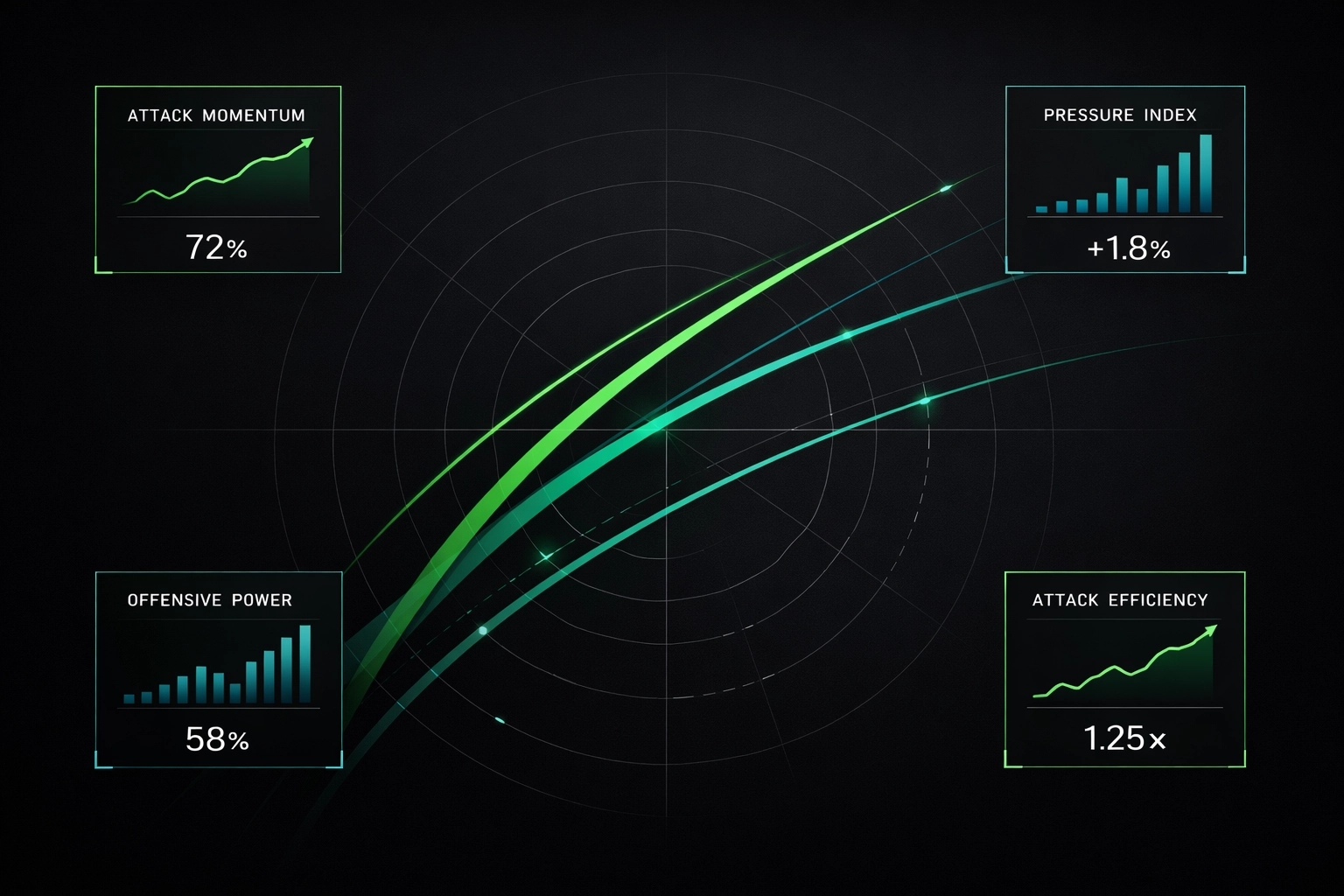
But here is the catch: the market knows this too. Bookmakers slash the odds on a late goal the moment a dominant team gets a corner in the 88th minute. To find value, you need to be ahead of that curve.
Our approach at Gecko Edge involves identifying the ineffective push. Sometimes, a team looks like they are dominant because they have 70% possession in the final ten minutes, but they are actually just passing in front of a well-organized low block. The in-play intelligence we provide helps you spot when the “favourite” is actually toothless, allowing you to find value in the “No More Goals” or “Under” markets when everyone else is betting on a late miracle.
The Math of Added Time
In recent seasons, we have seen a significant increase in the amount of added time played in major leagues. What used to be a standard three minutes is now frequently six, eight, or even ten minutes. This change has fundamentally altered the value of late-game markets.
If the bookmaker is pricing the “Over 2.5 Goals” market based on the assumption of 93 minutes of play, but the reality is likely to be 98 minutes, you have just found a massive edge. Those extra five minutes represent more than 5% of the total match duration, but they are often played at the highest intensity with the most tired defenders.
By analysing real-time game flow, Gecko Edge helps you calculate the “true” remaining time. We factor in the number of substitutions, injury breaks, and VAR interventions to give you a clearer picture of how much “the late show” will actually last. Smarter betting starts here: by understanding the clock better than the person setting the odds.
Risk Management: Keeping a Cool Head in Stoppage Time
The biggest danger of added-time betting isn’t the data: it’s your own pulse. It is very easy to get swept up in the drama. You see a flurry of activity, you feel the momentum, and you place a bet based on a “hunch.”
Professional betting is about removing the hunch. It is about the “Ask, Analyse, Act” framework.
- Ask: What is the current game state, and what is the market offering?
- Analyse: Does the live data from Gecko Edge support the visual narrative? Are the shots coming from high-value areas?
- Act: Only if the data shows a clear discrepancy between the actual probability and the market price.
If you are betting on the 90th minute to save your day, you aren’t trading; you are gambling. We encourage our users to treat the final ten minutes with the same analytical rigour as the first ten. If the value isn’t there, walk away. The “Late Late Show” happens every week; you don’t need to be in the audience for every performance.
The Edge in the Chaos
At the end of the day, football is unpredictable. That is why we love it. But while we can’t predict exactly when a ball will hit the back of the net, we can calculate the likelihood of it happening based on thousands of data points processed in real-time.
The final whistle isn’t the end of the story: it’s the conclusion of a complex series of events. By using the in-play intelligence provided by Gecko Edge, you stop guessing and start calculating. You move from being a spectator of the drama to a disciplined observer of the numbers.
Whether you are looking for that one final goal to tip the scales or spotting a defensive unit that refuses to break, the edge is there. You just need the right tools to see it.
Built For Bettors, Powered By AI. That is how we navigate the chaos of the final minutes. If you want to see how real-time intelligence can change your approach to the in-play markets, explore more at geckoedge.ai.
Smarter betting doesn’t happen by accident. It happens when technology meets discipline. Let’s make the “Late Late Show” work for you, rather than against you.