We’ve all been there. You check the post-match stats, see your team racked up 2.85 xG to the opponent’s 0.40, yet somehow you’re staring at a 1-0 loss and a voided betting slip. It feels like a robbery, doesn’t it?
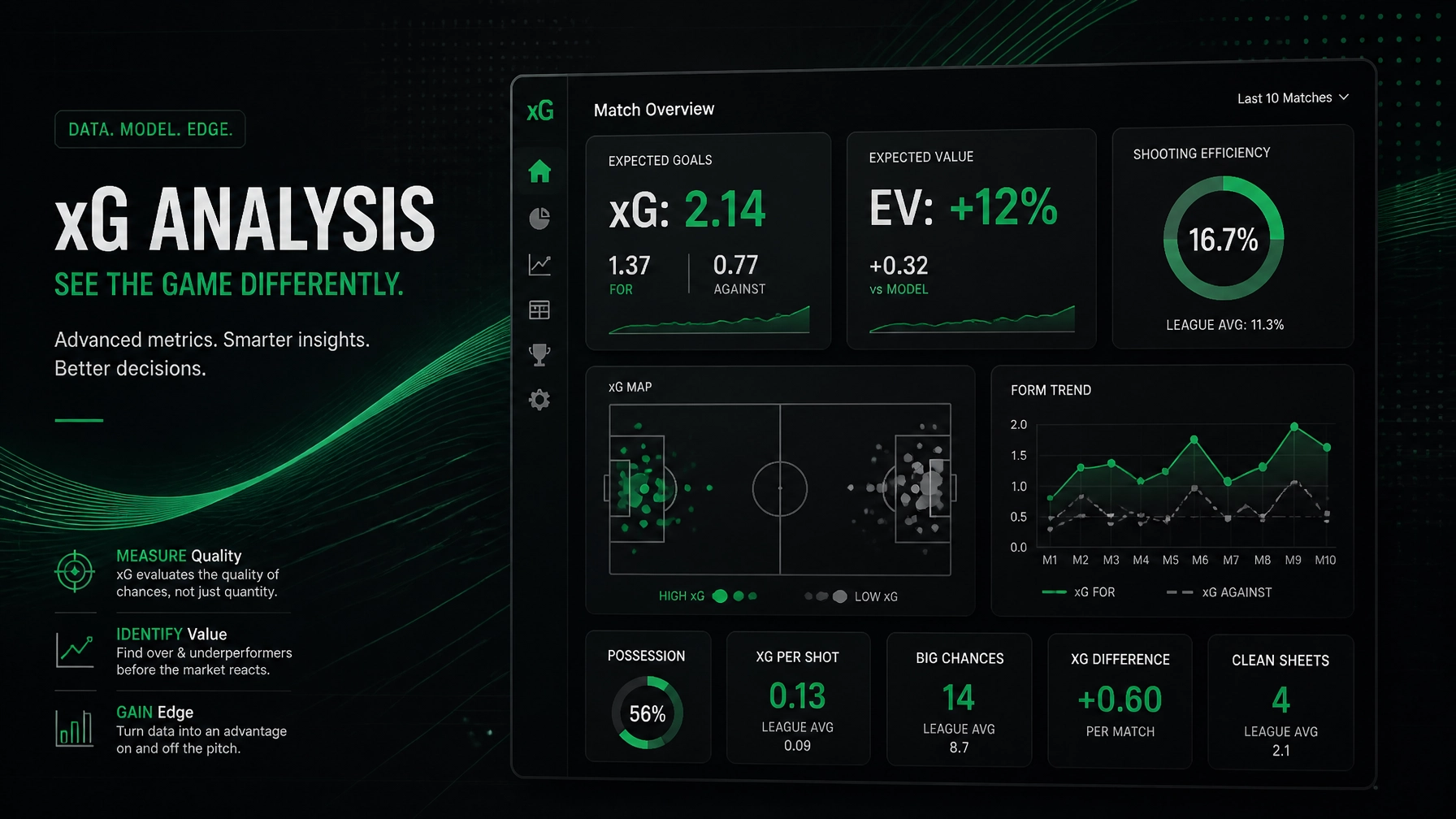
Expected Goals (xG) has transformed from a niche metric used by data nerds into a staple of every football broadcast. But here’s the problem: most bettors are using it like a blunt instrument when they should be using it like a scalpel. If you treat xG as a crystal ball, you’re going to lose money. If you treat it as a probability framework, you start to find an edge.
At Gecko Edge, we see thousands of matches analysed by our AI every week. We’ve noticed a pattern in how even “smart” bettors trip themselves up with xG.
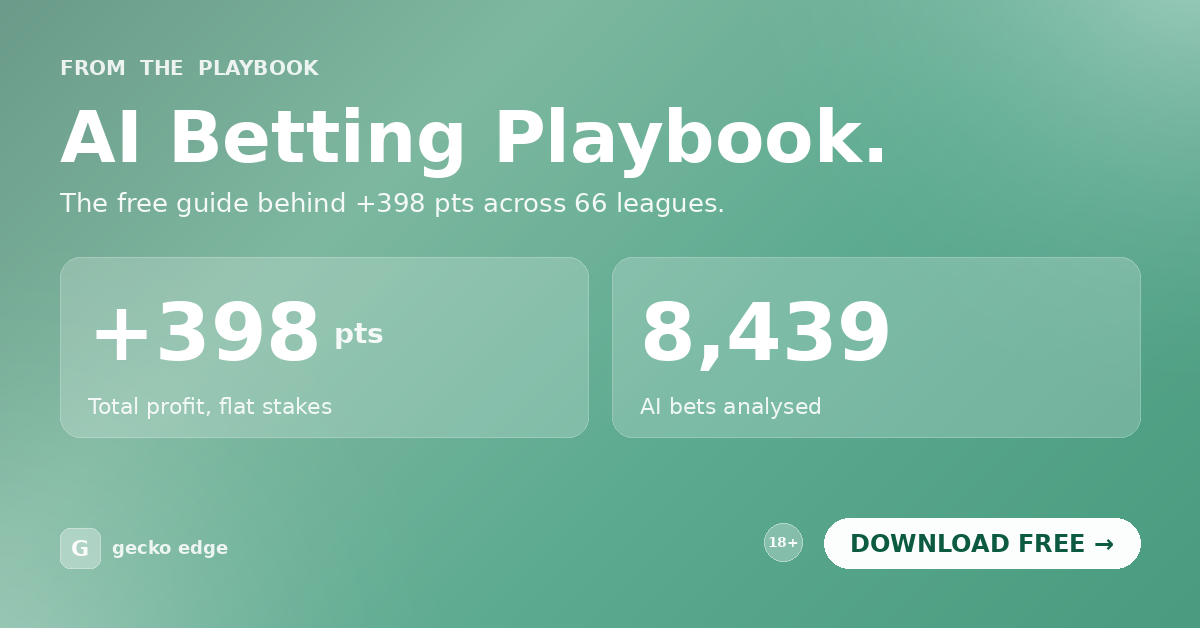
Gecko Edge has tracked 8,439 AI-generated bets and recorded +398pts of profit across 66 competitions. See how the model works →
Here are the 7 most common mistakes people make with xG analysis: and, more importantly, how to fix them.
1. The Trap of the Single-Game Sample
The most common error is overreacting to a single match. You see a team create a mountain of chances but fail to score, and you immediately assume they are “due” a goal-fest in their next game.
xG is a measure of probability over time. A single game is full of noise: a freak goal-line clearance, a slippery pitch, or a world-class save can skew the outcome entirely. If you upgrade a team’s rating based on one outlier performance, you’re chasing variance, not value.
The Fix: Stop looking at single-game xG in isolation. Instead, look at rolling 5-match or 10-match averages. This smooths out the “luck” and shows you the actual trend of a team’s attacking and defensive efficiency.

2. Ignoring the “Game State” Context
Most public xG models are “context-blind.” They count a shot at 0-0 the same way they count a shot when a team is 3-0 down in the 85th minute.
When a team is trailing late in the game, they often throw men forward, leading to a flurry of low-quality shots. This pads their xG, making them look dominant on paper when they were actually desperate. Conversely, a team leading 2-0 might stop attacking entirely, making their underlying numbers look weaker than they actually are.
The Fix: Use a model that understands context. Gecko Edge’s AI is built to recognise how game state affects performance. We look at when the chances were created and why. If you’re betting in-play, you need to know if that 1.5 xG was built during a period of genuine dominance or during “garbage time.” For more on this, check out our guide on how to spot value when the odds overreact.
3. Confusing Shot Volume with Shot Quality
Not all 0.10 xG chances are created equal. A team that takes 20 speculative shots from 30 yards might end up with the same xG as a team that has two tap-ins from three yards.
Beginner bettors often fall for “High Volume” teams. They see a team with 25 shots and think they are attacking powerhouses. In reality, they might just be inefficient. Bookmakers love “High Volume” traps because the public tends to overprice them.
The Fix: Look deeper into shot locations. A team consistently creating “big chances” (shots with an xG of 0.30+) is far more dangerous than one that relies on long-range efforts. We’ve written extensively about why high-frequency shooters can be value traps if you want to dive deeper.

4. Treating xG as a Score Predictor
xG is not a scoreline; it’s a probability distribution. If a match ends with an xG of 1.4 to 1.1, it doesn’t mean the “fair” result was a 1-1 draw. It means that, if played 10,000 times, the most frequent outcomes would cluster around those numbers: but thousands of those simulations would end 2-0, 0-1, or 3-2.
If you only bet on teams with “better” xG than their opponents, you aren’t necessarily finding value. You’re just betting on the favourite.
The Fix: Pivot your thinking from “who has more xG?” to “what is the Expected Value (EV)?” Value is the gap between the probability suggested by the data and the odds offered by the bookie. If the market has already priced in a team’s high xG, there is no bet. Gecko Edge focuses on the anatomy of a value bet, helping you find the gaps the market missed.
5. Mixing Your Data Sources
If you use xG from one website for the Premier League and another for the Championship, you’re making a tactical error. Every xG model is built differently. Some account for defender positioning; others only look at shot distance. Some use Opta data; others use Wyscout or StatsBomb.
If you mix them, your analysis becomes inconsistent. A 0.5 chance on one site might be a 0.3 on another.
The Fix: Pick one high-quality, AI-driven source and stick to it. Consistency is the foundation of any profitable betting strategy. At Gecko Edge, we provide a unified analysis across hundreds of leagues, ensuring your data is comparable whether you’re looking at the Premier League or the Japanese J2 League.
6. Neglecting Defensive Pressure
A massive flaw in basic xG models is that they don’t always know where the defenders are. A shot from the penalty spot is worth a certain amount, but that value changes drastically if there are four defenders and a goalkeeper in the way versus an open goal.
This is why some teams seem to “overperform” their defensive xG for years (like Sean Dyche-era Burnley). They weren’t just lucky; they were excellent at forcing opponents into taking “pressured” shots that the models overrated.
The Fix: Use advanced models that incorporate defensive positioning and “pressure” metrics. AI is particularly good at this because it can process the “spatial” data that simple event-based models miss. When you analyse a match with Gecko Edge, our models factor in the defensive context to give you a more accurate picture of chance quality.

7. Betting Without Price Discipline
This is the “pro” mistake. You can be the best xG analyst in the world, but if you don’t care about the price, you will go bust.
If your analysis says Team A has a 50% chance of winning (implied odds of 2.00), but the bookie is offering 1.80, you do not bet. It doesn’t matter how good their xG is. You are paying a premium for a “public” opinion.
The Fix: Always calculate the “Fair Price” before looking at the bookie’s odds. Use tools like Asian Handicaps to find better margins and manage your risk. If you’re new to this, our guide on Asian Handicaps decoded will show you how to protect your bankroll while chasing value.

Summary: Smarter Betting Starts with Context
xG is a brilliant tool, but it’s just one part of the puzzle. To truly beat the bookies, you need to combine it with real-time intelligence, market awareness, and an understanding of game dynamics.
Stop treating xG as the answer and start treating it as the question. Why did they have high xG? Was it repeatable? Was it priced correctly?
At Gecko Edge, we’ve built the tools to help you answer those questions instantly. We don’t just give you stats; we give you an edge.
Ready to move beyond basic tips? Analyse your next match with Gecko Edge.
{“@type”:”BlogPosting”,”about”:[{“name”:”Expected Goals (xG)”,”@type”:”Thing”},{“name”:”Football Betting Analysis”,”@type”:”Thing”},{“name”:”Artificial Intelligence”,”@type”:”Thing”}],”howTo”:[{“text”:”Stop overreacting to single-game xG and use rolling averages.”,”@type”:”HowToStep”},{“text”:”Adjust your analysis for game state (leading vs. trailing).”,”@type”:”HowToStep”},{“text”:”Differentiate between shot volume and shot quality.”,”@type”:”HowToStep”},{“text”:”Focus on Expected Value (EV) rather than just xG totals.”,”@type”:”HowToStep”}],”image”:”https://cdn.marblism.com/4MMGC33mRAN.webp”,”author”:{“name”:”Gecko Edge”,”@type”:”Organization”},”@context”:”https://schema.org”,”headline”:”7 Mistakes You’re Making with xG Football Analysis (And How to Fix Them)”,”publisher”:{“logo”:{“url”:”https://geckoedge.ai/logo.png”,”@type”:”ImageObject”},”name”:”Gecko Edge”,”@type”:”Organization”},”description”:”Learn the most common mistakes bettors make with Expected Goals (xG) and how to use AI-driven context to find real value in football betting.”,”datePublished”:”2026-06-26″,”mainEntityOfPage”:{“@id”:”https://geckoedge.ai/7-xg-mistakes-football-analysis”,”@type”:”WebPage”}}