Standard Expected Goals xG models have changed the way we look at football. Most bettors now understand that a shot from the edge of the box is less likely to go in than a tap-in from the six-yard line. We have moved past the era of simply counting “shots on target.”
But there is a problem. Most public xG models treat every pitch as an identical laboratory and every player as a perfectly rested machine. In the real world, a pitch in the Premier League can be significantly wider than one in the Championship, and a team returning from a mid-week European fixture in Baku is not the same team that played on Saturday.
At Gecko Edge, we believe that the next frontier of predictive modelling lies in these “hidden” variables. If you want to find true value in the market, you have to look where the crowd isn’t looking.
Gecko Edge has tracked 8,439 AI-generated bets and recorded +398pts of profit across 66 competitions. See how the model works →
Size Matters: How Pitch Dimensions Alter the Game
In most sports, the field of play is a fixed constant. In football, there is a surprising amount of leeway. FIFA’s regulations allow for a range of lengths and widths, and while the elite leagues try to standardise, subtle differences remain.
A narrow pitch changes the geometry of the attack. It forces play into the central corridors, making it easier for a well-organised defensive block to sit deep and frustrate an opponent. Conversely, a wide pitch stretches the horizontal distance between defenders. It creates gaps for “half-space” runs and gives wingers more room to isolate full-backs.

When we analyse xG through the lens of Gecko Edge AI, we see that the probability of a high-value chance being created changes based on the available space. A team built for crossing: like a classic Sean Dyche side: will naturally find more “quality” opportunities on a wider pitch where their wingers have time to pick out a delivery. On a cramped pitch, those same crossing opportunities are often blocked or rushed, lowering the actual xG of the attempt.
Most models ignore this. They see a cross from the same coordinate and assign it the same value. Our AI differentiates. It understands that the “environmental” context of the pitch is just as important as the location of the ball.
The Width Factor in Defensive Resilience
A narrow pitch is a defender’s best friend. It reduces the area they need to cover. When we look at underdog teams playing at home on smaller pitches, their “Expected Goals Against” often over-performs the reality. The AI at Gecko Edge identifies these discrepancies, spotting when a favourite is likely to struggle to break down a compact unit simply because the “geometry of the game” has shifted against them.
The Logistics of Exhaustion: Factoring in Travel Fatigue
We often hear pundits talk about “heavy legs,” but how do you quantify that? Standard statistics don’t have a column for “hours spent on a plane” or “circadian rhythm disruption.”
Travel fatigue is one of the most undervalued factors in the betting market. It isn’t just about the physical distance covered; it’s about the recovery window. A team playing on a Sunday after a Thursday night game in Eastern Europe is operating at a deficit.

The impact of this fatigue shows up in the data in subtle ways:
- Reduced Pressing Intensity: A tired team cannot maintain a high line or a high-intensity press. This allows the opposition more time on the ball in dangerous areas.
- Slower Defensive Transitions: Recovery runs become slower in the final 20 minutes, leading to an increase in high-quality chances conceded late in the game.
- Decision-Making Errors: Physical fatigue leads to mental fatigue. Pass completion rates drop, and mistimed tackles rise.
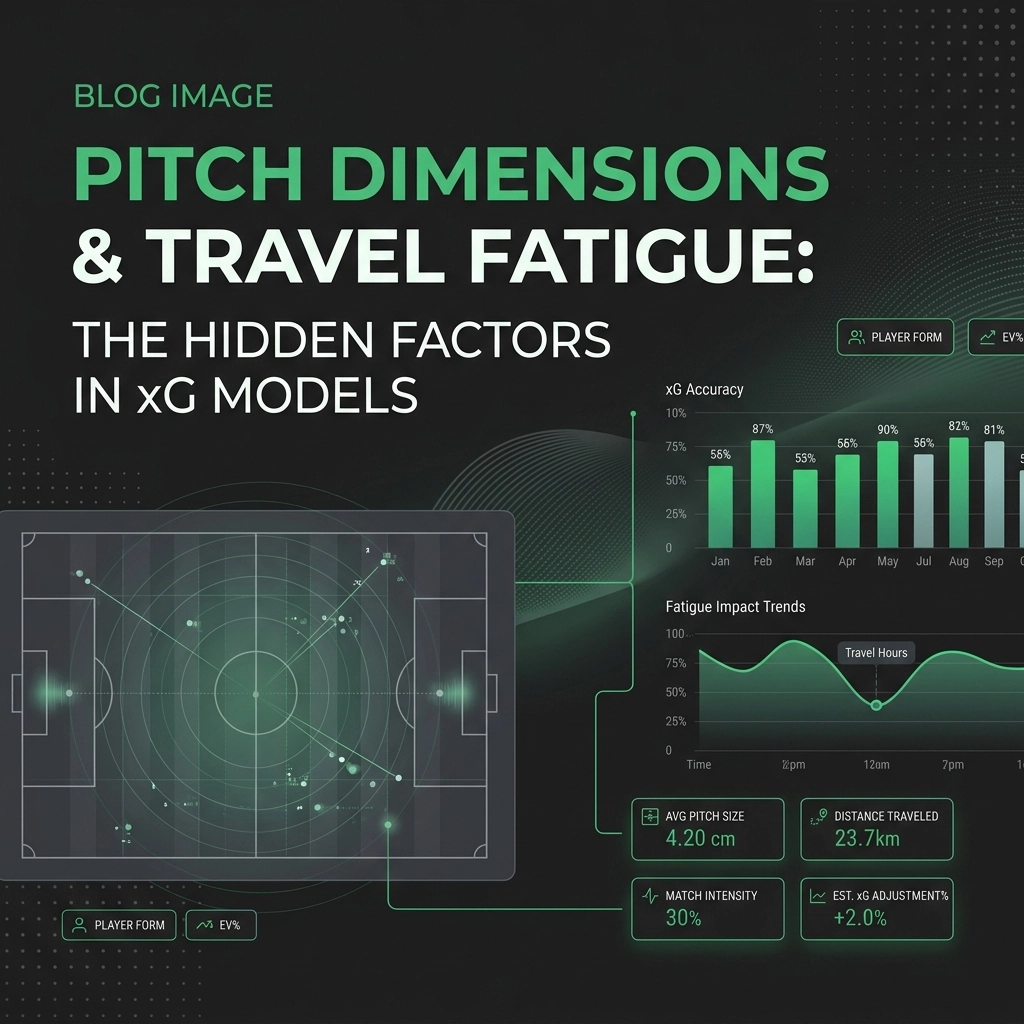
Gecko Edge uses machine learning to track these patterns across thousands of matches. Our models don’t just look at the schedule; they look at the output of teams in similar fatigue states. By correlating travel distance and rest days with performance metrics like “Sprints per 90” and “Defensive Duel Success Rate,” we can adjust the projected xG for a match with far greater precision than a human trader ever could.
The Thursday-Sunday Effect
The “Europa League Hangover” is a known phenomenon, but the market often over-corrects or under-corrects for it. By using AI-driven insights, we can see exactly which squads have the depth to rotate and which ones are likely to see their performance floor drop out. It’s about more than just the result; it’s about how the quality of the chances they create and concede changes under pressure.
Beyond Shot Location: The Gecko Edge Approach
If you are still betting based on the basic xG numbers you find on a free app, you are essentially using yesterday’s tools. The market is efficient, and it has already priced in basic shot data.
To find the edge: the Gecko Edge: you need to integrate variables that are difficult to scrape and even harder to interpret. This is where AI shines. A human can’t manually calculate the wind speed, pitch width, and travel miles for every player in the starting XI. An AI can do it in milliseconds.

We focus on “Contextual xG.” This is our way of saying that a shot doesn’t exist in a vacuum. It is the result of a physical environment (the pitch) and the physical state of the players involved (fatigue). When our AI flags a discrepancy between the “market xG” and our “Contextual xG,” we know we’ve found a potential opportunity.
Data Synergy and Predictive Power
The real magic happens when these factors combine. Imagine a team that relies on high-speed transitions, playing on a large pitch (requiring more running) only three days after a long-haul flight. The data suggests their performance won’t just dip: it will likely crater in the second half.
Predicting these “performance cliffs” is what separates professional traders from hobbyists. You can learn more about how we apply these complex data sets by visiting our AI Betting Education section.
Practical Application for Traders
How do you use this information? It starts with a shift in mindset. Instead of asking “Who is the better team?”, ask “Which team is better suited to this environment today?”
- Check the Pitch: Before placing a bet, look at the home team’s pitch dimensions. Are they an outlier?
- Audit the Schedule: Don’t just look at the last result. Look at the travel log. How many miles have they covered in the last 10 days?
- Monitor In-Play Fatigue: If you are using AI In-Play Betting tools, watch for a drop in pressing intensity around the 60th minute. This is often the “fatigue wall” hitting home.
At Gecko Edge, we provide the tools to make these observations actionable. We don’t believe in “sure things,” but we do believe in the compounding power of better information.
Smarter Betting Starts Here
The goal of any model is to reduce uncertainty. By factoring in pitch dimensions and travel fatigue, we remove two of the biggest “unknowns” that plague traditional xG models.
Football is a game of fine margins. A pitch that is five metres wider or a flight that is three hours longer can be the difference between a winning bet and a losing one. Our job is to make sure you are on the right side of those margins.
Built for bettors, powered by AI, Gecko Edge is here to help you see the game with total clarity. If you’re ready to move beyond the basics, check out our latest Case Studies to see these principles in action.
Ask the right questions. Analyse the hidden data. Act with confidence. That is the way of the professional bettor.