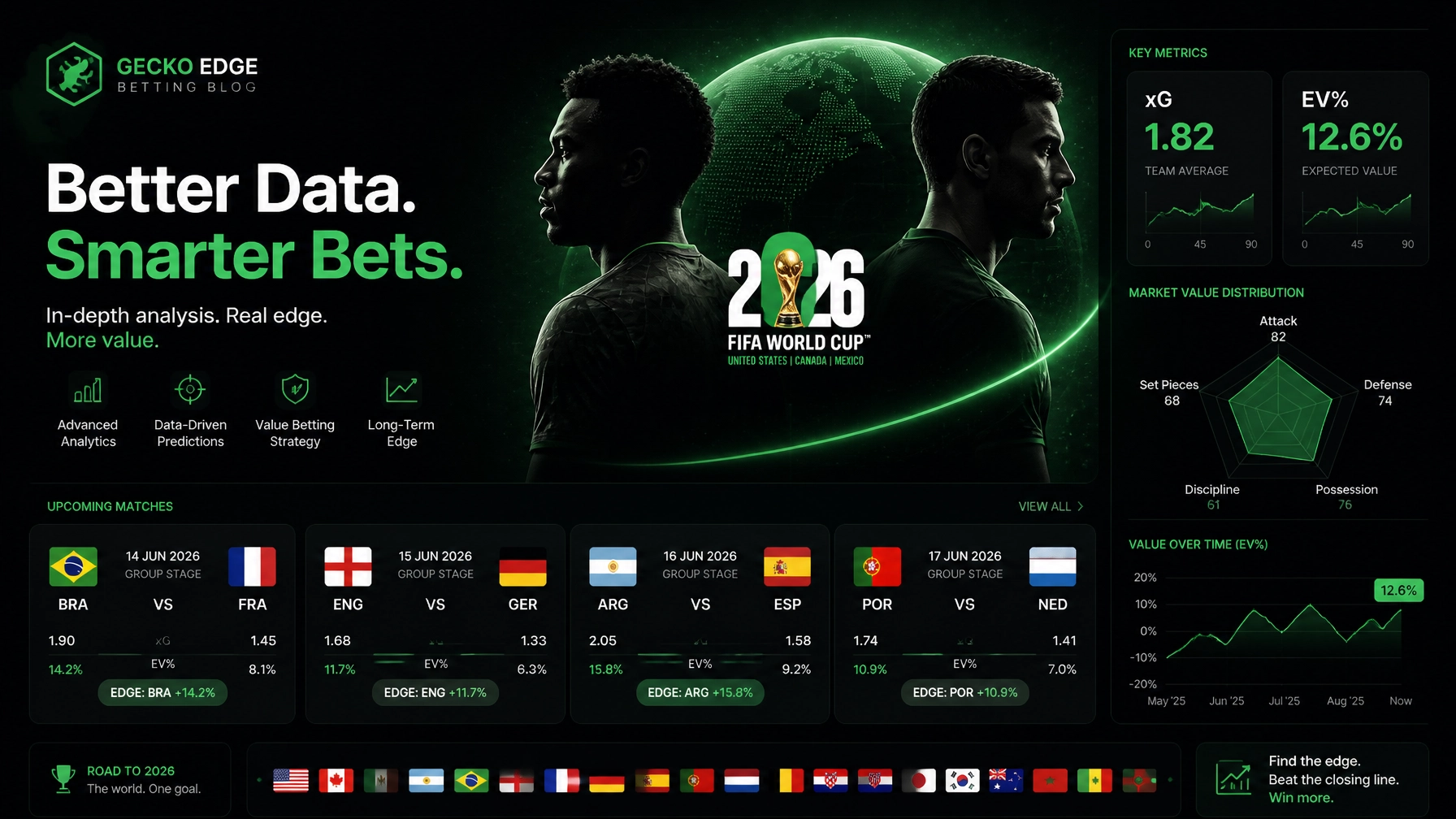
The 2026 World Cup is shaping up to be a data scientist’s dream and a casual bettor’s nightmare. We are seeing a tournament where goals are significantly outperforming expected goals (xG). In the early stages, we’ve tracked a surplus of nearly +19 goals relative to what the quality of chances suggested should have hit the back of the net.
When finishing is this “hot,” traditional intuition often fails. You see a high-scoring game and think the next one will be the same. But as a seasoned bettor, you know that’s exactly when the market becomes its most volatile. To find a consistent edge, you need to decide where to park your bankroll: the crowd-favourite Both Teams to Score (BTTS) market, or the precision-engineered Asian Handicap (AH).
At Gecko Edge, we spend our days analysing these nuances. If you want to move beyond gut feelings and treat this tournament like a professional trader, you need to understand which market suits the 2026 data landscape better.
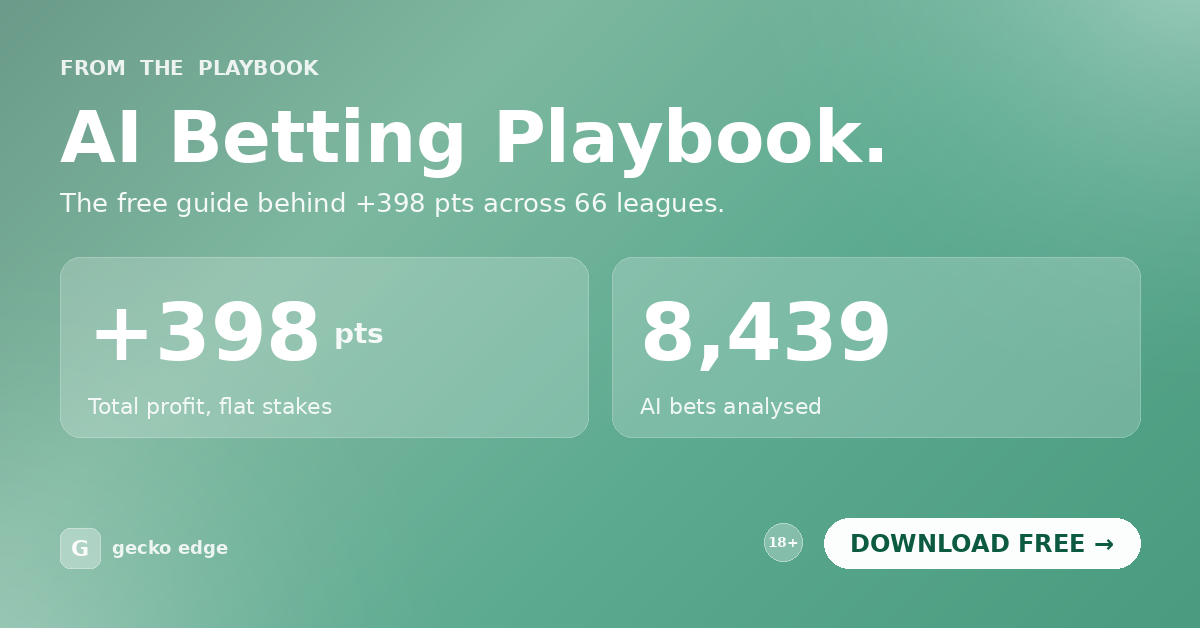
Gecko Edge has tracked 8,439 AI-generated bets and recorded +398pts of profit across 66 competitions. See how the model works →
The BTTS Market: Riding the Goal Wave
Both Teams to Score is arguably the most popular “fun” bet. You don’t care who wins, you don’t care about the margin; you just want to see both goalkeepers beaten. But in a high-variance tournament like the World Cup, “fun” can quickly become expensive if you aren’t backed by data.
When BTTS Makes Sense
In the 2026 context, we are seeing specific teams overperform their xG significantly. When you have two teams with high-octane transitional play and shaky defensive records, BTTS is a viable tool.
According to our AI Betting Playbook, you should look for “Double-Green” signals:
- Sustained xG Creation: Both teams consistently generating ≥ 1.1 non-penalty xG per 90.
- Defensive Fragility: Both sides conceding a high volume of high-quality chances (xGA ≈ 0.9+).
- Finishing Trends: Teams with forwards currently in “God mode,” outperforming their individual xG.
The Trap
The danger with BTTS in 2026 is the “regression to the mean.” When the tournament average is +19 goals over xG, the markets start to overprice the “Yes” outcome. If you are betting BTTS on a match where both teams have been lucky rather than clinical, you are buying at the top of the market. This is where Gecko Edge helps you filter the noise from the signal.

Asian Handicap: The Professional’s Precision Tool
If BTTS is a blunt instrument, the Asian Handicap is a scalpel. It removes the draw and forces you to think about relative performance. In a tournament that has already seen a historic number of draws in the opening rounds, the Asian Handicap is often the only way to find true value.
Why the Pros Favour AH
Asian Handicap allows you to monetise your xG analysis much more effectively than BTTS. While BTTS only cares about the occurrence of goals, AH cares about the dominance of play.
For example, if a heavy favourite is underperforming their results but overperforming their xG (the “unlucky” elite), the AH -0.75 or -1.25 lines often offer massive value. The public sees a team that “can’t score,” but Gecko Edge sees a team that is creating 2.5 xG per game and is due for a massive breakout.
Exploiting the “Draw Heavy” 2026 Trend
With many 2026 matches being cagey affairs, lines like +0.25 or +0.75 on compact, defensively sound underdogs have been goldmines. These lines give you a “half-win” even if the game ends in a draw, protecting your stake while you exploit the bookmaker’s over-reliance on the favourite’s reputation.
The Head-to-Head: Strategy Comparison
Choosing between these two isn’t about which market is “better” in a vacuum; it’s about which one fits the match profile.
| Feature | BTTS Strategy | Asian Handicap Strategy |
|---|---|---|
| Primary Metric | Combined xG / Finishing Form | xG Differential / Tactical Matchup |
| Risk Profile | Binary (Yes/No) | Scalable (Half-wins/Half-losses) |
| Market Efficiency | Often overpriced in high-scoring runs | Highly efficient, requires sharp AI |
| Best For… | Chaotic, transition-heavy games | Tactical battles and mispriced favourites |

Using xG to Decide
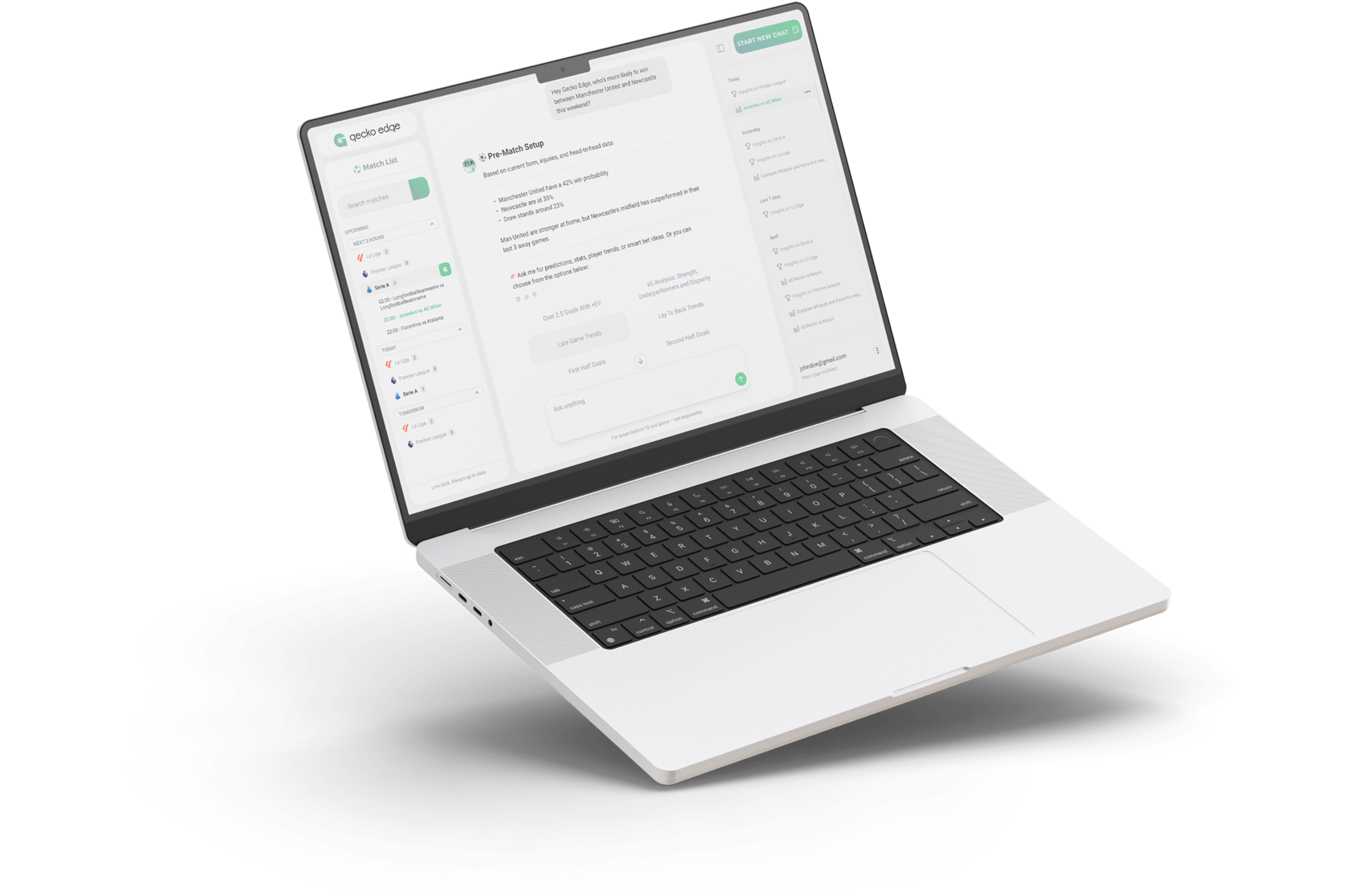
When you use the Gecko Edge platform, you’ll notice we provide an “Edge Score” for multiple markets. Here is how you should interpret them for the 2026 World Cup:
- Lean BTTS when both teams have a high “Shot Quality” metric but a low “Clean Sheet Probability.” If the game is expected to be a basketball-style end-to-end affair, don’t worry about who wins: just bet on the chaos.
- Lean Asian Handicap when there is a clear mismatch in “Control Metrics.” If one team averages 60% possession and creates 2.0 xG while conceding only 0.5, but the market is only giving them a -0.5 handicap because of a recent 0-0 draw, that is your entry point.
For more on these terms, check out our Betting Glossary.
Why AI is Mandatory for 2026
The sheer volume of matches in the 2026 World Cup makes manual analysis impossible. You cannot possibly track the fatigue levels, xG trends, and in-play momentum shifts for 48 teams across three countries.
Gecko Edge was built for bettors, powered by AI. Our models don’t just look at who scored; they look at how they scored. Did the goal come from a 0.02 xG worldie, or a 0.85 xG tap-in? Understanding this distinction is the difference between chasing a fluke and backing a trend.
Our context-aware AI also understands the nuance of the tournament stage. A group-stage match in the heat of Monterrey requires a different analytical lens than a knockout match in the rain of Seattle. We factor in travel distances, humidity, and even the “desperation index” (how much a team needs a win based on the live table).

The Verdict: Which is Better?
If you forced me to pick one for the 2026 World Cup, I would tell you that Asian Handicap is the professional’s primary market. It is more stable, it allows for better bankroll management through split-ball lines (+0.25, -0.75), and it more accurately reflects the underlying performance data we see at Gecko Edge.
However, BTTS is your opportunistic secondary market. It’s perfect for those matches where the tactical setup suggests a “defence-optional” approach. When our AI flags two transition-heavy teams playing in high-altitude venues, BTTS is often the smartest play on the board.
The key is to stop guessing. The bookmakers have better algorithms than your gut: but they don’t necessarily have better algorithms than Gecko Edge. We give you the tools to spot value when the odds overreact, whether that’s in the BTTS market or the Asian Handicap.
Smarter betting starts with better data. Are you ready to refine your edge?
Meta Title: BTTS vs Asian Handicap: 2026 World Cup Betting Strategy
Meta Description: Discover whether BTTS or Asian Handicap is better for your 2026 World Cup strategy. Learn how to use xG data and Gecko Edge AI to find a betting edge.
Meta Keywords: 2026 World Cup betting, BTTS strategy, Asian Handicap vs BTTS, xG football analysis, football betting AI, Gecko Edge, sports trading.
{“@type”:”BlogPosting”,”image”:”https://cdn.marblism.com/9XOEmPm8KFM.webp”,”author”:{“name”:”Gecko Edge”,”@type”:”Organization”},”@context”:”https://schema.org”,”headline”:”BTTS vs. Asian Handicap: Which Is Better for Your 2026 World Cup Strategy?”,”publisher”:{“logo”:{“url”:”https://geckoedge.ai/logo.png”,”@type”:”ImageObject”},”name”:”Gecko Edge”,”@type”:”Organization”},”articleBody”:”The 2026 World Cup is shaping up to be a data scientist’s dream and a casual bettor’s nightmare. We are seeing a tournament where goals are significantly outperforming expected goals (xG)…”,”description”:”A deep dive into the strategic differences between BTTS and Asian Handicap markets for the 2026 World Cup, powered by xG data and AI analysis.”,”datePublished”:”2026-06-26″,”mainEntityOfPage”:{“@id”:”https://geckoedge.ai/blog/btts-vs-asian-handicap-2026-world-cup-strategy”,”@type”:”WebPage”}}