For a long time, set pieces were the “dirty secret” of football. Pundits called them a distraction from “proper” football, and bettors often viewed them as chaotic, unrepeatable events: noise in an otherwise clean open-play signal.
But in the 2025/26 season, the noise has become the signal.
The maths of dead ball situations is no longer a niche hobby for tactical nerds; it is the cornerstone of modern match analysis. At Gecko Edge, we’ve watched the data evolve. While open-play xG (Expected Goals) often steals the headlines, the real value for a disciplined bettor often lies in the “frozen moments”: the corners, the free-kicks, and the long throws that decide matches when the open-play flow is stifled.
Gecko Edge has tracked 8,439 AI-generated bets and recorded +398pts of profit across 66 competitions. See how the model works →
The 25% Rule: Why 2026 is the Year of Set Pieces
The numbers for the current season are startling. Historically, non-penalty set pieces accounted for about 20% of all goals in the Premier League. However, data from the 2025/26 campaign shows a sharp jump to 25.4%. In some samples, that number reaches as high as 28.3%.
Why the sudden surge? It isn’t just about better headers; it’s about better maths. Clubs like Arsenal and Newcastle have moved beyond “getting it in the mixer.” They treat every corner like a laboratory experiment.

When you look at teams like Newcastle, where nearly 37% of their non-penalty goals come from set pieces, you realise that traditional betting models are missing a massive piece of the puzzle. If you are only looking at shots from open play, you are ignoring over a third of their scoring threat. This is where Gecko Edge steps in to bridge the gap between “standard stats” and “winning insights.”
Breaking Down the SPxG Model
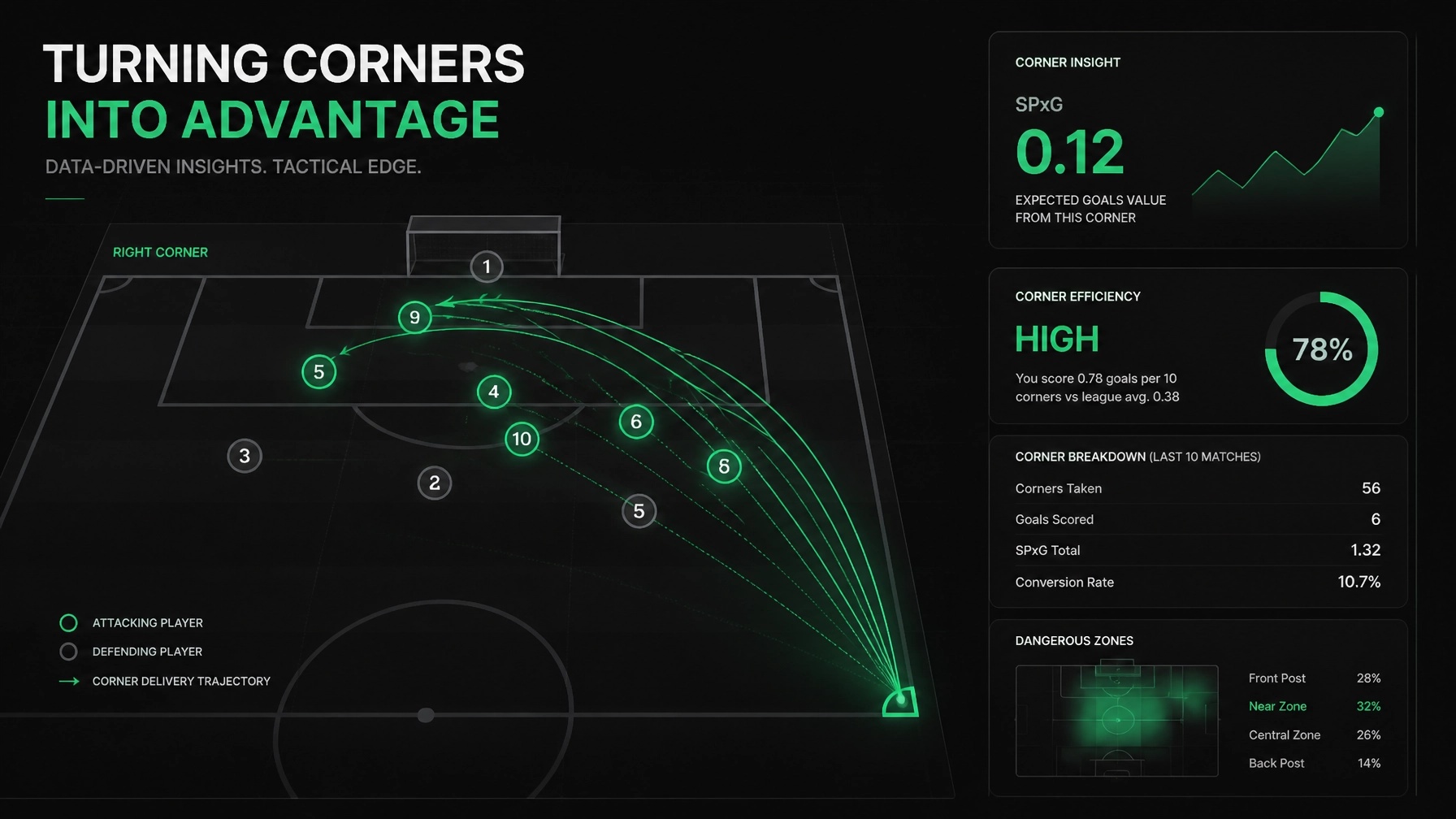
To bet smarter, you have to understand how we model these situations. At Gecko Edge, we don’t just count corners; we calculate SPxG (Set-Piece Expected Goals).
Standard xG gives a shot a value between 0 and 1. A penalty is roughly 0.76 xG. A typical header after a cross is about 0.10 xG. But set-piece maths is more complex because it’s a multi-stage process:
- The Delivery Probability: Is the ball landing in the “danger zone”?
- The Shot-from-Set-Piece Rate: How often does a team turn a dead ball into a strike? (Liverpool, for example, converts roughly 8.7% of corners into shots).
- The Second-Ball Retention: If the first header is cleared, who wins the rebound?
By treating set pieces as a “sub-model,” our AI can estimate the probability of an “unlikely” goal. We look at the mismatch between a team’s aerial dominance and an opponent’s history of conceding high-xG chances from corners. When a team with high SPxG_for meets a team with high SPxG_against, the market often lags behind the true probability of a goal.
Chaos vs. Context: The Gecko Edge Advantage
Most data providers give you the “what”: the number of corners or the total xG. But Gecko Edge gives you the “why.”
Football is chaotic. A corner involves 20 players in a 10-yard space. Traditional statisticians might call it a coin flip. We call it a context problem. Our AI understands that a corner taken in the 88th minute when a team is down by one has a different “urgency weight” than a corner in the 10th minute.

Our context-aware models look at:
- The Taker: Does the delivery change when a specific specialist is on the pitch?
- The Blockers: Is the team using “screens” to prevent the keeper from coming for the ball?
- The Market Trend: Are bettors overvaluing a team like Manchester City (who actually have low set-piece reliance) while ignoring the value in a team like Tottenham?
By integrating these nuances, we help you find the EV (Expected Value) in markets that the bookies often price using generic league averages.
Market Inefficiencies: Where the Value Hides
The most common mistake bettors make is assuming that “good teams score set pieces.” The data says otherwise.
Look at Manchester City. In the 2025/26 season, only 10.7% of their goals came from non-penalty set pieces. They dominate through open play. If you’re betting on City to score from a header, you’re likely overpaying for the privilege.
Conversely, teams like Crystal Palace or Bournemouth use set pieces as a strategic equaliser. They might look mediocre in a standard “shots on target” report, but their SPxG per match is elite. When these teams face a top-four side with a “soft” set-piece record, there is significant value in the Draw No Bet or Asian Handicap markets.
The “Unlikely” Goal: Predicting the Specialist
We often get asked how we predict goals from players who aren’t traditional strikers. It’s about mapping the delivery to the target. If Gecko Edge identifies that a team consistently targets the “far post zone” on outswinging corners, and the opponent has a historical weakness in that specific zone, the “Anytime Scorer” odds for a tall centre-back suddenly look very attractive.
This isn’t guesswork. It’s the AI Betting Playbook in action: turning a seemingly random event into a calculated risk.

Ask, Analyse, Act
The era of the “gut feeling” bettor is over. If you want to find an edge in the modern game, you have to look where others are too lazy to dig. Set pieces are no longer just a break in the action; they are the action.
At Gecko Edge, we’ve built the tools to help you navigate this complexity. We don’t just give you tips; we give you a framework.
- Ask: Which teams are over-performing their open-play xG?
- Analyse: Is that performance driven by sustainable set-piece routines?
- Act: Place your bets with the confidence that you’re backed by the same maths the pros use.
Smarter betting starts here. Don’t leave your strategy to chance: let the maths do the heavy lifting.
SEO Meta Data:
- Meta Title: Set-Piece Supremacy: The Hidden Maths of Dead-Ball Situations | Gecko Edge
- Meta Description: Discover how set-piece efficiency has surged to 25% of all goals in the 2025/26 season. Learn how Gecko Edge uses AI to model SPxG and find hidden betting value.
- Keywords: set-piece xG, football betting analysis, corner efficiency stats, Gecko Edge, dead-ball maths, Premier League 2026 data.
{“@type”:”BlogPosting”,”image”:”https://cdn.marblism.com/S2vOzucpNTY.webp”,”author”:{“name”:”Gecko Edge”,”@type”:”Organization”},”@context”:”https://schema.org”,”headline”:”Set-Piece Supremacy: The Hidden Math of Dead-Ball Situations”,”publisher”:{“logo”:{“url”:”https://geckoedge.ai/logo.png”,”@type”:”ImageObject”},”name”:”Gecko Edge”,”@type”:”Organization”},”articleBody”:”For a long time, set pieces were the ‘dirty secret’ of football… [Full text of the blog post]…”,”description”:”An in-depth look at how set-piece efficiency and SPxG modeling provide a competitive edge in football betting.”,”datePublished”:”2026-06-05″}