Master the final minutes. Learn how Gecko Edge uses AI live data and pressing intensity to predict late goals and find value in the 80+ minute market.
There is a specific kind of silence that falls over a stadium in the 79th minute. It is the moment where strategy often gives way to raw desperation. For the average spectator, it is the most stressful part of the match. For those of us using Gecko Edge, it is where the real work begins.
The final ten minutes of a football match are frequently dismissed as “chaos.” People think goals in this window are purely down to luck or “Fergie Time” spirit. But chaos is just a pattern that we haven’t decoded yet. When you strip away the emotion and look at the live data, the 80+ minute goal is one of the most predictable events in sport.
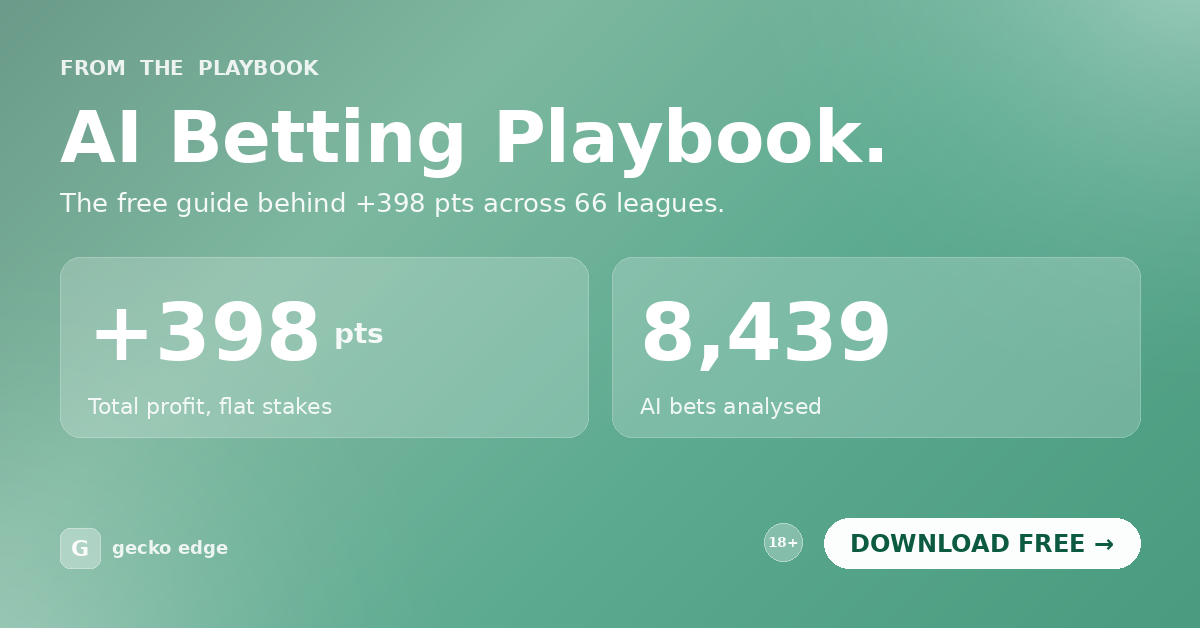
Gecko Edge has tracked 8,439 AI-generated bets and recorded +398pts of profit across 66 competitions. See how the model works →
We don’t guess. We don’t “feel” like a goal is coming. We look for the shift in the data.
The Mathematics of the Final Whistle
To understand why late goal hunting is a viable long-term strategy, we have to look at the numbers. Statistics show that roughly 42.6% of professional matches see at least one goal after the 80th minute. Think about that for a second. In nearly half of all games, the scoreline you see at 79:59 is not the final result.
The market, however, often fails to price this correctly. As the clock ticks toward 90, the odds for an “Over 0.5 Goals” or “Next Goal” market skyrocket. You are often looking at odds of 2.50 or higher for an event that occurs nearly 43% of the time. That is where expected value lives.
At Gecko Edge, we track these shifts in real-time. We aren’t looking for a miracle; we are looking for the point where the bookmaker’s fear of the clock outstrips the reality of what is happening on the pitch.

The Invisible Indicators: What the Eye Misses
Watching a game gives you a narrative. Live data gives you the truth. When we hunt for late goals, we focus on three primary live indicators that suggest a breakthrough is imminent.
1. Pressing Intensity Spikes
Most teams experience a physical drop-off late in the game. However, a team chasing a result will often find a “second wind” or take massive tactical risks. We look for a 15% or higher increase in pressing intensity compared to the match average.
When the defensive line moves ten yards higher and the “Time-to-Touch” for the opposing midfielders drops significantly, the pressure cooker is about to pop. Data suggests that this specific spike in intensity has a 78% correlation with a goal occurring within the next ten minutes.
2. The “Desperation” Metric
At Gecko Edge, we monitor possession not just by percentage, but by location. If a team is maintaining 70% possession but 40% of their touches are in the final third after the 75th minute, they aren’t just keeping the ball; they are sieging the goal.
We also look for “fresh legs” impact. A substitution involving a primary striker or an attacking winger in the 70th-75th minute window often resets the team’s energy levels just as the opposition’s defenders are beginning to cramp.
3. Set-Piece Frequency
Corners and free-kicks in the final ten minutes are high-value events. Tired defenders make mistakes. They stop tracking runs; they pull shirts; they lose their vertical leap. If a team has won three or more corners since the 75th minute, it’s a clear sign of sustained pressure that the xg-stats models will begin to highlight.

Timing Your Entry: The 78-84 Minute Window
In the world of inplay-trading, timing is everything. Entering too early (the 65th minute) means you are paying a premium for time you might not need. Entering too late (the 88th minute) means you are at the mercy of the referee’s whistle and the dreaded “ball out of play” waste.
The “Sweet Spot” is usually between the 78th and 84th minutes.
By this point:
- The odds have usually drifted to a point where the ev-betting profile is attractive.
- The tactical patterns of the final push are established.
- The referee’s likely “added time” is becoming clear based on earlier stoppages.
I always tell my friends: don’t chase the game. Let the data bring the game to you. If the metrics don’t show that intensity spike by the 80th minute, walk away. There will be another match in ten minutes.
How Gecko Edge Simplifies the Hunt
The problem with live betting is information overload. You have the live stream, the Twitter feed, the basic stats on the sportsbook app, and your own nerves. It’s too much.
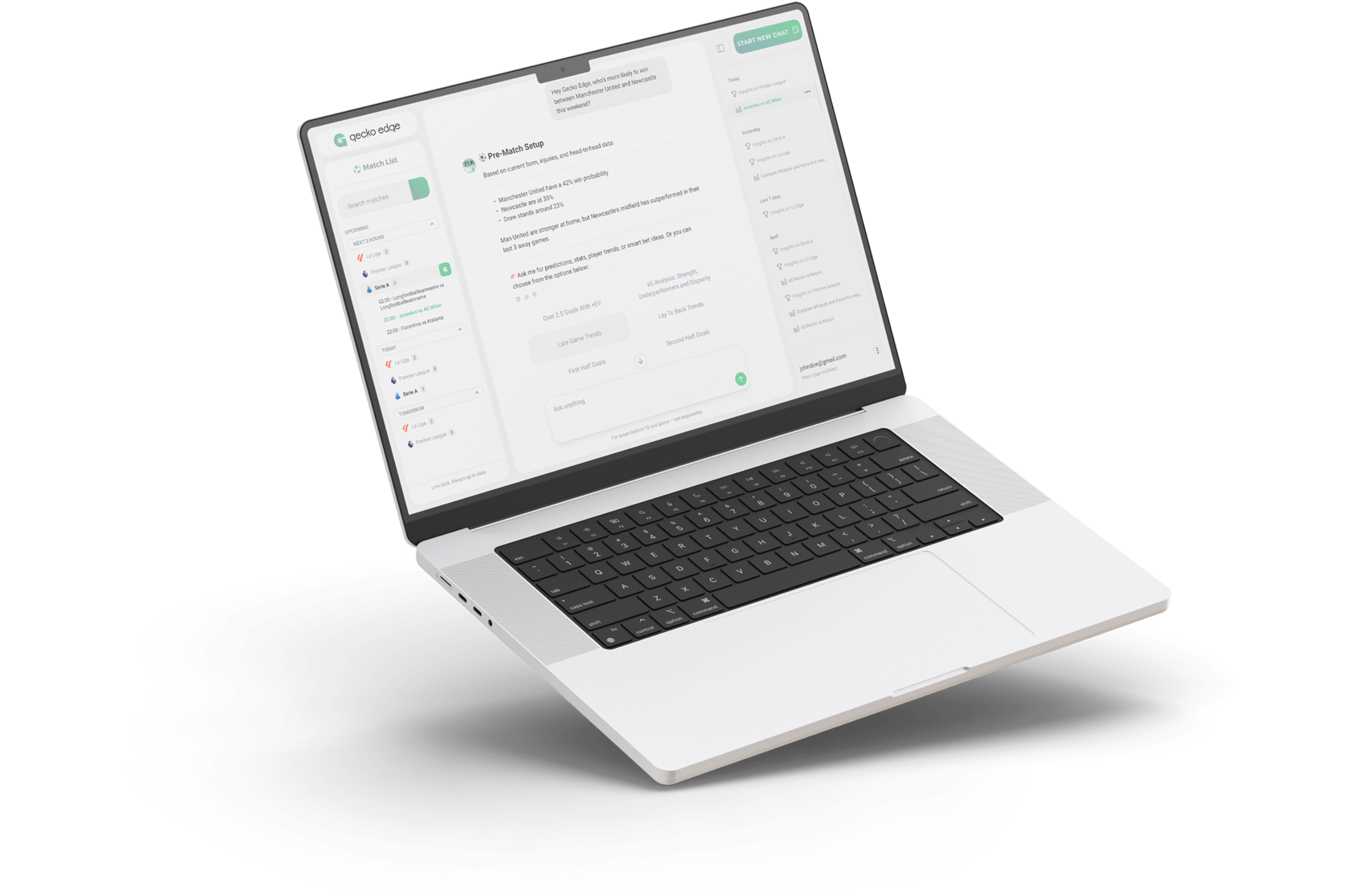
Gecko Edge was built to cut through that noise. Our AI doesn’t get nervous. it doesn’t care about the name of the club or the history of the derby. It only cares about the current flow of play.
Using ai-inplay-betting tools, you can set alerts for these specific late-game conditions. Instead of watching twenty games and hoping for a goal, the system flags the two games where the data suggests a goal is statistically overdue.
Ask the system for the high-pressure games. Analyse the suggested entry point. Act with confidence.

The Psychology of the Late Goal Hunter
To succeed in this niche, you need a specific mindset. You have to be comfortable with the fact that many of your bets will lose in the 94th minute. That is the nature of the beast.
But you aren’t betting on a single game; you are betting on the mathematical reality that a team under extreme pressure, against a tired defence, with high expected-goals metrics, will eventually break through.
When you use ai-football-predictions, you are shifting the odds in your favour over hundreds of matches. You are no longer a gambler; you are a trader managing risk.
Final Thoughts: Smarter Betting Starts Here
Late goal hunting is one of the most exciting ways to engage with football, but without data, it’s just a coin flip. By focusing on pressing intensity, possession location, and set-piece pressure, you turn that coin flip into a calculated edge.
The 80th minute isn’t the beginning of the end. If you’re using Gecko Edge, it’s just the beginning of the profit window.
Stay sharp. Use the data. Trust the process.
For more insights into how we decode the beautiful game, check out our football-betting-secrets or dive into our latest blog posts.
Built For Bettors, Powered By AI.
1 comment