We are officially mid-way through the 2026 World Cup, and if there is one thing this expanded 48-team format has taught us, it’s that the gap between the “elite” and the “rest” has never been smaller. We’ve seen traditional giants struggling to break down disciplined blocks in the heat of Miami and the high altitudes of Mexico City.
For the casual fan, a shock result is an upset. For us, it’s often just the data finally catching up with the market’s outdated perceptions.
The reality is that “favorites” aren’t dead, but the value in backing them almost certainly is. When everyone and their neighbor is piling into Brazil, France, or England, the bookmakers slash the prices until there is zero juice left. To find a real edge in this tournament, you have to look where others are afraid to: at the underdogs.
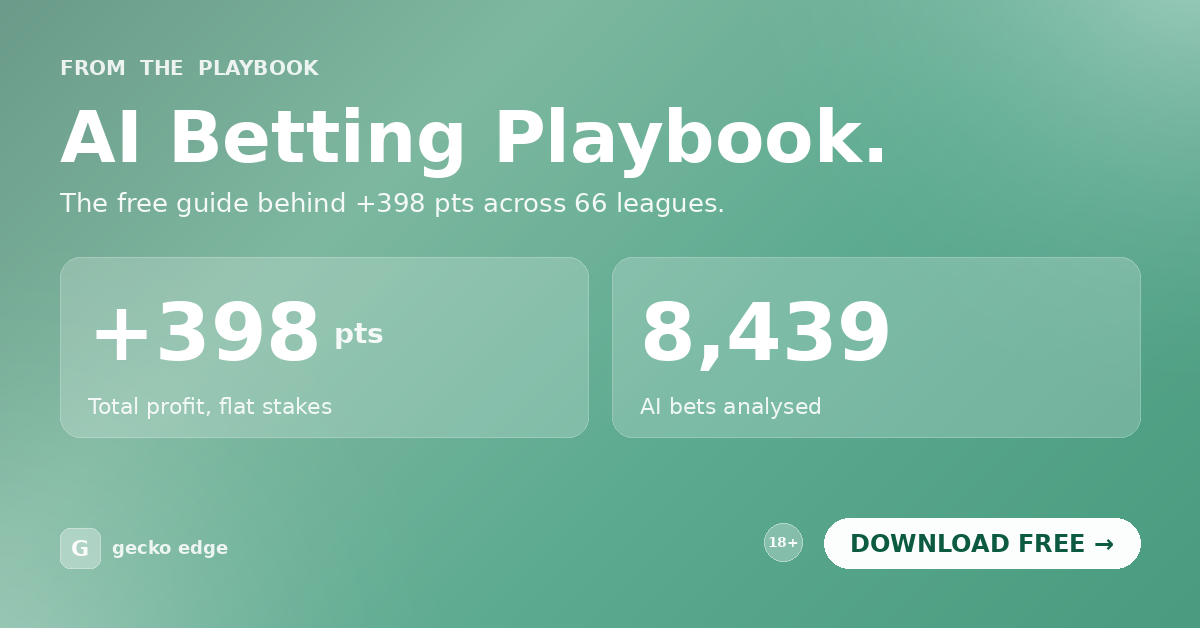
Gecko Edge has tracked 8,439 AI-generated bets and recorded +398pts of profit across 66 competitions. See how the model works →
But how do you separate a genuine “value dog” from a team that’s just destined to lose? At Gecko Edge, we use AI to look past the name on the shirt and focus on the mechanics of the match. Here is how you can do the same.
The “Reputation Tax” and Market Anchoring
The biggest obstacle to profitable betting in international football is what I call the “Reputation Tax”. Markets are heavily anchored to historical success. Because a nation won a trophy in 2018 or 2022, the public assumes they are inherently superior in 2026, regardless of their current form or tactical decline.
In this World Cup, we’ve seen several “elite” squads arriving with aging core players or managers clinging to rigid, predictable systems. Meanwhile, mid-tier nations from AFC and CAF have spent the last four years refining high-press systems and low-block transitions that are specifically designed to frustrate possession-heavy giants.
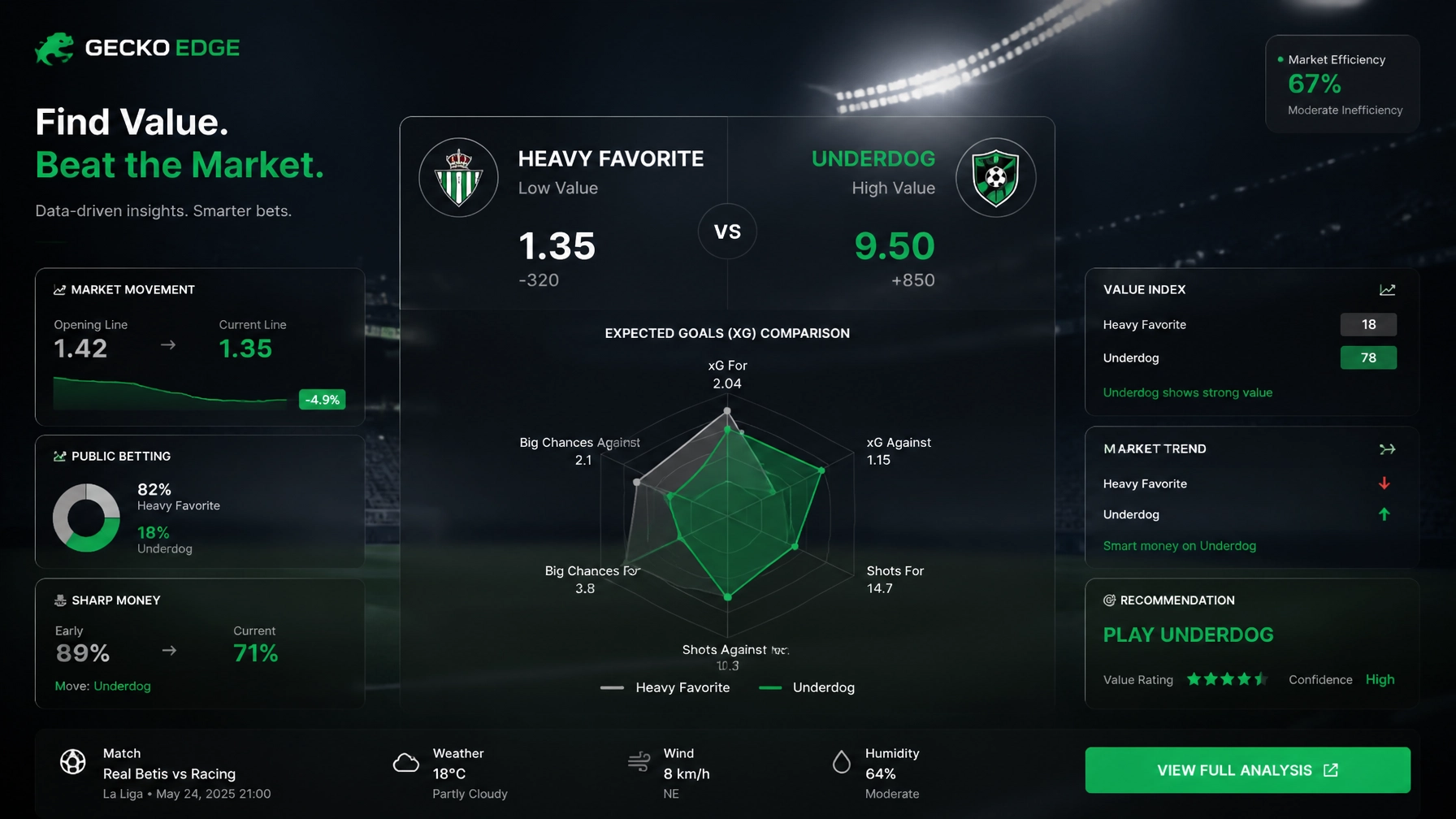
When the market prices a game based on prestige, they create a “value gap”. If a team like South Korea or Morocco has a 30% chance of winning based on their recent xG (Expected Goals) performance, but the odds imply only a 15% chance because they are playing a “big” name, that is where we strike.
Using xG to Spot the “Live” Outsider
To find these opportunities, you need to look at more than just the final score of their last match. You need to analyse the quality of the chances they create and concede.

In tournament football, I look for two specific underdog profiles:
- The Defensive Grinder: These teams have a very low xGA (Expected Goals Against). They don’t care about possession; they care about “box dominance”. They force opponents to take low-quality long shots. If a favorite is struggling to create high-probability chances (0.15 xG or higher per shot), a “Grinder” is a prime candidate for a +1.5 Asian Handicap.
- The High-Variance Counter-Puncher: These teams might concede chances, but they are lethal on the break. They have a high “xG per shot” because when they do attack, it’s usually a 3-on-2 or 2-on-1 situation. These are the teams that cause the massive +500 (6.0) upsets.
By using the Gecko Edge platform, you can see these metrics in real-time. Our AI doesn’t just look at the raw xG; it understands the context. Is the favorite struggling because of the humidity? Is the underdog’s low block holding up under pressure, or are they just getting lucky? This level of insight is what moves you from guesswork to strategy.
Tactical Archetypes: The 2026 Shift
The 2026 World Cup has been defined by tactical discipline. With the travel distances between host cities and the varying climates, physical fatigue is a massive factor. This favors the underdog. A team that sits deep and stays compact uses less energy than a favorite trying to “force” a breakthrough for 90 minutes.
When looking for an underdog to back, ask yourself:
- Do they have a set-piece edge? In tight tournament games, a single corner can be the difference. If an underdog has a high xG from dead-ball situations, they are never truly out of the game.
- How do they handle the “Hydration Breaks”? In the hotter US venues, these breaks act as mini-halftimes. Disciplined underdogs use this time to reset their shape.
- Is the favorite playing “Hero Ball”? If a big team starts relying on individual brilliance rather than team structure, their xG usually plummets while their frustration rises.
Smart Markets: It’s Not Always About the Win
One mistake I see bettors make is thinking they have to pick the underdog to win the match outright. That’s a high-variance play that can burn through your bankroll. Instead, use the markets that give you a safety net.

- Asian Handicap (+1.0, +1.5): This is my bread and butter. If the underdog loses by one goal (at +1.5), you still win. If they draw or win, you win big.
- Double Chance (X2): This covers the draw and the underdog win. In the group stages, where many teams are happy to settle for a point, this is incredibly valuable.
- Team Totals (Over 0.5): Sometimes, you don’t care if the dog loses 4-1, as long as they nick one goal. If the data shows the favorite’s defense is prone to lapses on the counter, backing the underdog to score a single goal is often priced far too high.
The In-Play Advantage with Gecko Edge
The best way to spot a live underdog is to watch the first 15 minutes of the match. Is the favorite’s passing crisp? Are the underdog’s defenders tracking runs efficiently?
Often, the pre-match “value” on an underdog increases ten minutes into the game if the favorite starts strongly but fails to score. The odds on the underdog or the draw will drift, even if the underlying xG shows the game is actually quite balanced.

Our AI Betting Playbook teaches you how to build a system around these live shifts. By combining real-time data with a solid understanding of market psychology, you can act while others are still reacting.
Final Thoughts: Stop Chasing Names
The 2026 World Cup is a data-rich environment. The bookmakers are good, but they are still susceptible to the same biases as the general public. They have to price games to balance their books, which means they often have to offer “too much” on the underdogs because everyone is backing the big names.
If you want to be a professional bettor, you have to be willing to back the “unpopular” side. You have to trust the numbers, respect the context, and have the patience to wait for the right entry point.
Underdogs aren’t just “lucky” teams anymore. In the modern game, they are calculated, data-driven units designed to exploit the arrogance of the elite. With Gecko Edge, you have the tools to see that plan in action before the rest of the world catches on.
Smarter betting starts here. Are you ready to find the edge?
{“@type”:”BlogPosting”,”image”:”https://cdn.marblism.com/_-3jhuTnm9c.webp”,”author”:{“name”:”Gecko Edge”,”@type”:”Organization”},”@context”:”https://schema.org”,”headline”:”Are Favorites Dead? How to Spot High-Value Underdogs in the 2026 World Cup”,”publisher”:{“logo”:{“url”:”https://geckoedge.ai/logo.png”,”@type”:”ImageObject”},”name”:”Gecko Edge”,”@type”:”Organization”},”description”:”Learn how to use AI and xG data to identify high-value underdog betting opportunities in the 2026 World Cup. Move beyond reputation and find the real edge.”,”datePublished”:”2026-06-30″,”mainEntityOfPage”:{“@id”:”https://geckoedge.ai/are-favorites-dead-world-cup-2026-underdogs”,”@type”:”WebPage”}}