The 2026 World Cup is hurtling toward its climax. For bettors, this is the ultimate test of discipline and strategy. By now, everyone is talking about Expected Goals (xG). It’s the metric that was once the secret weapon of professional traders but is now a staple of every television broadcast and social media thread.
But here is the truth: most people are using it wrong.
In a high-stakes tournament like the World Cup, raw data can be a trap. If you are looking at xG in isolation, you aren’t seeing the full picture: you’re seeing a flat reflection of a complex, living game. To find a real edge before the final whistle blows, you need to move beyond the surface.
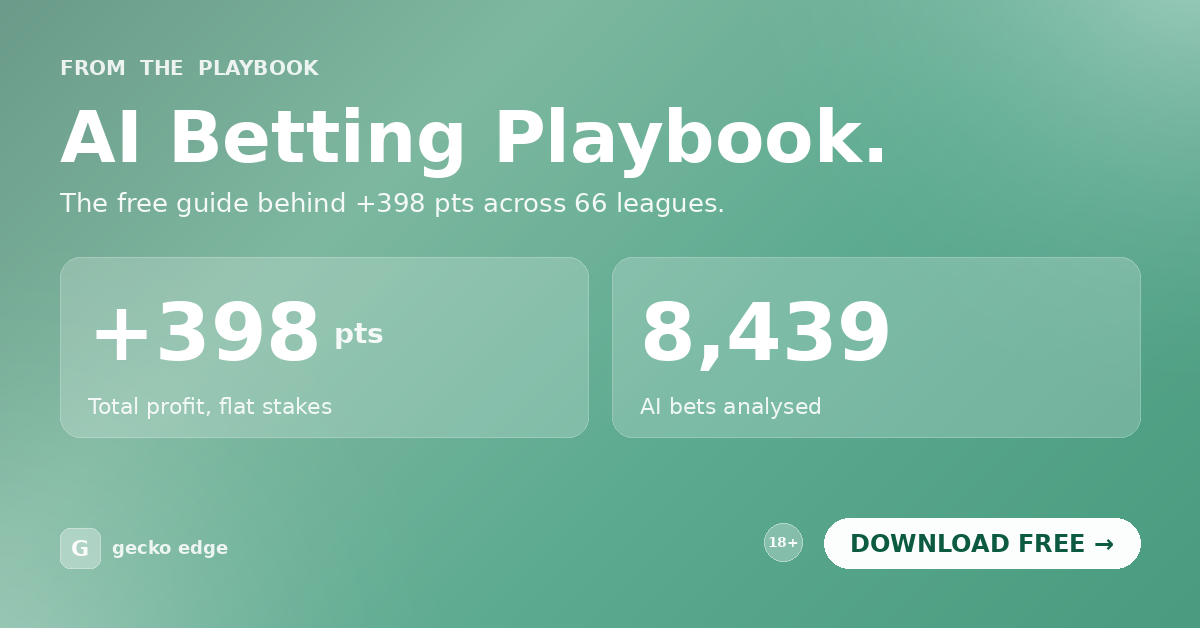
Gecko Edge has tracked 8,439 AI-generated bets and recorded +398pts of profit across 66 competitions. See how the model works →
At Gecko Edge, we build tools that bridge the gap between raw stats and winning strategies. We see the common pitfalls every day. Here are the seven biggest mistakes bettors make with World Cup xG and, more importantly, how you can fix them to refine your betting strategy.
1. Overreacting to the “Small Sample Size” Trap
The biggest mistake is treating three group-stage games like a 38-game Premier League season. In league football, xG eventually regresses to the mean. If a team is underperforming their xG over six months, they are likely “unlucky.”
In a World Cup, a team can be “unlucky” for their entire tournament and be on a plane home before the regression ever happens.
If you see a team with a massive xG but zero goals after the group stage, don’t blindly back them in the Round of 16 just because “the numbers say they’re due.” In short tournaments, variance is king.
The Fix: Look for consistency, not just totals. Instead of looking at cumulative xG, look at the quality of chances created across different game states. Use Gecko Edge to see rolling averages that include qualifiers and friendlies to get a truer sense of a team’s baseline.
2. Ignoring the “Game State” Context
xG doesn’t know the score. It doesn’t know that a team is 2-0 down and throwing the kitchen sink at the opposition in the 85th minute.
When a team is trailing, their xG naturally inflates as they take more risks and desperate shots. Conversely, a team leading by two goals will sit back, stop attacking, and concede xG. If you look at the final box score and see “Team A: 2.5 xG vs Team B: 0.8 xG,” you might think Team A was dominant. But if Team B scored two early goals and spent the rest of the match defending, the xG numbers are lying to you.

The Fix: Analyse xG based on the scoreline. Look at “Expected Goals while Level.” This tells you how a team performs when the game is actually “on.” Our AI-powered insights at Gecko Edge automatically adjust for game state, giving you a clearer picture of who is actually controlling the match.
3. Blindly Trusting Every xG Model
Not all xG is created equal. Some models only count where the shot was taken. Better models include where the defenders were, the speed of the attack, and the height of the ball.
During the World Cup, you will see a dozen different xG figures for the same match. One site says 1.2, another says 1.8. If you don’t know why they differ, you are guessing, not analysing.
The Fix: Stick to one or two reliable, high-fidelity models and understand their methodology. Professional bettors don’t shop around for the “best” looking number; they look for the most accurate one. If you’re unsure of the terminology, check our betting glossary for a breakdown of how these metrics are calculated.
4. Forgetting the “Human Element” in Finishing
xG measures the quality of the chance, not the quality of the player taking it. A 0.3 xG chance for Kylian Mbappé is not the same as a 0.3 xG chance for a centre-back who has wandered up for a corner.
In the World Cup final, the pressure is immense. Some players thrive; others wilt. Raw xG assumes an “average” finisher is taking the shot. But in these high-pressure moments, world-class finishing: or a lack thereof: can defy the models for an entire tournament.
The Fix: Weigh your xG analysis against player-specific data. Is the team creating chances for their best finishers, or are they racking up “junk” xG from low-probability long shots? Gecko Edge helps you identify which teams are actually getting the ball into the “danger zone” for their key men.
5. Neglecting xGA (Expected Goals Against)
Most bettors are obsessed with goals. They look at who is attacking well. But in knockout football, defence wins trophies.
If you only look at offensive xG, you’re missing half the equation. You need to look at xGA: how many high-quality chances a team is conceding. A team might be winning games 1-0, but if their xGA is 2.5 per match, their luck is about to run out.

The Fix: Focus on the xG Difference (xGD). This is the simplest way to see who is truly dominating the pitch. A positive xGD indicates a team that is outperforming its opponents consistently. Use our blog resources to learn how to layer defensive metrics into your predictions.
6. Misusing xG for “Over/Under” Markets
It is tempting to see two teams with high xG and immediately hammer the “Over 2.5 Goals” market. This is a classic mistake.
In the World Cup knockout stages, the tempo of the game changes. Teams become more conservative. Managers make tactical substitutions to “lock down” a game. xG from the group stages doesn’t always translate to the high-tension environment of a quarter-final or semi-final.
The Fix: Factor in tournament dynamics and manager tendencies. Use Gecko Edge‘s context-aware AI to see how teams have historically performed in knockout scenarios versus group play. Often, the “Under” offers much better value when the market overreacts to high group-stage xG.
7. Failing to Use xG for Live (In-Play) Betting
If you only use xG to place pre-match bets, you are leaving money on the table. xG is a powerful tool for in-play intelligence.
Live betting is about spotting a shift in momentum before the bookies adjust the odds. If a heavy favourite is 0-0 at half-time but has racked up 1.5 xG, the “to win” odds might still be high enough to offer value. Alternatively, if an underdog is leading 1-0 but has an xG of 0.05, you know a comeback is likely.

The Fix: Use real-time data feeds. At Gecko Edge, we provide instant, expert-level analysis for live matches. Instead of guessing based on “gut feeling,” you can see the underlying numbers as they happen, allowing you to act with quiet confidence.
Final Thoughts: Move Beyond the Noise
xG is not a crystal ball. It is a lens. If the lens is dirty or you’re looking through it at the wrong angle, you’ll see a distorted reality.
As we approach the World Cup Final, the margins for error are thinner than ever. The casual bettors will be chasing narratives and “star power.” The sharp bettors will be looking at the data: but they will be looking at it with context, humility, and the right tools.
Don’t let raw numbers lead you astray. Analyse the game state, account for the human element, and never ignore the defensive side of the ball.
Ready to stop guessing and start strategising? Join the community of serious bettors at Gecko Edge and see how our context-aware AI can give you the edge you’ve been looking for.
{“@type”:”BlogPosting”,”image”:”https://cdn.marblism.com/ccwJeOrOgPZ.webp”,”author”:{“name”:”Gecko Edge”,”@type”:”Organization”},”@context”:”https://schema.org”,”headline”:”7 Mistakes You’re Making with World Cup xG (and How to Fix Them Before the Final)”,”publisher”:{“logo”:{“url”:”https://geckoedge.ai/logo.png”,”@type”:”ImageObject”},”name”:”Gecko Edge”,”@type”:”Organization”},”description”:”Learn the common pitfalls of using xG in World Cup 2026 betting and how to improve your strategy with context-aware AI and data-driven insights.”,”datePublished”:”2026-06-30″,”mainEntityOfPage”:{“@id”:”https://geckoedge.ai/blog/world-cup-xg-mistakes”,”@type”:”WebPage”}}