Every season, as the final whistle approaches for the bottom half of the table, a familiar narrative takes over the airwaves. We hear it from commentators, read it in the tabloids, and see it reflected in the betting markets: “The Survival Instinct.”
The logic seems sound on the surface. A team fighting for its Premier League life “must win” to stay up. Therefore, they will run harder, tackle more fiercely, and somehow find a gear they’ve lacked for the previous nine months. But for the serious bettor, the question isn’t whether a team wants to win. It’s whether that desire is already priced into the market: and if it’s actually a hindrance rather than a help.
At Gecko Edge, we look past the emotive headlines. Using AI-driven analysis, we’ve dissected the “must-win” narrative to see if it holds up under the cold light of data.
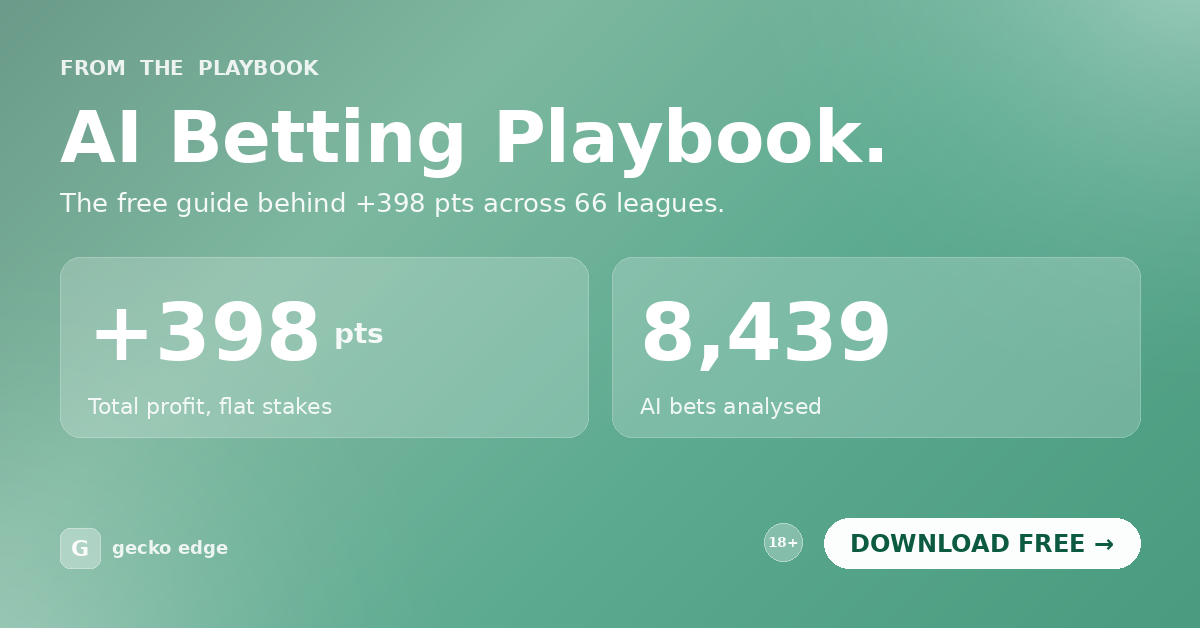
Gecko Edge has tracked 8,439 AI-generated bets and recorded +398pts of profit across 66 competitions. See how the model works →
The Myth of the “Must-Win” Performance Boost
The first mistake most casual bettors make is equating desperation with quality. Psychology suggests the opposite is often true. In professional sports, extreme pressure often leads to “choking”: a physiological and cognitive response where anxiety disrupts the fluid, automatic movements required for high-level performance.
Research into football psychology shows that relegation pressure triggers both cognitive anxiety (fear of failure) and somatic anxiety (physical tension). This doesn’t make a striker more clinical; it makes them snatch at shots. It doesn’t make a defender more resolute; it makes them hesitate or commit rash fouls.

Data from the 2025–26 season highlights this beautifully. While the narrative suggested teams like West Ham would find their “survival instinct,” their xG (Expected Goals) output often remained stagnant or even declined during their most desperate moments. The “desperation” manifested as more shots from distance and higher-variance play, rather than better-constructed chances.
When Gecko Edge analyses these matches, our AI doesn’t just look at the league table. It looks at the quality of the team’s underlying performance. If a team is playing poorly but the price is shortening because “they need it more,” that is a clear signal of market inefficiency.
Market Inflation and the “Big Club” Trap
Bookmakers are well aware of the public’s romanticism. They know that casual money flows toward the “must-win” story. This often leads to inflated prices: not for the win, but for the relegation itself, or conversely, overly short odds for the desperate team to succeed.
We saw this clearly with high-profile clubs in crisis. Take the example of Tottenham or West Ham in recent seasons. When a “big club” is threatened, the media coverage is 24/7. This creates an availability bias; because everyone is talking about them staying up or going down, bettors over-estimate the likelihood of those specific outcomes.
In one snapshot of the relegation market, a staggering 80% of all relegation bets were placed on a single high-profile club, despite their model-based probability of going down being significantly lower. This “public steam” moves the lines away from reality.
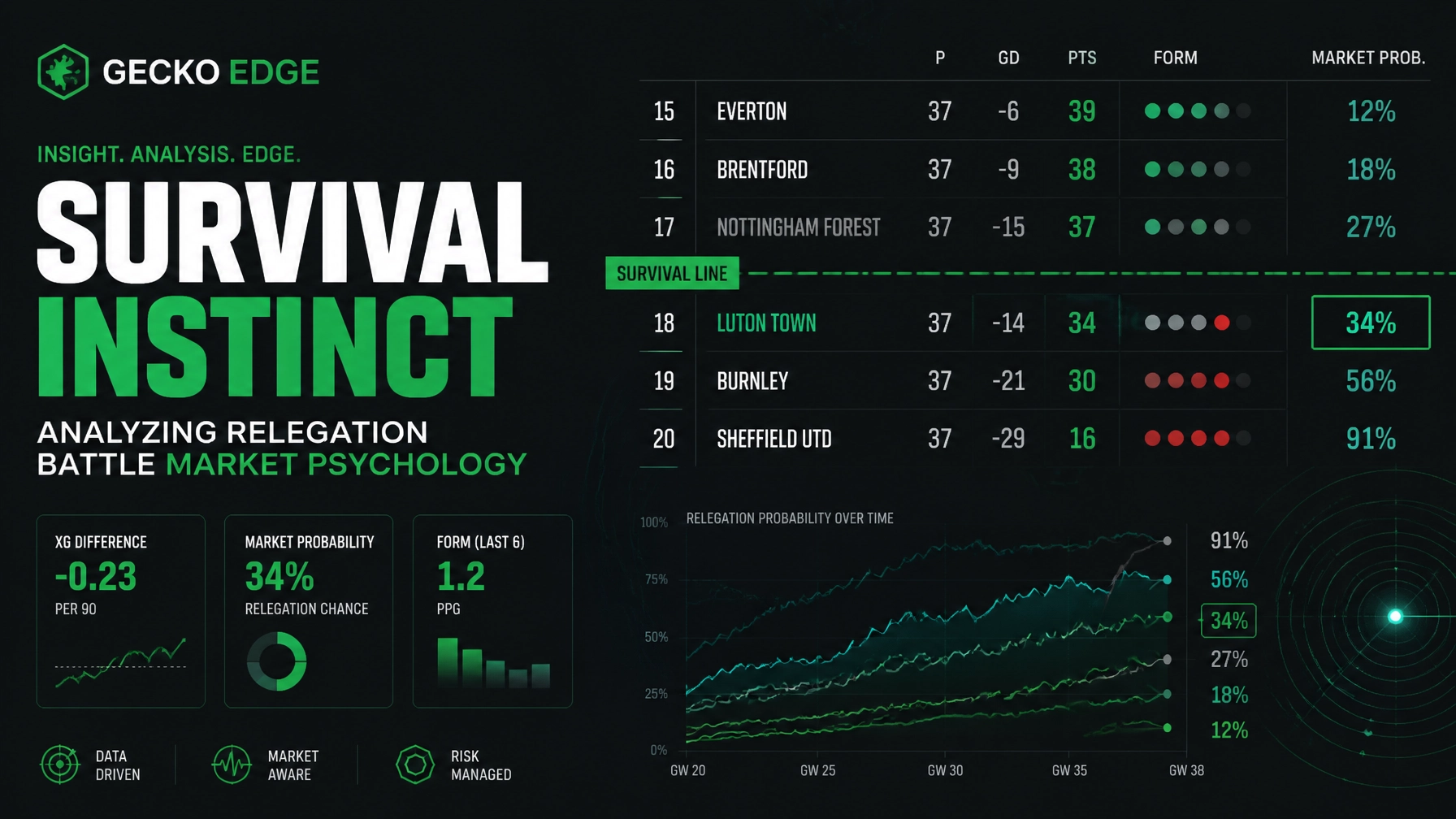
Gecko Edge identifies these discrepancies by comparing market-implied probabilities with our internal xG and Elo-based models. If the market says a team has a 77% chance of going down, but the AI: calculating squad depth, fixture difficulty, and tactical matchups: puts it at 93%, there is a massive opportunity to find value by fading the public sentiment.
Tactical Reality vs. Narrative Fluff
Beyond the psychology, there is the tactical reality of a relegation battle. A team that needs a win is often forced to play in a way that doesn’t suit them. A traditionally defensive side might be forced to push higher up the pitch, leaving gaps that a mid-table opponent (with nothing to play for but pride and bonuses) can exploit on the counter.
This is where “In-Play Intelligence” becomes vital. In a relegation decider, the game state changes rapidly. If a desperate team goes 1-0 down, their tactical discipline often evaporates.

Our AI Betting Playbook teaches users to look for these “Game State” shifts. While the market might still be pricing the match based on the pre-game “must-win” narrative, the live data might show a team that has completely lost its shape. This is where the real edge is found: not in the “survival instinct,” but in the tactical collapse that pressure often causes.
The Value of the “Unmotivated” Opponent
One of the greatest sources of value in late-season betting is the team with “nothing to play for.” The narrative says they are “on the beach.” However, professional footballers are rarely “on the beach” when millions of viewers are watching.
Without the crushing weight of relegation pressure, these teams often play with a freedom and technical composure that their desperate opponents lack. When the market over-corrects for a relegation-threatened team’s motivation, it often leaves the price of the “unmotivated” opponent or the draw significantly higher than it should be.
How to Bet Relegation Battles Smarter
If you want to move from guesswork to strategy, you need to strip away the emotion. Here is the framework we suggest using Gecko Edge:
- Ignore the Word “Must”: Every team wants to win. Motivation is a baseline, not a differentiator.
- Compare xG to Implied Odds: If a team is priced as a favourite because they “need” the win, but their recent xG performance is bottom-three, the value is almost certainly on the other side.
- Monitor Team Cohesion: Is the dressing room toxic? Are there wage disputes? Pressure cracks weak foundations. A cohesive, well-run small club (like Luton or Brentford in recent years) often handles pressure better than a “big” club in disarray.
- Use Context-Aware AI: Our tools understand that a “must-win” game in May is different from a mid-season clash. We factor in the specific pressure points of the season’s end to provide a more accurate prediction.

The Gecko Edge Advantage
The relegation battle is the ultimate test of a bettor’s discipline. It is where sentiment and data collide most violently. By using Gecko Edge, you gain access to the same level of analytical depth that professional syndicates use.
We don’t just give you tips; we give you the tools to build your own strategy. Whether you’re looking for value in the “Draw No Bet” market for an undervalued underdog or analysing the referee factor in high-tension matches, our platform ensures your decisions are backed by data, not desperation.
Stop betting on “instinct” and start betting on insight. Smarter betting starts here.
{“@type”:”BlogPosting”,”image”:[“https://image.pollinations.ai/prompt/A%20modern%2C%20data-driven%20visualization%20of%20a%20football%20league%20table’s%20bottom%20section%2C%20with%20glowing%20green%20accents%20on%20a%20dark%20charcoal%20background.%20Subtle%20grid%20lines%2C%20radar%20charts%2C%20and%20a%20glowing%20%22survival%20zone%22%20indicator.%20Sleek%20typography%20showing%20%22xG%22%20and%20%22Market%20Probability%22%20comparisons.%20High-contrast%2C%20analytical%2C%20Gecko%20Edge%20brand%20colours%20#34B06C?width=1024&height=576&nologo=true”],”author”:{“url”:”https://geckoedge.ai/”,”name”:”Gecko Edge”,”@type”:”Organization”},”@context”:”https://schema.org”,”headline”:”Survival Instinct: Analyzing Relegation Battle Market Psychology”,”keywords”:”football betting psychology, relegation battle statistics, must-win narrative, xG models, Gecko Edge, AI betting analysis, market inflation”,”publisher”:{“logo”:{“url”:”https://geckoedge.ai/logo.png”,”@type”:”ImageObject”},”name”:”Gecko Edge”,”@type”:”Organization”},”description”:”Explore the psychology of relegation battles in football betting. Learn why the ‘must-win’ narrative is often a market trap and how data-driven AI can help you find value by fading public sentiment.”,”datePublished”:”2026-06-05″,”mainEntityOfPage”:{“@id”:”https://geckoedge.ai/blog/relegation-battle-market-psychology”,”@type”:”WebPage”}}