Expected Value; most bettors think they are looking for winners. They spend their weekends scouring lineups, checking injury reports, and trying to predict who will lift the trophy or take the three points.
If you want to move from being a hobbyist to a serious bettor, you need to stop looking for winners and start looking for value.
The gap between a team winning and a bet being “good” is where the profit lives. To find that gap, we use Expected Value (EV). In the modern era of football trading, our best raw material for calculating EV is Expected Goals (xG). But raw xG is just noise unless you know how to process it.
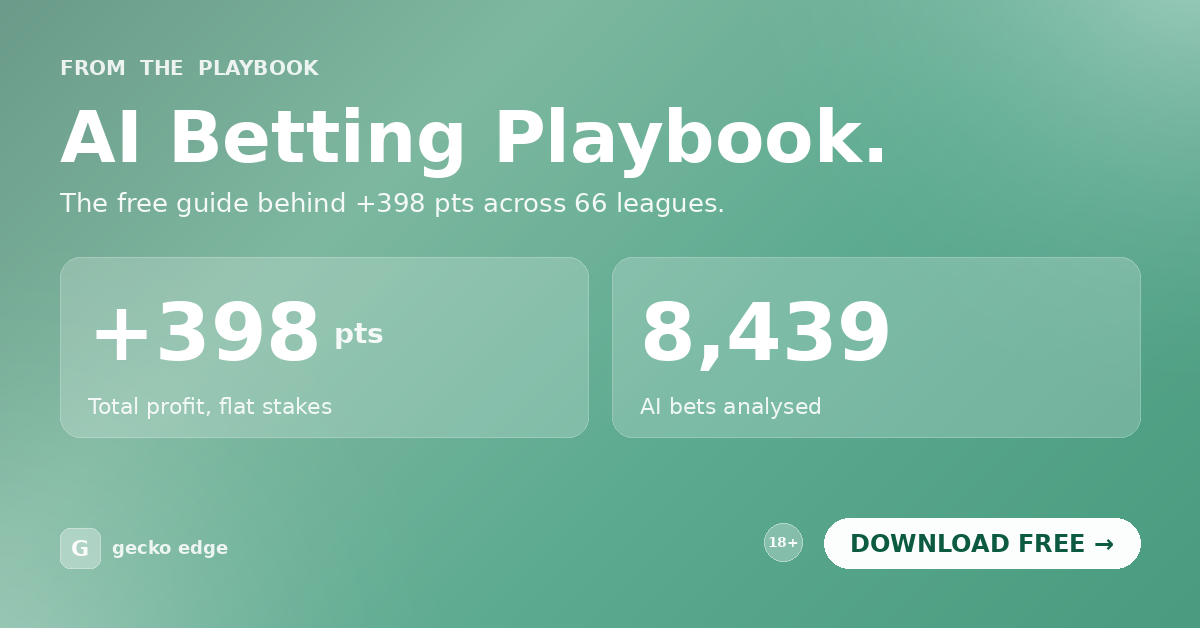
Gecko Edge has tracked 8,439 AI-generated bets and recorded +398pts of profit across 66 competitions. See how the model works →
At Gecko Edge, we focus on the bridge between raw data and actionable odds. This guide will show you how to build that bridge yourself.
Understanding the Core: What is Expected Value?
Expected Value is a simple concept that most people overcomplicate. It is the measure of what you can expect to win or lose on a bet if you were to place that same bet hundreds of times at the same odds.
Think of it like a coin toss. If I offer you evens (2.00) on heads, the Expected Value is neutral. Over 1,000 tosses, you’ll likely break even. But if I offer you 2.10 on heads, and the true probability remains 50%, you have a +EV bet. You might lose the first toss, or the first five, but over time, the maths makes you a winner.
In football, we don’t have the luxury of knowing the “true” probability. We have to estimate it. That is where xG comes in.

The Raw Material: Why xG is Your Best Starting Point
Expected Goals (xG) measures the quality of a shot based on variables like distance, angle, and type of assist. It tells us how many goals a team should have scored based on the chances they created.
For a serious bettor, xG is superior to actual scorelines because it removes the “noise” of luck. A deflected goal or a world-class save doesn’t change the fact that a high-quality chance was created. By looking at xG, we see the underlying reality of a team’s performance.
However, raw xG is not a win probability. If a team has 2.1 xG and their opponent has 1.2 xG, it doesn’t mean the final score will be 2-1. It means that, on average, they created better chances. To turn this into value, we need to convert these figures into a percentage chance of a win, draw, or loss.
Step 1: Converting xG to Win Probabilities
To get from xG to odds, we usually use something called a Poisson Distribution. Don’t let the name intimidate you. It’s just a mathematical way of taking an average (the xG) and figuring out the likelihood of different outcomes (0 goals, 1 goal, 2 goals, etc.).
If Team A has an xG of 1.6, the Poisson model tells us there is a:
- 20% chance they score 0 goals.
- 32% chance they score 1 goal.
- 26% chance they score 2 goals.
By doing this for both teams, we can create a grid of every possible scoreline (0-0, 1-0, 0-1, 1-1, etc.). Adding up all the home win cells gives us the total probability of a home win.
This is exactly how professional syndicates build their own “true” lines. They aren’t guessing; they are calculating.
Step 2: The Expected Value Calculation Formula
Once you have your estimated probability, you compare it to the bookmaker’s odds. This is the moment of truth.
The formula for EV is:
(Probability of Winning × Profit if Win) – (Probability of Losing × Stake)
Let’s look at a practical example.
Imagine Gecko Edge‘s models suggest Manchester City has a 65% chance of beating Liverpool. The bookmaker is offering odds of 1.80.
- Stake: £100
- Probability of Win: 0.65
- Profit if Win: £80
- Probability of Loss: 0.35
- EV: (0.65 * £80) – (0.35 * £100) = £52 – £35 = +£17
In this scenario, the bet has an Expected Value of +17%. This is a massive edge. In the long run, betting into these discrepancies is the only way to stay profitable.

Step 3: Finding the Edge in the Market
Knowing the EV is one thing. Finding it in the wild is another. The market is efficient, especially in the Premier League. Bookmakers use incredibly sophisticated models, and they bake a “margin” (the overround) into their odds.
To beat them, you need a more accurate estimate of probability than they have. This usually comes from:
- Superior Data: Using advanced metrics like xG+ (which accounts for player positioning and pressure).
- Speed: Identifying when a line opens at the wrong price before the rest of the market moves it.
- Specialisation: Looking at markets where the bookmaker’s models might be less refined.
This is where Gecko Edge changes the game. We don’t just give you the raw stats; we provide the refined analysis that points directly to the value. Smarter betting starts here because we do the heavy mathematical lifting, allowing you to focus on execution.
Why Most Bettors Fail at Expected Value
The biggest hurdle isn’t the maths; it’s the psychology.
A +EV bet can still lose. In fact, if you bet on something with a 55% win probability, you are going to lose 45% of the time. Most bettors see a “value” bet lose and assume the model is broken. They start chasing losses or abandoned their strategy.
Professional bettors look at the closing line. If you bet on a team at 2.10 and they close at 1.95, you have won, regardless of the match result. You beat the market. If you consistently beat the closing line, the maths dictates that you will be profitable over a large enough sample size.

How Gecko Edge Simplifies the Process
Calculating Poisson distributions and scouring multiple books for price discrepancies is a full-time job. Most people don’t have the time to build and maintain complex spreadsheets.
Gecko Edge was built for bettors who want the precision of a professional syndicate without the manual labour. Our AI-driven platform takes raw xG and hundreds of other data points to calculate real-time probabilities.
We don’t just tell you what happened; we show you what is likely to happen next. By integrating these calculations into a clean, sharp interface, we help you identify +EV opportunities in seconds. Whether you are looking for a deep dive in our Knowledge Base or looking for specific terms in our Betting Glossary, we provide the tools to elevate your game.
Summary: Ask, Analyse, Act
The journey from a casual punter to a professional trader follows a simple rhythm:
- Ask: Is this price representative of the true probability?
- Analyse: Use xG and EV calculations to find the discrepancy.
- Act: Place the bet only when the maths is in your favour.
Stop guessing. The data is available, the formulas are proven, and the tools are ready. Betting isn’t about being right about a result; it’s about being right about a price.
If you are ready to stop chasing “locks” and start building a portfolio based on logic and data, check out how we are Built For Bettors, Powered By AI.
The math doesn’t lie. It just requires the right lens to see it.
Q1: What is expected value (+EV) in betting?
Expected value, or EV, is the theoretical average profit or loss of a bet if it were placed an infinite number of times. A positive EV (+EV) bet returns more on average than it costs; a negative EV (-EV) bet loses money over time. The formula is: (probability of winning × payoff) – (probability of losing × stake). Bettors who consistently place +EV bets profit over the long run, regardless of how individual outcomes land.
Q2: How do you calculate expected value on a bet?
EV is calculated by multiplying the probability of winning by the net profit per win, then subtracting the probability of losing multiplied by the stake. For example, a bet at 2.50 odds (40% implied probability) where your true model estimates the actual probability at 50% has an EV of: (0.50 × £1.50) – (0.50 × £1) = +£0.25 per £1 staked. That’s a 25% EV bet, well above any reasonable threshold.
Q3: What’s a good EV threshold to bet on?
Most disciplined bettors use an EV threshold between 2% and 8%, depending on confidence in their model and market liquidity. Higher thresholds catch only the clearest mispricings but reduce bet volume; lower thresholds increase volume at the cost of margin per bet. Gecko Edge applies a divergence check alongside EV calculation, requiring the model’s edge to be consistent across multiple market inputs before flagging a bet as actionable.
Q4: How is +EV different from value betting?
The terms are used interchangeably by most bettors. Both describe placing bets where your assessed probability exceeds the bookmaker’s implied probability after their margin. The mechanical difference is that +EV is the calculated output (a number, e.g. +5.3%), while “value betting” is the broader practice of seeking out such bets. Either way, sustained profit depends on the accuracy of your underlying probability model and disciplined bankroll management.
Q5: Can you make consistent profit from +EV betting?
Long term yes, but only with a sufficient sample size, disciplined staking, and an accurate probability model. Short-term variance is significant even on +EV bets. Bettors hit losing runs on +5% EV plays exactly as the underlying maths predicts, then recover as volume builds. Gecko Edge’s pipeline produces +EV bets vetted through Bayesian blending, divergence flagging, and post-market sanity checks before they reach the user.

9 comments