High Volatility Leagues; most bettors look for safety. They look for the big six in the Premier League or the predictable giants of La Liga. But safety often comes with a price: lack of value. To find a real edge, you have to look where the market feels uncomfortable. You have to look at the chaos.
High volatility leagues, think the Brazilian Série A, the Argentinian Primera, or the gritty lower divisions of English football, are often viewed as “unpredictable.” To the average punter, they are a coin flip. To a seasoned trader using Gecko Edge, that volatility is exactly where the profit hides.
The “Both Teams to Score” (BTTS) market is particularly lucrative here. In these leagues, defensive structures are often secondary to individual flair or sheer physical intensity. If you know how to filter the noise, you can find consistent value.
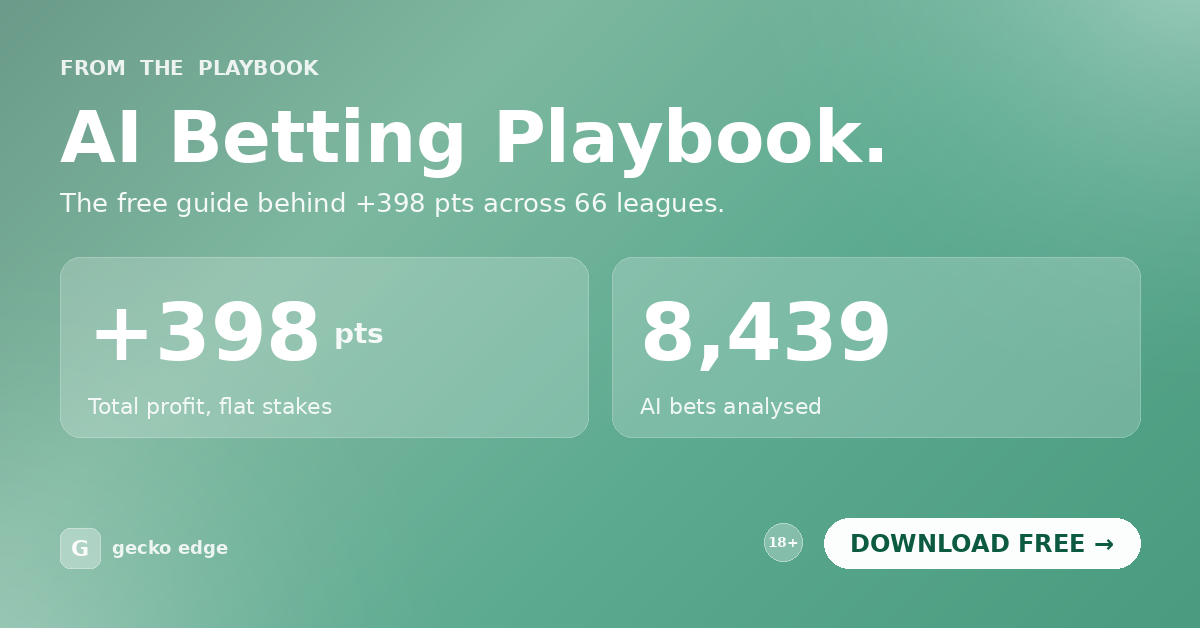
Gecko Edge has tracked 8,439 AI-generated bets and recorded +398pts of profit across 66 competitions. See how the model works →
Defining the High-Volatility Environment
When we talk about volatility, we aren’t just talking about random results. We are talking about leagues where the gap between the “best” and “worst” teams is narrow, or where external factors, travel, altitude, or pitch quality, heavily influence the 90 minutes.
In South American football, for example, the home-field advantage is massive, but so is the defensive fragility of teams forced to travel across a continent. In the English League Two, the lack of tactical discipline often leads to “basketball-style” matches where transitions are constant.
The goal isn’t to guess who wins. The goal is to identify matches where neither side has the defensive discipline to keep a clean sheet, but both have the offensive tools to hurt the other.

The Offensive-Defensive Profile: Finding the “Sweet Spot”
The most common mistake in BTTS betting is picking two “good” teams. Usually, two good teams result in a tactical stalemate.
The “Sweet Spot” for BTTS in volatile leagues is a match involving a team with a clinical attack and a porous defence. At Gecko Edge, we look for teams that fit a specific profile:
- The Glass Cannon: High scoring average (1.5+ goals per game) but a low clean-sheet percentage (under 20%).
- The Desperate Host: A home team that consistently concedes but is forced by their fans to attack.
- The Tactical Mismatch: A high-pressing side against a team that insists on playing out from the back despite lacking the technical quality to do so.
In leagues like the Dutch Eredivisie or the German Bundesliga 2, these profiles are common. However, in the lower divisions, you find these gems at much better prices because the bookmakers struggle to keep up with the squad rotations and local dynamics.
The 60% Rule and the xG Threshold
Data is your anchor in a sea of volatility. While a league’s average BTTS rate gives you a baseline, you need to go deeper into the knowledge-base to understand the underlying metrics.
A solid starting point is the 60% frequency rule. Look for matchups where both teams have seen “BTTS – Yes” land in at least 60% of their fixtures over the current season. This isn’t just a trend; it’s a reflection of their tactical identity.
However, past results can be deceptive. This is where Expected Goals (xG) becomes essential. For a high-confidence BTTS selection, you want to see an xG of at least 1.3 for both sides in the specific matchup. If both teams are consistently creating chances equivalent to 1.3 goals or more, the probability of both scoring shifts to roughly 73%. When the market prices this at 1.80 (55%), you have found your edge.

Contextual Variables: South America and Beyond
In high volatility leagues, the numbers on the screen are only half the story. You must account for the environment.
In the Brazilian Série A, mid-week travel can be Gruelling. A team flying from Porto Alegre to Fortaleza is covering thousands of miles. Fatigue leads to defensive lapses. It doesn’t necessarily stop a star striker from producing a moment of magic, but it almost certainly stops a back four from maintaining their shape for 90 minutes.
Similarly, in the English National League, weather plays a huge role. A heavy pitch slows down the defenders more than the ball, often leading to mistakes and untidy goals. These are the “dirty” BTTS winners that high-level traders thrive on.
We built Gecko Edge to help process these variables, ensuring that Smarter Betting Starts Here. It’s about taking the emotion out of a rain-soaked Tuesday night in Bradford and looking at the cold, hard probability.
The Danger of the “Over-Analysis” Trap
One of the 7 mistakes you’re making with EV betting calculations is trying to account for too many variables.
In volatile leagues, keep it simple.
- Ask: Is the star striker fit?
- Analyse: Does the data support a high-scoring game?
- Act: Is the price higher than the calculated probability?
If the answer to all three is yes, the bet is valid. Don’t let a “gut feeling” about a new manager or a local rivalry override the statistical evidence. Mastery comes from trusting the process even when the league feels chaotic.

Staking for Longevity
Volatility means swings. Even the best BTTS strategy will face a sequence of matches where the ball simply won’t go in, or a goalkeeper has the game of his life.
In these leagues, we recommend a conservative staking plan. While you might be tempted to go heavy on a match with a 70% BTTS probability, the smart move is to stick to 1 or 2 units. This protects your bankroll from the inevitable “high-volatility” variance.
Betting is a marathon, not a sprint. If you are looking for long-term growth, you must respect the responsible betting disclaimer. The edge is found in the volume of smart bets, not the size of a single one.
The Role of AI in Filtering Volatility
The human mind is poorly equipped to handle the sheer volume of data generated by global football. We get bored. We get biased. We remember the one time a Brazilian team let us down and forget the ten times they paid out.
AI doesn’t have these weaknesses. At Gecko Edge, our algorithms scan thousands of data points across these high-volatility leagues in seconds. They identify the “Glass Cannons” and the “Desperate Hosts” with cold precision.
By using technology to filter the noise, you aren’t just gambling; you are trading information. You are looking for the discrepancy between what the public thinks (that these leagues are random) and what the data proves (that they follow specific, exploitable patterns).

Final Thoughts: Smarter Betting Starts Here
Choosing the best BTTS strategy for high volatility leagues requires a shift in mindset. You have to embrace the messiness of the game while maintaining the discipline of a mathematician.
Look for the leagues with open play. Target the teams with weak foundations and strong finishers. Use xG to verify your targets. And most importantly, use the tools available to you.
The market is often wrong about “small” leagues because it doesn’t pay them enough attention. That is your opportunity. Analyze the data, understand the context, and act with confidence.
If you’re ready to refine your approach, dive into our AI betting education to see how we’re changing the game. The edge is there: you just have to be sharp enough to take it.