The short answer
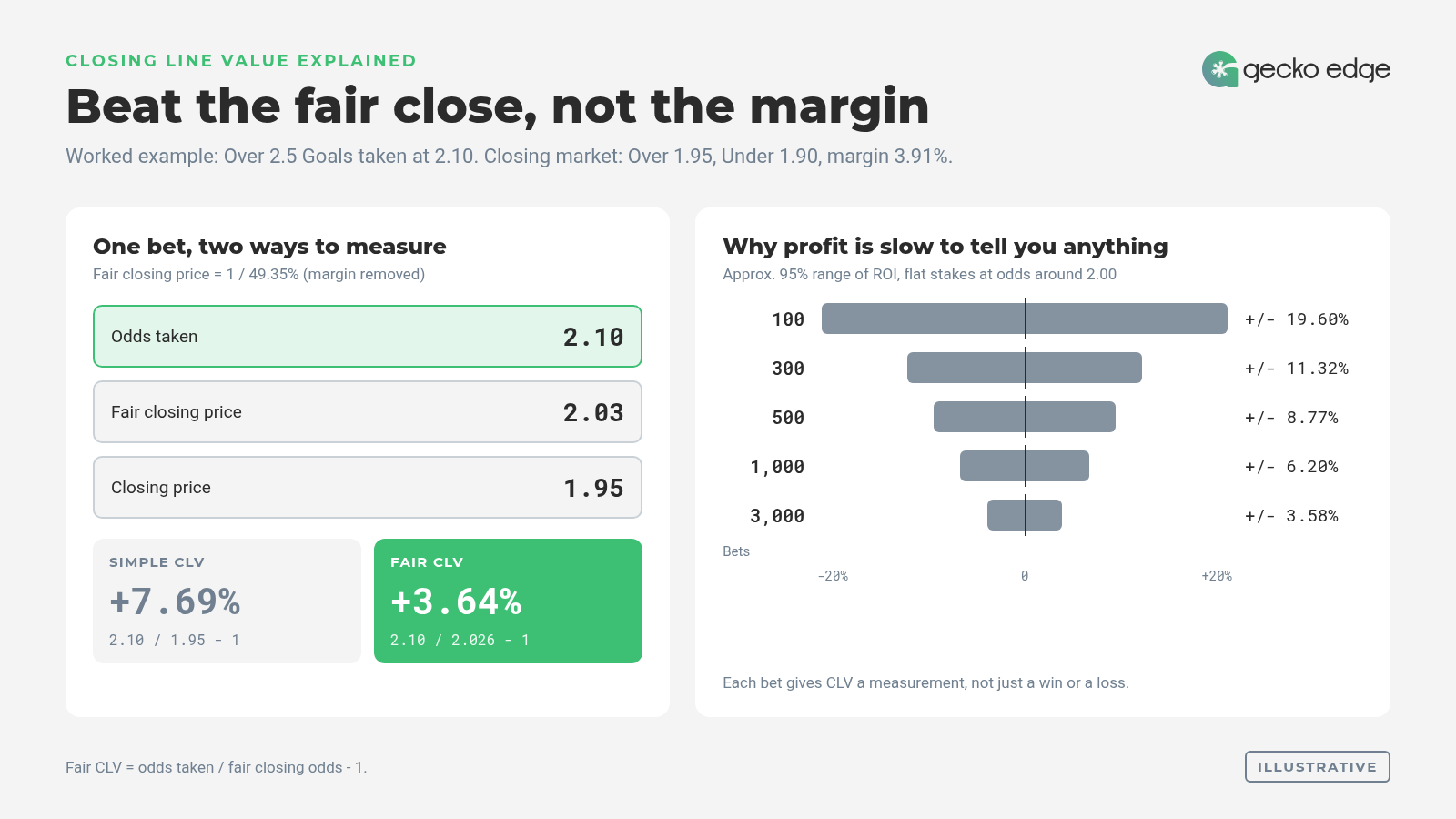
Closing line value (CLV) compares the odds you took with the final odds just before kick-off. If you took 2.10 and the fair closing price was 2.03, you beat the close by about 3.6%. Consistently beating the closing price is one of the clearest early signs that your process finds real value.
Profit is the result everyone looks at, but it is a slow and noisy way to judge a betting process. CLV gives you a measurement on every bet, whether it wins or loses. This guide covers the definition, the formula with and without the margin, a worked football example, and how many bets you need before either CLV or profit means anything.
What the closing line is and why it matters
The closing line is the last price available before a match kicks off. It matters because of what has happened by then. Team news has landed. Line-ups are known. The market has had hours or days to absorb information, and the most informed money has had its chance to move the price. By kick-off, the closing price is usually the market’s best estimate of the outcome’s probability.
That makes it a useful benchmark. If you regularly take prices that are longer than where the market finally settles, you were consistently ahead of the information that arrived later. If you regularly take prices shorter than the close, the market moved against you, and your edge at the time of the bet may not have been real.
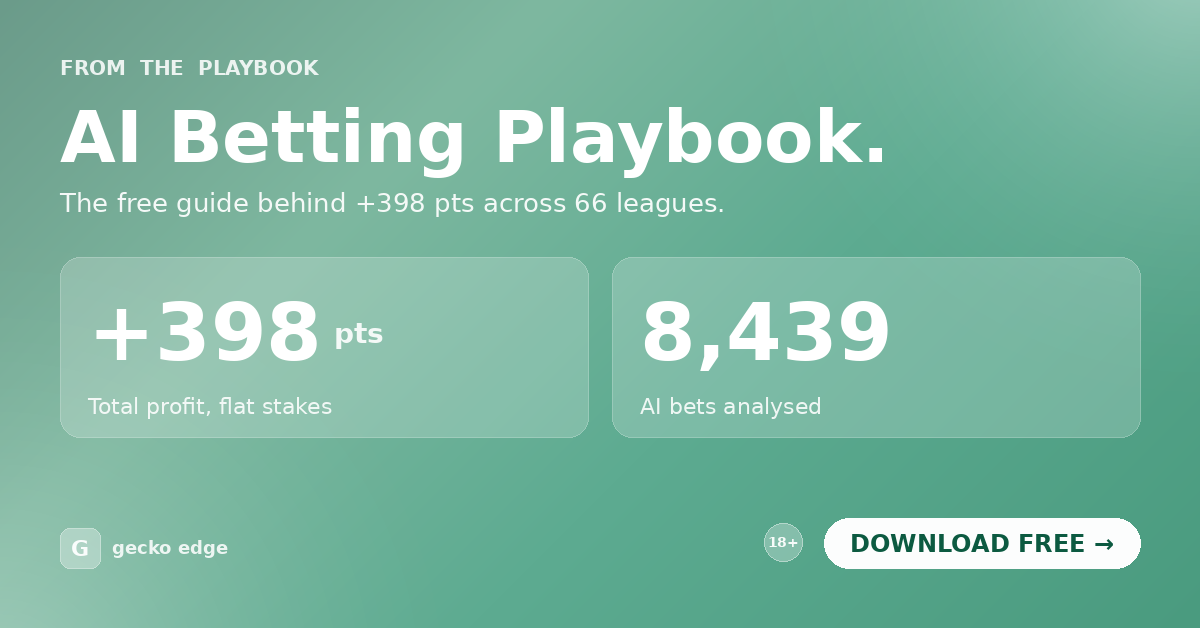
Gecko Edge has tracked 8,439 AI-generated bets and recorded +398pts of profit across 66 competitions. See how the model works →
Reading market odds as probabilities has research behind it. In a 2017 arXiv preprint, Kaunitz, Zhong and Kreiner used the probabilities implied by the odds across many bookmakers as estimates of the chance of each outcome in football matches.
Our knowledge base explains why the same line moves from -EV to +EV, or the other way, over time, and when is the best time to analyse a match.
How to calculate CLV
Simple CLV
The quick version compares the odds you took with the closing odds on the same side:
Simple CLV = odds taken / closing odds – 1
A positive figure means you took a longer price than the close.
Fair CLV (preferred)
The simple version has a flaw. The closing price includes the bookmaker’s margin, so comparing against it flatters your result. Fair CLV removes the margin from the closing market first:
- Convert both closing prices to implied probabilities: 1 / odds.
- Add them together. The amount over 100% is the margin.
- Divide your side’s implied probability by that total to get the no-margin probability.
- Fair closing price = 1 / no-margin probability.
Fair CLV = odds taken / fair closing odds – 1
You can do the margin step with our free no-vig calculator.
Which closing line to use
Use a close from a liquid, low-margin market, with the margin removed. A thin market, or one with a large margin, gives a noisier benchmark. The best price you could have taken elsewhere is a separate measure: it tells you about your price shopping, not about whether the market moved your way.
Worked example
Here is one bet, with illustrative figures, not a live fixture.
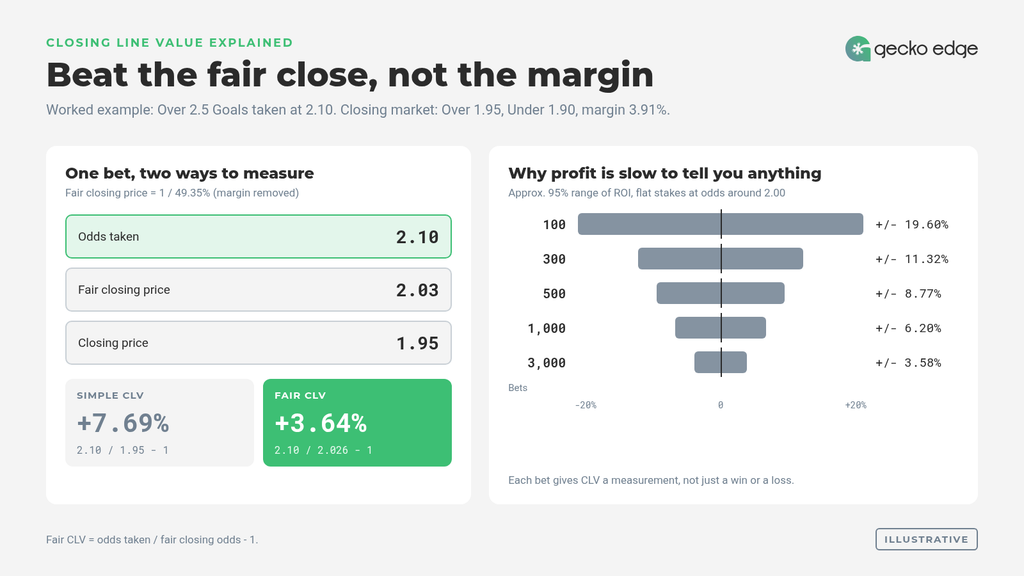
- You took Over 2.5 Goals at 2.10.
- The closing market was Over 1.95, Under 1.90.
- Implied probabilities: 1 / 1.95 = 51.28% and 1 / 1.90 = 52.63%, a total of 103.91%, so the margin is 3.91%.
- No-margin Over probability: 51.28 / 103.91 = 49.35%, so the fair closing price is 2.03 (2.026 unrounded).
Simple CLV: 2.10 / 1.95 – 1 = +7.69%.
Fair CLV: 2.10 / 2.026 – 1 = +3.64% (2.026 is the unrounded fair closing price shown as 2.03).
The simple figure flatters the result because it ignores the margin. Use the fair version. Here, more than half of the apparent +7.69% was the bookmaker’s margin, not an edge.
What is a good CLV?
A good CLV is a positive average across many bets. There is no single magic figure, and any single bet tells you very little. One bet can beat the close comfortably because of a late injury you could not have known about; another can miss the close for the same reason.
What matters is the pattern. Small numbers matter here: a consistent positive average, even a small one, sustained across a large sample, is a strong sign. A large average over a handful of bets is not yet evidence of anything. Look at the average, and look at it by market and league, because an edge in one area can hide a leak in another.
For how big an edge needs to be at the point of decision, see what is a good EV % in betting?
Why CLV is a faster signal than profit
Profit depends on results, and results in football are noisy. With flat stakes at odds around 2.00, the standard error of ROI is roughly 1 / square root of the number of bets:
| Bets | 1 standard error of ROI | Approx. 95% range |
|---|---|---|
| 100 | +/- 10.00% | +/- 19.60% |
| 300 | +/- 5.77% | +/- 11.32% |
| 500 | +/- 4.47% | +/- 8.77% |
| 1,000 | +/- 3.16% | +/- 6.20% |
| 3,000 | +/- 1.83% | +/- 3.58% |
After 300 bets, a true +5% edge and a zero edge can produce very similar profit figures. CLV usually separates them sooner, because each bet gives a measurement, not just a win or a loss.
The table shows why. At 300 bets, the 95% range is about 11 points either side of the true ROI. A +5% edge could plausibly show anything from a small loss to a large profit, and so could a zero edge. Even at 1,000 bets the range is still about 6 points either side. Our article on losing runs and variance covers what that feels like in practice.
CLV is less noisy because it does not wait for the result. Every bet produces a number: how far your price sat above or below the fair close. That number varies far less from bet to bet than a win or a loss does, so its average settles sooner.
CLV and EV: how they fit together
EV and CLV measure different moments. EV is measured when you decide: it is the gap between your probability and the price on offer at that time. CLV is measured afterwards: it shows how the market moved after you took the price.
Prices drift both ways. A bet can be +EV when you take it and still close against you, because the market learned something your model did not. A bet can also look marginal at the time and close well in your favour. Over many bets, a process with real +EV at decision should tend to show positive CLV. If your EV figures are consistently positive but your CLV is not, that gap is worth investigating.
The relationship works in sequence: measure, decide, record, review. A Gecko Edge analysis gives the EV at the moment you run it, and the knowledge base explains why EV moves as prices and inputs change. CLV is how you check, afterwards, whether those decisions tended to beat the market. If you want the process that comes before this, see how to find value bets in football.
Limits of CLV
CLV is a strong signal, but not a perfect one:
- Thin markets. In lower leagues or niche markets, the close may reflect little money and little information. Beating it means less.
- Steam-chasing. If you simply follow prices that are already moving, you can show positive CLV without having any view of your own, so in that case it reflects timing rather than judgement.
- Account limits. Some bookmakers limit stakes on accounts that consistently beat the close, which can cap how much use you get from a measured edge.
- In-play. Bets placed during a match have no meaningful closing price, so CLV does not apply to most in-play entries.
How to track CLV
- Record the odds you took. The price you actually got, not the price you first saw.
- Record the closing odds for both sides. You need both to remove the margin.
- Remove the margin. Convert to implied probabilities, divide by the total and turn the result back into a fair price.
- Calculate CLV per bet. Odds taken / fair closing odds – 1.
- Average across bets and segment by market and league. One overall figure can hide very different results underneath.
The +EV Bet Tracker lets you record the odds you took, which is the first step. You can record the odds you took in the +EV Bet Tracker. Our knowledge base also explains how to track Concierge Premium Portfolio bets and record the odds you took.
FAQ
What is closing line value?
The difference between the odds you took and the final pre-match odds, usually expressed as a percentage.
How do you calculate CLV?
Divide the odds you took by the fair closing odds (margin removed) and subtract 1.
What is a good CLV?
Any consistent positive average across a large sample is a good sign. Look at the average, not single bets.
Can you beat the closing line and still lose money?
Yes, over short runs. Variance can outweigh a real edge for hundreds of bets.
Does CLV matter for in-play bets?
Much less. There is no single closing price for most in-play entries.
Which closing odds should I use?
A liquid, low-margin market close, with the margin removed.
Is CLV the same as EV?
No. EV is measured when you decide; CLV measures how the market moved after you took the price.
References
- Kaunitz, L., Zhong, S. and Kreiner, J. (2017). arXiv preprint arXiv:1710.02824 [stat.AP]. https://arxiv.org/abs/1710.02824
18+ only. Gecko Edge provides football analytics data for information and entertainment. It does not place bets and no outcome is certain. Bet responsibly, only with money you can afford to lose, and set limits before you start. Free, confidential support: GamCare (https://www.gamcare.org.uk).
Betting responsibly: limits, discipline and where to get support
Try Gecko Edge for free. No card needed.
Last reviewed: 5 November 2026