

Asian Handicap; when you sit down to look at a weekend of football, the first market you usually see is the Match Result, the classic 1X2. It is the language of the game. Home win, draw, or away win. It is simple, intuitive, and, for many, the only way they have ever interacted with a sportsbook.
But if you are looking at betting not as a weekend hobby, but as a long-term strategy for growth, simplicity can be expensive. Professional traders often look past the 1X2 market toward the Asian Handicap (AH). To the uninitiated, Asian Handicaps look like a complex mess of decimals and fractions. To a seasoned bettor, they represent efficiency, lower risk, and a significantly higher return on capital.
At Gecko Edge, we believe in stripping away the noise. If you want to build a sustainable bankroll, you need to understand which market actually serves your interests rather than the bookmaker’s margin.
The 1X2 Trap: A Familiar Face with Hidden Costs
The Match Result market is where most money flows. Because of its popularity, you might think it offers the best value. In reality, it is often where the bookmaker hides their largest “overround”, the profit margin they bake into the odds.
In a 1X2 market, there are three possible outcomes. This creates a higher level of uncertainty. More importantly, it allows the bookmaker to spread their margin across three different results. In major leagues, the margin might be 5% or 6%. In lower leagues, it can climb much higher. You are essentially paying a premium for the simplicity of the bet.
The “draw” is the silent killer of 1X2 strategies. Football is a low-scoring sport where roughly 25% of matches end in a stalemate. If you are backing a favourite in the 1X2 market, that draw outcome is working against you 100% of the time. You need the team to win outright, or you lose your entire stake. This leads to high variance, long losing streaks that test even the strongest mental game.

Asian Handicap: Stripping Away the Noise
The Asian Handicap was designed to level the playing field and, more importantly for us, to remove the draw as a binary “loss” event. By giving one team a head start (or a deficit), the market is reduced to two outcomes.
This shift from three outcomes to two changes the mathematics of your betting bank significantly. Here is why professionals prefer it:
- Lower Margins: Because AH markets are more competitive and have only two outcomes, bookmakers operate on much thinner margins, often as low as 2%. This means the odds are “truer” to the actual probability of the event.
- Stake Protection: Lines like AH 0.0 (Draw No Bet), AH +0.5, or split lines like AH -0.75 offer ways to have your stake returned or half-returned if the game doesn’t go exactly as planned.
- Higher Strike Rate: By removing the “dead” outcome of a draw, you win or push more often. This creates a smoother equity curve for your bankroll.
If you are new to these terms, our knowledge-base betting glossary is a great place to get up to speed on the specific mechanics.
The Math of Longevity: ROI vs ROC
This is the point where most casual bettors lose interest, but it is the most important part of this article. To treat betting like a business, you must understand the difference between Return on Investment (ROI) and Return on Capital (ROC).
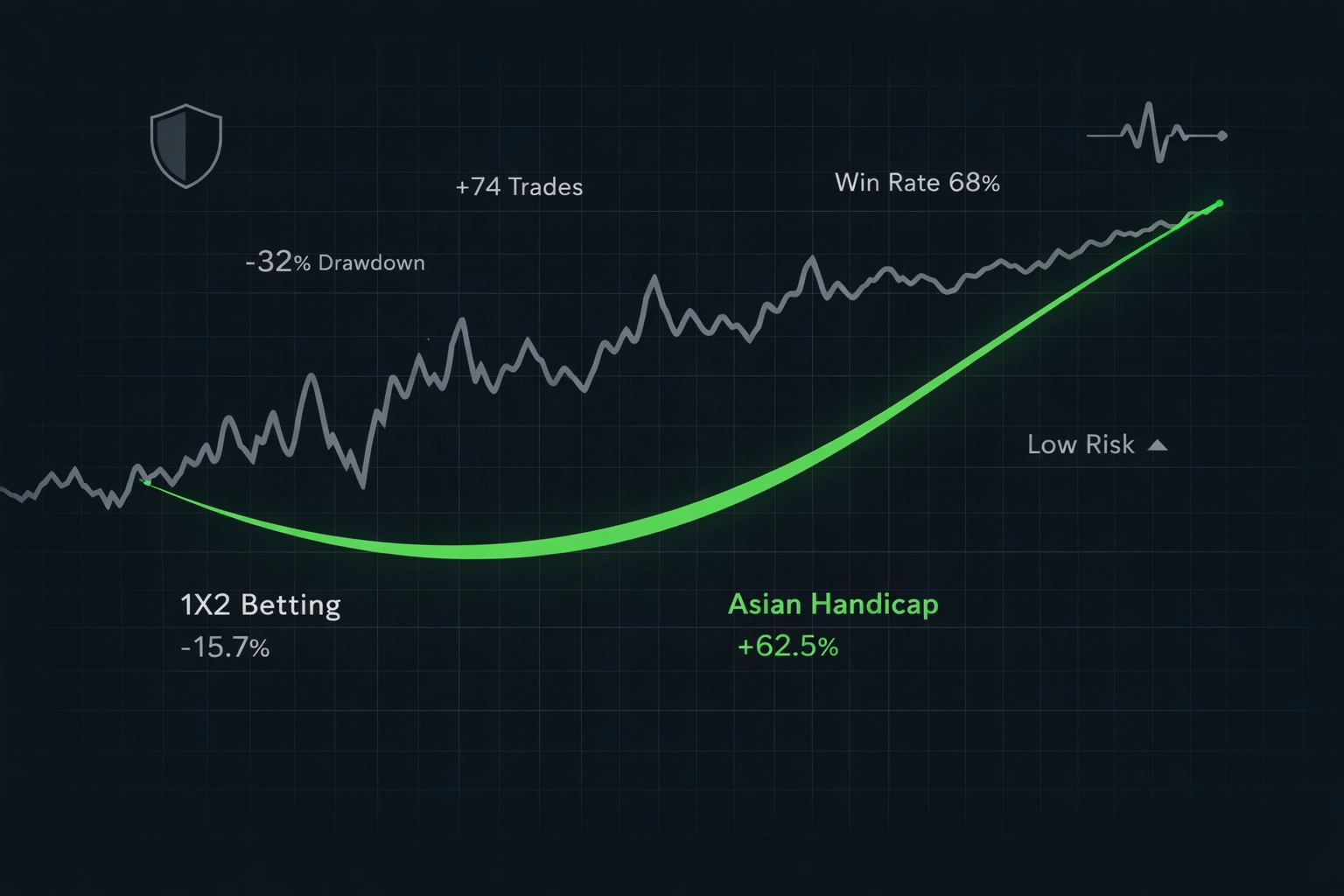
A recent comparative study of two systems, one using Asian Handicaps and one using 1X2 Win bets, showed a staggering difference. The AH system produced a 17.9% ROI. The 1X2 system, following the same teams, produced only 4.2%.
But look at the ROC. Because the AH system had a higher strike rate (62 wins out of 107 bets) compared to the 1X2 system (21 wins out of 107), the AH system achieved a 63.8% Return on Capital. The 1X2 system managed just 4.5% ROC.
Why? Because the lower variance of Asian Handicaps allows you to use your bankroll more efficiently. You don’t need a massive “safety net” bankroll to survive 10-game losing streaks that are common in 1X2 betting. With Gecko Edge, we focus on identifying these high-probability value spots where your capital works harder for you.
Why Variance is the Silent Killer
Variance is the difference between what you expect to happen and what actually happens in the short term. In 1X2 betting, variance is a monster. Because you are often betting on outcomes with odds of 2.00 or higher to account for the draw, your losing streaks will naturally be longer.
Long losing streaks lead to “tilt.” They lead to bettors chasing losses or abandoning a perfectly good strategy because they’ve lost six games in a row.
Asian Handicap betting dampens this volatility. When you take a +0.25 handicap, a draw still nets you a half-win. Your bankroll doesn’t take the “full hit” of a loss. This steady progress is the hallmark of a professional. It isn’t about the one big Saturday acca; it’s about being slightly more right than wrong, thousands of times over.
The Role of AI in Choosing Your Market
The difficulty with Asian Handicaps is that they require more precise analysis. You aren’t just asking “Who will win?” You are asking “By how much?” or “Can this underdog keep it within one goal?”
This is where technology changes the game. Human intuition is terrible at calculating goal distributions. We tend to remember the 4-0 thrashing but forget the dozen 1-0 grinds. At Gecko Edge, our AI models don’t have memories; they have data.
By processing thousands of data points, from xG to tactical setups, AI can identify when a bookmaker has set an AH line at -1.25 when the true probability suggests -1.75. That “quarter-goal” difference is where the professional profit lives. We dive deep into these concepts in our AI betting education section, showing you how to spot these discrepancies before the market adjusts.
When to Stick with Match Result
Is there ever a time to use 1X2? Occasionally, yes.
The 1X2 market can be useful when you are backing a heavy underdog where you believe the outright win probability is being massively underestimated. In these “longshot” scenarios, the Asian Handicap might not offer a high enough price to justify the risk. However, these are rare exceptions. For your “bread and butter” daily activity, the AH market is almost always the superior choice for value.

Making the Switch: A Mentor’s Advice
If you’ve spent years betting 1X2, switching to Asian Handicaps feels like learning a new language. Start slow.
- Ask: Does this 1X2 price represent real value, or am I just picking a winner?
- Analyse: Look at the Asian Handicap equivalent. If the team is -0.5, that is the same as a win. Compare the odds. Often, the AH -0.5 will have slightly better odds than the 1X2 Home Win.
- Act: If the AH line offers more protection (like the +0.25 or the 0.0), take the protection.
The goal is to stay in the game. The 1X2 market is designed to entice you with simple choices, while the Asian Handicap market is built for those who want to win over the next year, not just the next ninety minutes.
Final Thoughts
The battle between Asian Handicap and Match Result isn’t really a battle of markets; it’s a battle of philosophies. One is built on the excitement of the “result,” and the other is built on the reality of the “margin.”
By favouring the Asian Handicap, you are choosing lower margins, higher strike rates, and better return on capital. You are choosing to act like a professional.
At Gecko Edge, we provide the tools to navigate these markets with precision. Whether you are looking for AI betting tips or looking to refine your own models, remember: Smarter betting starts when you stop looking for winners and start looking for value.
The data is clear. The pros have made their choice. Now it’s time to make yours.