Bet Builder; the ultimate double-edged sword in modern football trading. On one side, they offer the chance to craft a narrative, to turn a hunch about a single match into a high-yield return. On the other, they are the highest-margin product a sportsbook offers. If you aren’t walking into a Bet Builder with a clear understanding of EV betting calculations, you aren’t just betting; you are donating.
At Gecko Edge, we’ve spent years looking under the hood of these products. The “Same Game Multi” or “Bet Builder” is designed to be seductive. It’s accessible, it’s fun, and it feels beatable because you know the teams involved. But the house edge on a standard three-leg Bet Builder can often climb toward 20% or 30%.
To win, you have to move beyond the narrative and start looking at the numbers. You need to find where the bookmaker’s pricing deviates from reality. This is how we find betting value picks in a market designed to hide them.
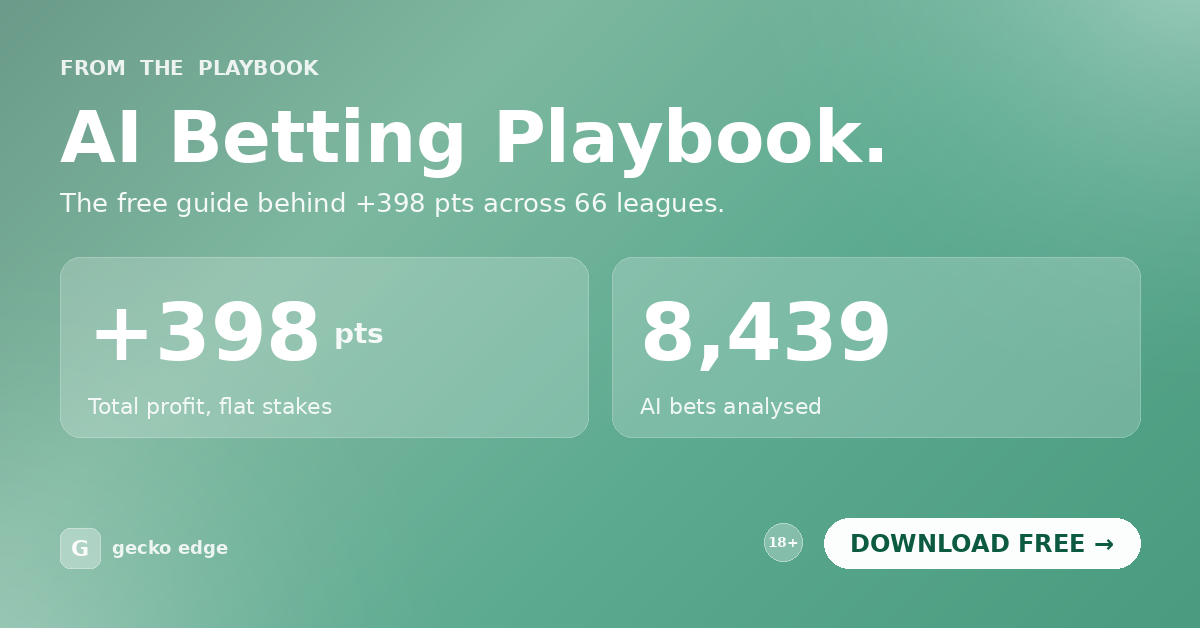
Gecko Edge has tracked 8,439 AI-generated bets and recorded +398pts of profit across 66 competitions. See how the model works →
The compounding problem: Why margins explode
In a standard single bet, the bookmaker takes a small cut, known as the “overround” or “vig.” Usually, this is around 4% to 7% for a major Premier League match. When you combine selections into a Bet Builder, those margins don’t just sit next to each other; they compound.
Think of it like a tax on your potential profit. If each leg of your bet has a 5% margin, by the time you’ve added four legs, you are fighting against a mathematical headwind that is almost impossible to overcome through “gut feeling” alone. This is the primary reason why a sophisticated football betting strategy must prioritise Expected Value (EV).

To find value, you must first understand the “fair price.” If the fair price of a selection is 2.00 (50%), but the bookie is offering 1.90, you are getting negative EV. In a Bet Builder, these small discrepancies are magnified. Our job is to reverse the math, to identify the fair probability of the combined events and compare it to the price on the screen.
Spotting hidden margins with EV betting calculations
Positive Expected Value (+EV) occurs when the probability of an outcome is higher than what the odds suggest. It sounds simple, but in the context of a Bet Builder, the calculation becomes complex because the events are often correlated.
If you bet on Manchester City to win and Erling Haaland to score, those aren’t independent events. If Haaland scores, the probability of City winning increases. Sportsbooks have complex algorithms to account for this correlation, but those algorithms aren’t perfect. Sometimes they over-adjust, and sometimes they miss the mark entirely.
To spot these hidden margins, follow this three-step framework: Ask, Analyse, Act.
1. Ask: What is the fair probability?
Before looking at the odds, determine the likelihood of each leg occurring. Use historical data, team news, and underlying metrics like xG. If you’re looking for a deeper dive into these metrics, check out our guide on 7 mistakes you’re making with expected goals football analysis.
2. Analyse: Compare against the sharp market
Look at “sharp” bookmakers or betting exchanges. If the exchange price for “Over 2.5 Goals” is 1.80, but your Bet Builder tool is pricing it at 1.70 as part of a multi, the bookmaker is taking a massive additional margin. At Gecko Edge, we use AI to scrape these discrepancies in real-time, identifying where the Bet Builder engine is being overly greedy.
3. Act: Only take the value
If the combined fair odds are 4.00 and the bookie offers 4.50, you have a +EV bet. If they offer 3.80, you walk away. It doesn’t matter how much you “feel” the bet will land. Long-term profitability is built on the gap between price and probability.
The secret of correlation: Finding the “Double Count”
The biggest secret in the Bet Builder world is the “Double Count.” This happens when a bookmaker’s algorithm fails to properly discount the odds for two highly correlated events, or conversely, when they penalise the odds too heavily.
Consider a “Team to Win” and “Total Corners” combination. Does a team winning always mean they will have more corners? Not necessarily. A team leading 2-0 early might stop attacking, leading to fewer corners. Most casual bettors assume “Dominance = Corners,” and the bookies price it accordingly. However, if the data suggests a specific team plays a counter-attacking style even when leading, you might find betting value picks by going under on corners while taking the win.

By using EV betting calculations, you can stress-test these combinations. You are looking for the “uncorrelated correlation”, instances where the market thinks two things are linked, but the data says otherwise. This is where the real margin is hidden.
Why predictive models are non-negotiable
In the modern era, you cannot manually calculate the true probability of a 5-leg Bet Builder before the odds move. The market is too fast. This is why Gecko Edge focuses on predictive football models.
Our AI doesn’t just look at who might win. It simulates the match thousands of times to see how different events interact. Does a yellow card for a specific central midfielder correlate with an increase in total match goals? Often, yes. If the Bet Builder tool doesn’t price that correlation accurately, that is your entry point.
Using a data-driven football betting strategy means you stop guessing and start calculating. You move from being a gambler to being a value hunter.
A practical example of +EV in Bet Builders
Let’s look at a typical Premier League match: Liverpool vs Chelsea.
- Leg 1: Liverpool to win (Fair odds 1.60)
- Leg 2: Mo Salah to have 2+ shots on target (Fair odds 2.10)
- Leg 3: Over 3.5 Cards (Fair odds 1.50)
If these were independent, the fair price would be 5.04. However, because Salah shooting on target is correlated with Liverpool winning, the bookie might offer 4.20.
Now, if our Gecko Edge model shows that in high-stakes games between these two, the card count actually rises significantly in the second half regardless of the score, we might find that the “Over 3.5 Cards” leg is being undervalued. If the model says the true fair price for the trio is 4.00, and the bookie is offering 4.20, you have found a +EV opportunity.

Managing your bankroll in the Bet Builder era
Because Bet Builders usually involve higher odds, the variance is higher. You will have longer losing streaks than you would betting on Asian Handicaps or Match Results. To survive, you must master calculated risk and expected value in a volatile market.
Never stake the same amount on a 10/1 Bet Builder as you would on a 1/1 single. We recommend using a fractional Kelly Criterion or a fixed percentage of your bankroll (usually 0.25% to 0.5%) for these types of high-variance plays. The goal isn’t to get rich on one Saturday afternoon; the goal is to consistently exploit the hidden margins until the math takes over.
Smarter betting starts here
The era of “gut feeling” betting is over. The sportsbooks are using world-class AI to set their margins; you need to use world-class AI to find the gaps in them.
Bet Builders aren’t your enemy if you know how to price them. They are simply another market: a complex one, certainly: but one where the less-informed public creates huge amounts of noise. Your job is to find the signal.
By focusing on EV betting calculations and using the tools provided by Gecko Edge, you can turn the bookmaker’s favourite product into your own personal edge.

Ask the right questions. Analyse the data with precision. Act only when the value is on your side. That is how you win at football betting in 2026.
If you’re ready to refine your approach further, explore our AI betting education section to stay ahead of the curve. Smarter betting isn’t just about knowing football; it’s about knowing the math behind the game.

1 comment