Does a new manager actually improve results? We use Gecko Edge data and AI metrics to debunk the ‘New Manager Bounce’ myth for smarter football trading.
It is one of the oldest tropes in football. A team is languishing in the relegation zone, the atmosphere is toxic, and the board finally pulls the trigger. A new face arrives in a sharp suit, gives a rousing press conference about “returning to the club’s DNA,” and three days later, they beat a top-six side 1-0.
The commentators call it the “New Manager Bounce.” The fans call it a miracle. At Gecko Edge, we call it a data point that needs interrogation.
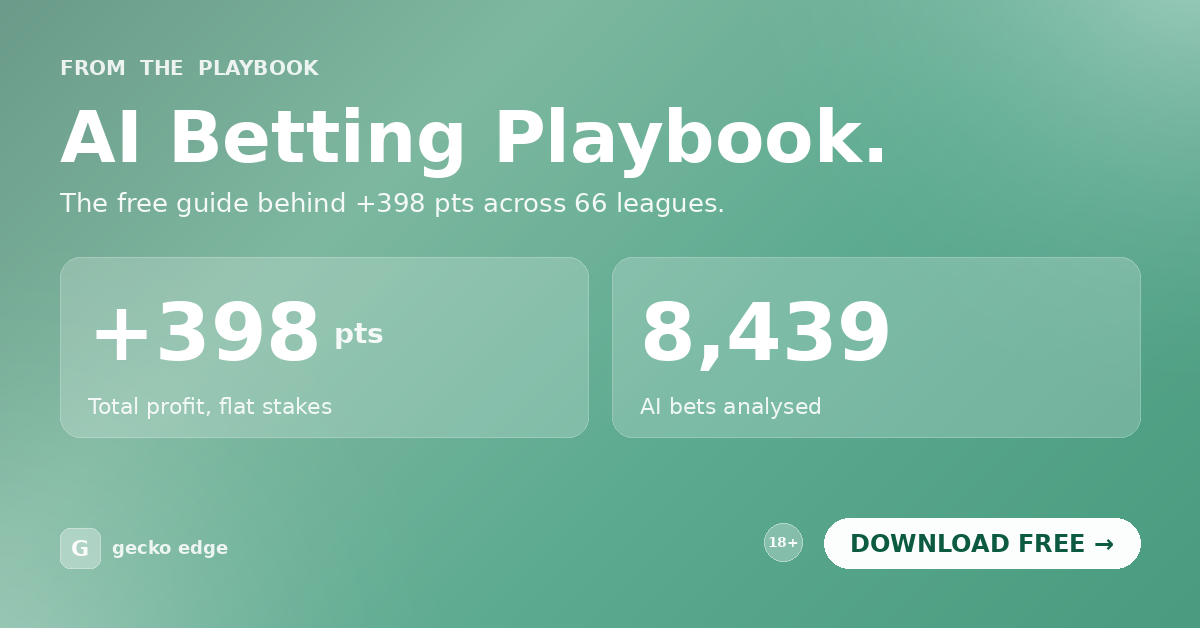
Gecko Edge has tracked 8,439 AI-generated bets and recorded +398pts of profit across 66 competitions. See how the model works →
In the world of professional betting, relying on narratives is a quick way to drain your bankroll. We prefer to look at the underlying mechanics. Is the bounce a genuine tactical shift, or is it just the inevitable result of probability correcting itself? Let’s look at the numbers.
The Anatomy of a Crisis
To understand the bounce, you have to understand why it happens. Usually, a manager is sacked when results are at their absolute floor. The team isn’t just losing; they are underperforming their own talent level.
Historically, data shows that in the Premier League, new managers earn an average of 7.31 points in their first six games. Compared to the 0.78 points per game that relegated teams usually average, that looks like a massive transformation. It’s a jump from “dead and buried” to “mid-table security.”
But here is the catch: Gecko Edge models suggest that much of this isn’t due to the new manager’s tactical genius. It is a phenomenon known as “Regression to the Mean.”

Regression to the Mean: The Great Illusionist
Imagine you flip a coin ten times and it comes up tails eight times. You decide to change the person flipping the coin. The next ten flips result in five heads and five tails. Did the new flipper “fix” the coin?
Of course not. The coin just returned to its natural probability.
Football teams are much the same. Boards usually sack managers when a team is on a statistically improbable run of bad luck or poor finishing. Even if they did nothing: even if they left the seat empty: results would likely improve simply because the “bad luck” window has to close eventually.
By using the ultimate guide to xG stats, we can see this clearly. Often, a team’s Expected Goals (xG) remains identical before and after a manager change, but their actual goals increase. The “bounce” is frequently just a return to finishing efficiency that was missing during the final weeks of the previous regime.
What Gecko Edge Data Actually Confirms
We analysed five seasons of managerial changes across Europe’s top five leagues. The results were telling. While 72% of clubs saw a points-per-game increase in the five matches following a hire, the “bounce” was rarely a revolution.
Here is what Gecko Edge looks for to determine if a bounce is “real” or “fake”:
- The Defensive Floor: A real bounce usually shows a significant drop in Expected Goals Against (xGA). New managers often “simplify” the game, focusing on a rigid defensive block. If the xGA drops, the bounce has legs.
- Shot Volume vs. Shot Quality: Fake bounces often rely on one or two long-range screamers. Real bounces involve an increase in touches in the opposition box.
- Set-Piece Efficiency: New managers often spend their first 48 hours on the training ground fixing set-piece routines. We’ve seen teams significantly over-perform in the corners market during the first three games of a new tenure.
The Psychological Sugar High
We cannot ignore the human element. A new manager provides a psychological reset. Players who were “frozen out” by the old boss suddenly have a point to prove. The intensity in training goes up. The stadium atmosphere shifts from hostile to hopeful.
This creates a short-term “sugar high.” It’s an spike in physical output: sprints, duels won, and distance covered. However, our AI models at Gecko Edge show that this physical spike usually lasts about four to six weeks. Once the “new car smell” wears off, the team’s performance usually reverts to whatever their squad depth and wage bill suggest it should be.

Trading the Bounce: A Professional Perspective
As a bettor, how do you handle this? You don’t just “back the bounce” blindly. You look for the disconnect between the market’s perception and the AI’s reality.
The market often overreacts to a new manager. They see a big name like Mourinho or Conte and immediately shave the odds on that team winning their next three matches. This is where the value lies for the analytical trader.
If Gecko Edge shows that a team’s underlying metrics (xG, xA, field tilt) haven’t actually improved despite a 2-0 win in the manager’s first game, the “bounce” is a mirage. In that scenario, we look to fade the team in their third or fourth match when the market still thinks they are “transformed,” but the data shows they are still the same struggling squad.
On the flip side, if the AI detects a genuine tactical shift: perhaps a move from a high press to a successful counter-attacking system: we can find value before the rest of the market catches on. You can find more on these tactical adjustments in our AI betting playbook.
The “Dead Man Walking” Phase
One of the most profitable times to use Gecko Edge isn’t actually after the manager is hired, but right before they are fired.
There is a period we call “The Noise.” This is when a manager has lost the dressing room, but hasn’t been sacked yet. The xG might look okay, but the “eye test” shows players walking back during transitions. Our AI tools can often spot these patterns of declining intensity before the board makes a move.
Smart betting isn’t just about finding winners; it’s about identifying when a team has “given up.” When you see that pattern, you aren’t just betting against a team; you’re betting against a broken culture.
Conclusion: Fact or Fiction?
So, is the New Manager Bounce fact or fiction?
The answer is: It’s a short-term fact driven by long-term fiction.
The points increase is real, but the reason for it is rarely “tactical genius.” It is a combination of regression to the mean, a temporary psychological lift, and often, a favourable run of fixtures that boards conveniently time with a sacking.
At Gecko Edge, we don’t buy into the narrative. We don’t care about the manager’s “passion” or their history with the club. We care about the numbers. If the data says the team is still conceding high-quality chances, we don’t care who is wearing the tracksuit on the touchline.
Smarter betting starts with seeing past the headlines. It starts with asking why things are happening, rather than just observing that they are. Whether you are looking at Asian Handicaps or match outcomes, let the AI filter the noise so you can find the signal.
The bounce might get the fans off the board’s back for a month, but it won’t fool the data. And it shouldn’t fool you.

Want to see the data for yourself? Explore the Gecko Edge knowledge base and start making informed decisions based on AI-driven insights, not just match-day myths.