



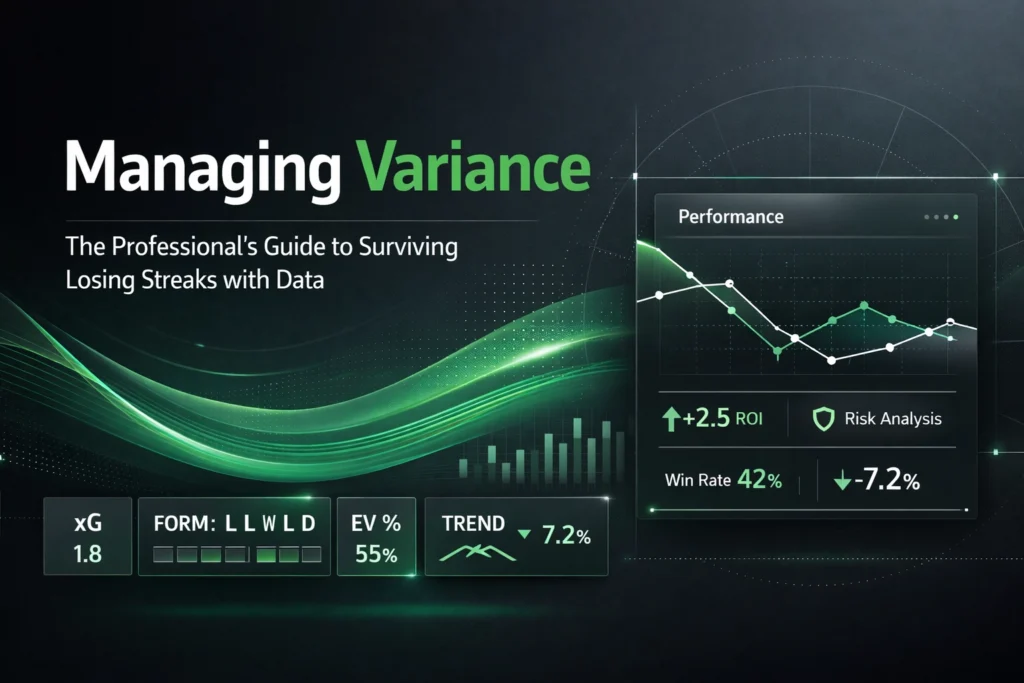
Every bettor hits them. Those brutal weeks where nothing lands. That’s variance. Where your carefully researched picks turn sour one after another. That’s variance. Where you start questioning everything.
Here’s the thing most people don’t tell you: losing streaks don’t mean your strategy is broken. They’re a mathematical certainty. Even the sharpest approach will hit rough patches. The difference between professionals and casual punters isn’t avoiding variance, it’s understanding it.
Let me walk you through how data-driven bettors survive the red weeks without losing their minds or their bankroll.
What Variance Actually Means (In English, Not Maths Class)
Variance is just the spread of outcomes around your expected result.
Think of it like this: you’ve got a coin that’s slightly weighted. It lands on heads 52% of the time. If you flip it ten times, you might get six heads. Or four. Or even just two.
That doesn’t mean the coin suddenly changed. It’s still 52%. But in small samples, anything can happen.
Same goes for betting. Your strategy might have a genuine edge, positive expected value, proper data backing it up, but over ten bets, twenty bets, even fifty bets, you can still end up in the red.

The maths behind it is simple: the more uncertain the outcome of each individual bet, the wider your variance. A coin flip that pays evens has less variance than a longshot accumulator. Both might have the same expected value, but one will swing your bankroll around far more violently.
Most bettors abandon good strategies during these swings. They panic. They chase. They convince themselves the edge is gone.
The professionals? They expected the swings in the first place.
Why Your +EV Strategy Will Still Lose (Sometimes A Lot)
Positive expected value doesn’t mean “wins every time.” It means over the long haul, you come out ahead.
Let’s say you’ve built a strategy that wins 55% of the time at evens. Brilliant, that’s a genuine edge. But here’s the reality: you can easily lose ten in a row. The probability isn’t zero. It’s unlikely, sure, but it happens.
I’ve seen bettors with proven models hit eight-week losing runs. Not because the model broke. Not because they suddenly forgot how to bet. Just because variance exists.
The math doesn’t care about your feelings. It doesn’t know you need a win to feel validated. It just plays out over thousands of bets, not dozens.
This is where most people crack. They see red and assume everything’s wrong. They start tweaking the strategy mid-stream, adding random filters, chasing different markets. They turn a temporary dip into permanent damage.
Gecko Edge users avoid this trap because they’ve already seen the variance before they placed the first bet.
How Backtesting Shows You The Future (Sort Of)
Here’s the secret weapon: backtesting.
Before you risk a penny, you can run your strategy through years of historical data. You see every win. Every loss. Every brutal three-week stretch where nothing clicked.
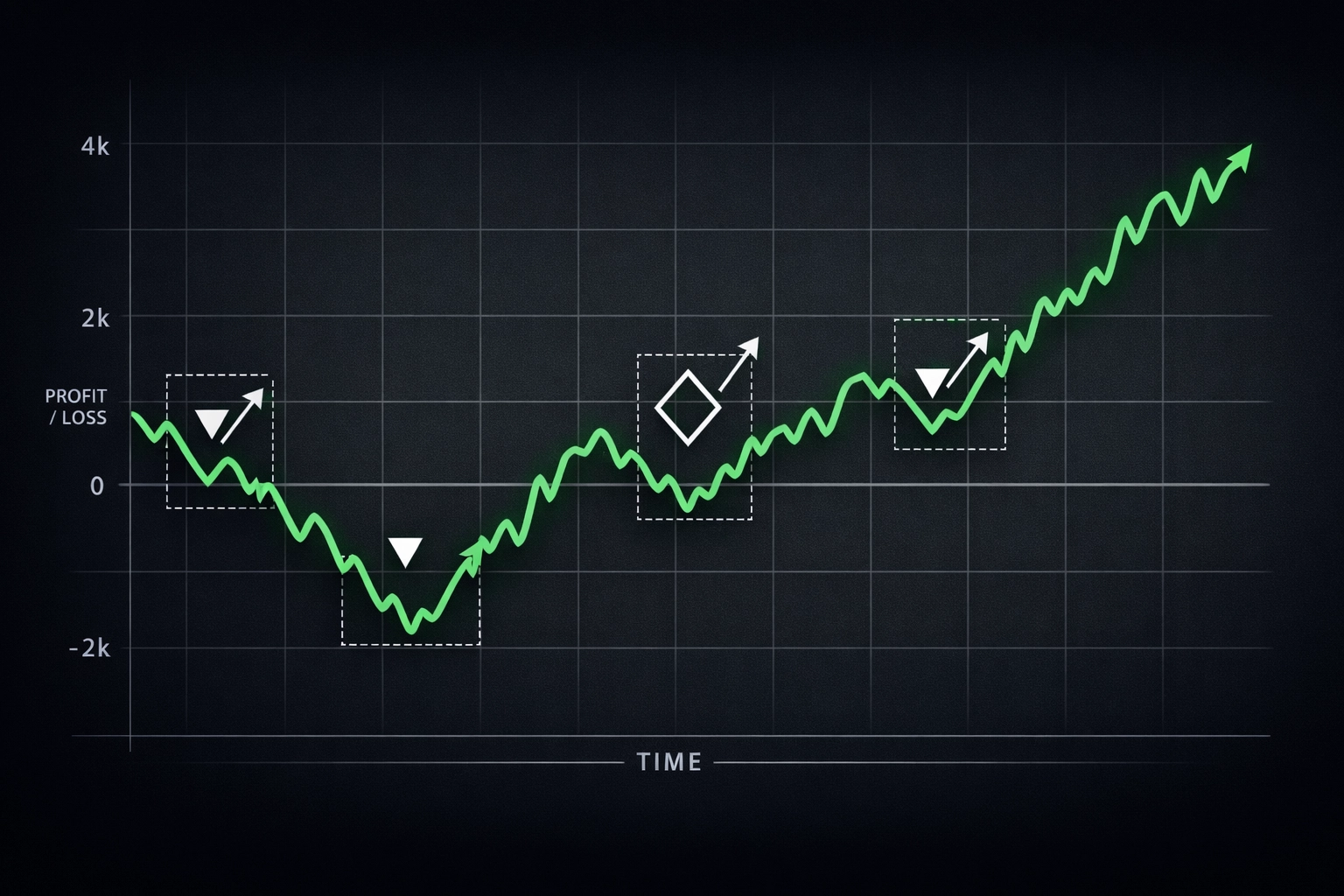
And here’s the beautiful part, you see that those stretches didn’t kill the strategy. You watch the line dip, then recover. Dip again, then push higher.
When you’ve seen your approach survive ten different losing runs in backtested data, the eleventh one in real time doesn’t feel like the end of the world. It feels like Tuesday.
Gecko Edge lets you build strategies, then stress-test them against massive datasets. You can filter by league, season, team form, anything. Then watch how the variance actually played out.
You learn your strategy’s personality. Some are steady with small swings. Others are volatile but explosive. Neither is wrong, you just need to know which you’re dealing with.
The confidence this builds is enormous. When you’re four bets down and your mates are asking if you’ve lost it, you can look at your backtest and say, “Yeah, this happened in 2019 too. Then I won seven straight.”
That’s not blind faith. That’s data.
The Psychology Trap (And How To Avoid It)
Let’s be honest: knowing the maths and feeling calm during a losing streak are two different things.
You can understand variance intellectually and still feel that knot in your stomach when bet number six loses. That voice that whispers, “Maybe this time it’s different. Maybe the edge is gone.”
This is where process beats emotion every single time.

Keep a record. Not just wins and losses, but why you placed each bet. What the model said. What the value was. When you’re in a rough patch, you can review and see: did I follow the strategy or not?
If you did, and you’re still losing, that’s variance. Annoying, but normal.
If you didn’t: if you started making reactive bets, chasing, going off-script: that’s a different problem. And at least now you know what to fix.
Gecko Edge makes this tracking automatic. Every pick, every model output, every result logged and analysed. You can look back at any rough patch and see exactly what happened. No guesswork. No selective memory.
Most bettors lose during variance not because the strategy failed, but because they stopped trusting it. The data keeps you honest. It reminds you that you’re playing the long game, not the last-five-bets game.
Building Variance Into Your Bankroll Strategy
Here’s the practical bit: if you know variance exists, you plan for it.
That means proper staking. Not betting 10% of your bankroll on every pick because “you’re confident.” Not doubling up after a loss to “get it back quick.”
The Kelly Criterion is one approach: staking a percentage based on your edge and the odds. Flat staking works too, especially when you’re still learning your strategy’s variance profile.
The point is this: your bankroll needs to be big enough to survive the bad runs without you going bust or panicking.
If your backtests show your strategy can lose fifteen units before bouncing back, then you need a bankroll that can handle that and then some. Maybe thirty units. Maybe fifty.
Most bettors are under-bankrolled. They treat betting like a hobby budget, then wonder why three losses feel like a crisis.
Professionals size for the worst-case scenario they’ve seen in the data, then add a buffer. Because sooner or later, you’ll hit a run worse than anything in your backtest. That’s variance too.
When To Actually Worry (Because Sometimes You Should)
I’m not saying ignore every losing streak. Sometimes, things do break.
Odds change. Markets adapt. A strategy that worked brilliantly in 2023 might be less effective now. Teams change managers. Leagues shift.
The question is: how do you tell the difference between variance and decay?
Simple. Compare current results to your backtested expectations.
If your model said you’d win 56% of the time and you’re at 54% after 200 bets, that’s probably just variance. If you’re at 48%, something’s changed.

Gecko Edge gives you real-time tracking against your backtested projections. You can see if you’re running within normal variance bands or if you’ve genuinely drifted off course.
This is where the AI modelling becomes invaluable. It’s not just tracking results: it’s constantly comparing them to expected distributions. It flags when something looks statistically off, not just emotionally rough.
You stop second-guessing your gut and start trusting the numbers. Which, if you’re using data to bet in the first place, is exactly what you should be doing.
The Long Game Is The Only Game
Professional bettors don’t obsess over individual results. They track edges, volume, and long-term ROI.
A losing week? Annoying. A losing month? Frustrating. But neither means the strategy is toast.
What matters is whether you’re making +EV decisions consistently. The results take care of themselves over time. Variance smooths out. The edge shows up.
Most people quit right before the curve turns. They hit variance, panic, and walk away: often just as the strategy is about to rebound.
The ones who survive are the ones who understood variance from day one. Who built it into their plan. Who used data to stay calm when intuition screamed otherwise.
Gecko Edge is built for exactly this. Strategy building. Backtesting. Real-time tracking. All designed to help you see through the noise and stick with what works.
Because in betting, the long game isn’t just the smart game. It’s the only game that matters.