
Expected value is the difference between making money and losing it long-term. Get it wrong, and you’re essentially gambling blindly. Get it right, and you’ve got a mathematical edge that compounds over time.
Most bettors skip this calculation entirely. They see odds, feel confident about a match, and place their bet. That’s not betting: that’s hoping with money involved.
Let us show you how to calculate EV properly, the mistakes that kill accuracy, and why Gecko Edge makes this entire process effortless with AI-powered calculations.
Gecko Edge has tracked 8,439 AI-generated bets and recorded +398pts of profit across 66 competitions. See how the model works →
The Foundation: What Expected Value Actually Means
Expected value tells you the average return you can expect from a bet if you placed it hundreds of times under identical conditions. It’s not about predicting one match result: it’s about understanding whether a betting opportunity is mathematically profitable over time.
Here’s the core formula:
EV = (Probability of Win × Potential Profit) – (Probability of Loss × Stake)
Simple enough. But accuracy depends entirely on getting those probabilities right. And that’s where most people fail.
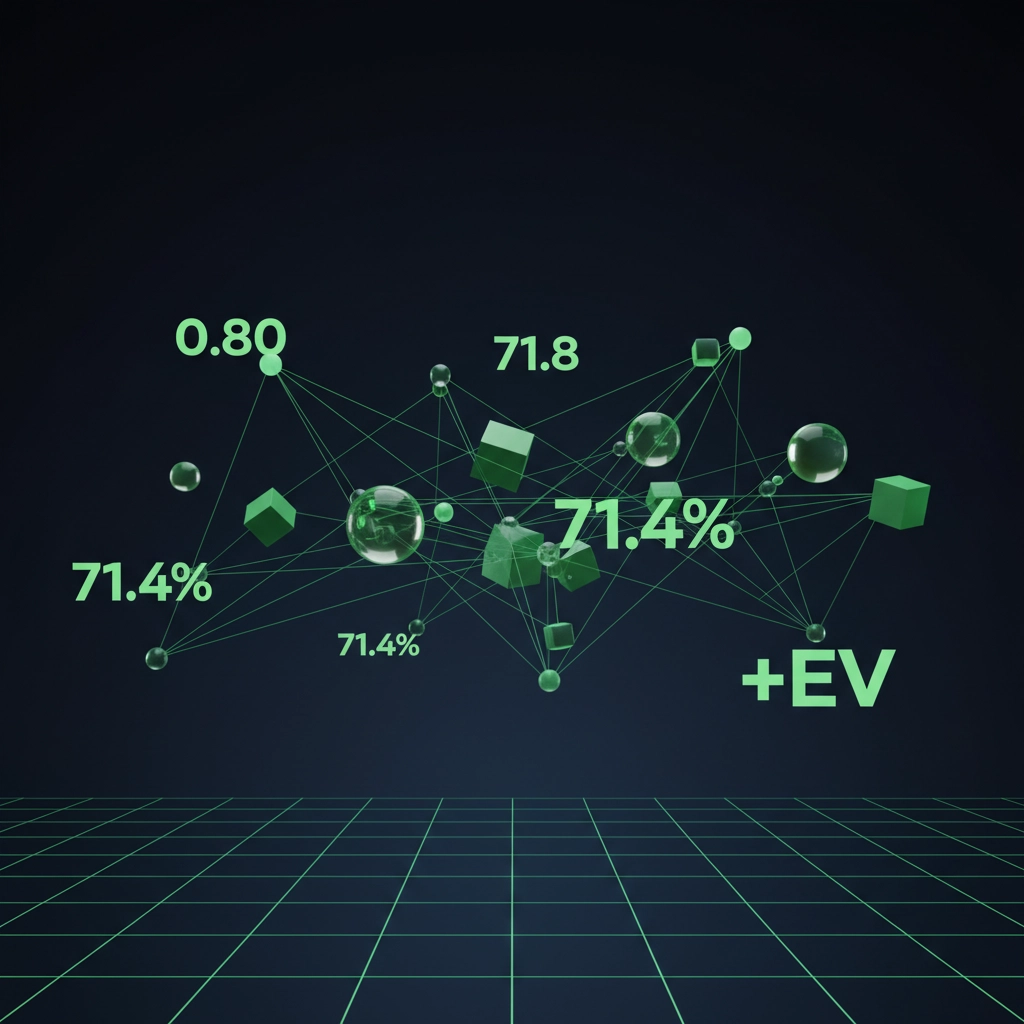
Expected Value: Step-by-Step +EV Calculation Process
Let’s work through a real example. Manchester City are playing at home against Brighton. The bookmaker offers odds of 1.40 for City to win.
Step 1: Convert Odds to Implied Probability
Decimal odds to implied probability: 1 ÷ odds = implied probability
1 ÷ 1.40 = 0.714 (71.4%)
This is what the bookmaker thinks City’s win probability is, including their margin.
Step 2: Estimate the True Probability
This is the crucial step. You need to determine City’s actual win probability based on your analysis. Consider:
- Recent form and results
- Head-to-head records
- Team news and injuries
- Home advantage factors
- Tactical matchups
Let’s say your analysis suggests City has an 80% chance of winning (0.80).
Step 3: Calculate the EV
- Stake: £100
- Potential profit if City wins: £40 (£140 return – £100 stake)
- Probability of winning (your estimate): 0.80
- Probability of losing: 0.20
EV = (0.80 × £40) – (0.20 × £100)
EV = £32 – £20 = +£12
Positive EV (Expected Value) means this bet is mathematically profitable long-term.
Step 4: Validate Your Calculation
Always double-check by considering if the implied probability makes sense. If bookmakers price City at 71.4% but you believe they have an 80% chance, that 8.6% difference represents your edge.
Common Mistakes That Kill Accuracy
Overconfidence Bias
The biggest error is inflating your team’s chances because you “feel” they’ll win. Emotion has no place in probability estimation. Your 80% confidence doesn’t mean 80% probability.
Ignoring the Bookmaker’s Margin
Bookmakers build profit margins into their odds. The true implied probability is lower than what the odds suggest. A 1.40 favourite might actually be priced as if they have a 68% chance, not 71.4%.
Using Historical Win Percentages Blindly
“Arsenal win 65% of their home games” doesn’t mean they have a 65% chance against Liverpool. Context matters more than raw percentages.
Forgetting About Draw Probability
In football, draws happen roughly 25-30% of the time. Many bettors calculate EV on win/loss scenarios and forget the third outcome entirely.

Advanced EV Calculations for Football Markets
Over/Under Goals Markets
For a match with Over 2.5 goals at odds of 2.00:
Your estimated probability of 3+ goals: 55%
Implied probability: 50%
Stake: £100
EV = (0.55 × £100) – (0.45 × £100) = £55 – £45 = +£10
Asian Handicap Example
Liverpool -1 Asian Handicap at 1.90:
- Your probability Liverpool wins by 2+: 60%
- Implied probability: 52.6%
- Stake: £100
EV = (0.60 × £90) – (0.40 × £100) = £54 – £40 = +£14
Correct Score Betting
This gets complex quickly. For a 2-1 home win priced at 8.00:
- Your estimated probability: 15%
- Implied probability: 12.5%
- Stake: £20
EV = (0.15 × £140) – (0.85 × £20) = £21 – £17 = +£4
Improving Your Probability Estimates
Use Multiple Data Sources
Don’t rely on one metric. Combine:
- Expected goals (xG) data
- Recent form trends
- Squad availability
- Historical matchup data
- Market sentiment
Track Your Accuracy
Keep records of your probability estimates vs. actual outcomes. If you predict 70% win probability 100 times, roughly 70 should win. If not, you’re systematically over or underestimating.
Understand Model Limitations
No model captures everything. Weather, referee decisions, individual brilliance: football has random elements that affect outcomes but can’t be quantified easily.

Why Manual EV (Expected Value) Calculations Are Getting Harder
Modern football generates massive amounts of data. Player heat maps, pass completion rates, defensive actions, set-piece statistics: the variables affecting match outcomes multiply constantly.
Processing this information manually while maintaining accuracy becomes nearly impossible. You’re competing against:
- Professional trading teams with advanced models
- AI Betting systems processing real-time data
- Bookmakers with sophisticated pricing algorithms
That’s where Gecko Edge changes everything.
The Smarter Way: AI-Powered Expected Value (+EV) Calculations
Gecko Edge processes thousands of data points in real-time to generate accurate probability estimates and EV calculations. Instead of spending hours analyzing team sheets and form guides, you get precise mathematical edges instantly.
The AI Betting Model considers factors human analysis often misses:
- Micro-trends in player performance
- Weather impact on playing styles
- Referee tendencies for specific matchups
- Real-time market movements
- Historical pattern recognition
While you’re manually calculating whether Liverpool at 1.50 offers value, Gecko Edge has already identified three positive EV opportunities you missed entirely.
Practical Tips for Better Expected Value Calculations
Start Conservative
When estimating probabilities and expected value, err on the conservative side initially. It’s better to miss a marginally positive EV bet than to inflate your estimates and place negative EV bets.
Focus on Familiar Leagues
Your probability estimates will be more accurate for competitions you follow closely. Don’t try to calculate EV for obscure leagues where your knowledge is limited.
Use Closing Line Value
Compare your bets to closing odds. If you consistently bet teams that drift in price, you’re likely overestimating their chances.
Consider Correlated Markets
If you think a match will be high-scoring, both teams scoring and over 2.5 goals become more likely. Your EV calculations should reflect these correlations.
Account for Variance
Even positive EV bets lose frequently. Liverpool at 80% true probability still loses 20% of the time. Size your bets to survive the inevitable losing streaks.
Moving Beyond Basic Expected Value Assessments
Once you master basic EV calculations, consider:
Kelly Criterion sizing – Optimizing bet size based on EV and probability
Portfolio effects – How multiple bets interact with each other
Live betting EV – Calculating value as matches progress
Arbitrage identification – Finding guaranteed profits across different bookmakers
But here’s the reality: manual calculation for all these scenarios becomes overwhelming quickly. Professional bettors either specialise in narrow areas or use sophisticated tools.
Gecko Edge handles the complexity while you focus on the bigger picture: identifying opportunities and managing your bankroll effectively.
Expected value separates profitable bettors from gamblers. Calculate it accurately, respect what it tells you, and you’ll have a mathematical framework for long-term success. Or let Gecko Edge do the heavy lifting while you focus on what matters most( making smart betting decisions based on solid mathematical foundations.)

3 comments