



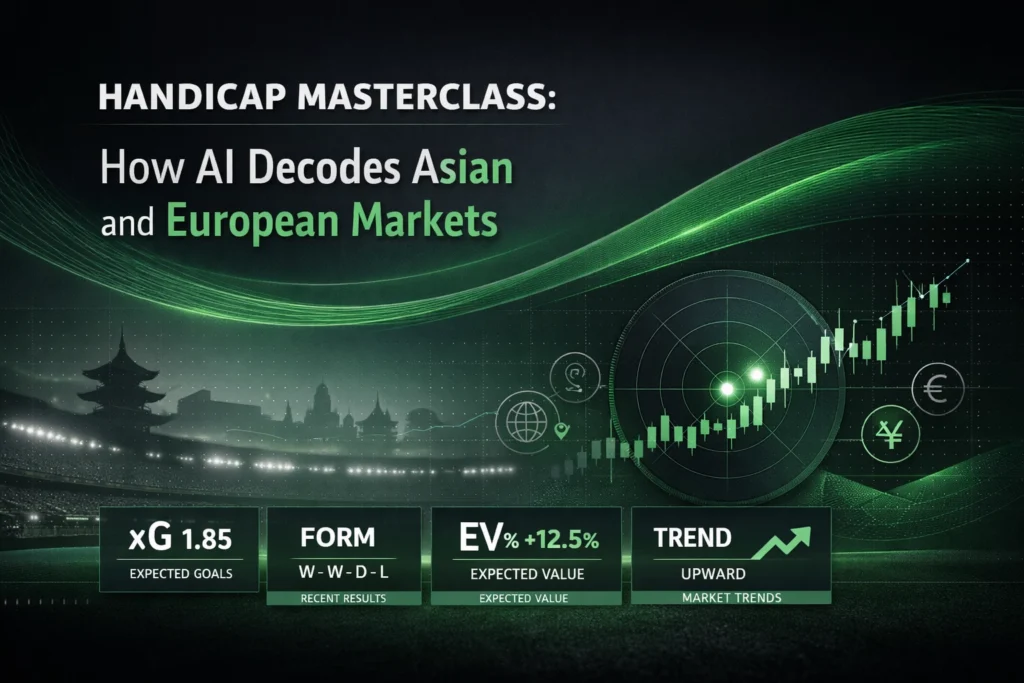
Asian Handicap; if you’ve spent any time looking at a sportsbook, you’ve seen them: the pluses, the minuses, and those confusing decimals like -0.75 or +1.25. To the uninitiated, handicap markets look like a complicated maths exam. To a seasoned pro, they are the most fertile ground for finding value.
At Gecko Edge, we see these markets as more than just “head starts.” They are mathematical puzzles. When the bookie gives a team a one-goal deficit, they aren’t just guessing; they are trying to balance the scales so that both sides of the bet look equally attractive. Our job: and the job of our AI: is to figure out where that balance is slightly off.
In this masterclass, we’re going to strip away the jargon. We’ll look at the differences between Asian Handicap and European Handicap and, more importantly, how we use technology to spot the “true” line before the market catches up.
Gecko Edge has tracked 8,439 AI-generated bets and recorded +398pts of profit across 66 competitions. See how the model works →
The Goal Behind the Head Start
At its core, a handicap is designed to make a one-sided match interesting. If the league leaders are playing a team in the relegation zone, nobody wants to bet on the favourite at odds of 1.10. It’s boring, and the risk-to-reward ratio is rubbish.
By applying a handicap, the bookmaker effectively starts the game at 0-1 or 0-2. Now, the favourite has to win by three clear goals for your bet to land. Suddenly, the odds are back to evens, and the game is a contest again.
But there are two very different ways this is handled in the betting world: the European way and the Asian way. Understanding the difference is the first step toward smarter betting.

European Handicaps: The Traditional Three-Way
The European Handicap (EH) is the simpler of the two. It behaves exactly like a standard Match Result (1X2) bet, but with a predetermined scoreline added at the start.
Because it’s a three-way market, you have three options: Home, Draw, or Away.
Let’s say Arsenal are playing at home against Fulham. The bookie offers a European Handicap of -1 for Arsenal.
- Arsenal (-1): You need Arsenal to win by two goals or more (2-0, 3-1, etc.).
- Handicap Draw (-1): You need Arsenal to win by exactly one goal (1-0, 2-1, 3-2). In this scenario, the “-1” makes the “adjusted” score a draw.
- Fulham (+1): You need Fulham to draw or win the match.
The “Draw” option is what makes the European market tricky. It’s an all-or-nothing affair. If you bet on Arsenal -1 and they only win 1-0, you lose your stake. There is no safety net. This is why EH markets often offer higher odds: they are riskier because the “Draw” remains a valid outcome.
Asian Handicaps: The Punter’s Favourite
Now, let’s talk about the Asian Handicap (AH). This is where the professionals live. Why? Because it eliminates the possibility of a draw, effectively turning a three-way market into a two-way market.
If the game ends in a “tie” after the handicap is applied, your stake is simply returned to you. This is called a “Push.”
But the AH goes deeper with half-goals and quarter-goals:
- Full Lines (e.g., -1.0, -2.0): If your team wins by exactly the margin specified, you get your money back.
- Half Lines (e.g., -0.5, -1.5): There is no possibility of a push. You either win or you lose. A -0.5 handicap is effectively the same as a straight “To Win” bet.
- Quarter Lines (e.g., -0.75, -1.25): This is where people get confused, but it’s actually quite brilliant. A -0.75 bet splits your stake in half: 50% goes on the -0.5 line and 50% goes on the -1.0 line.
If your team wins by one goal, you win half your bet (the -0.5 part) and get the other half back (the -1.0 part). It’s a way of hedging your bets within a single selection.

Why the Market Matters to AI
You might wonder why Gecko Edge cares about these distinctions. It’s because liquidity and efficiency live in the Asian markets.
Most of the world’s smartest money flows through Asian Handicap lines. Because these markets move fast and react to every bit of news: injuries, line-up changes, even weather: they are incredibly efficient.
However, “efficient” doesn’t mean “perfect.”
Our AI at Gecko Edge analyses historical data, real-time performance metrics, and situational factors to calculate the “True Line.” While the bookie might set the line at -1.25 based on public perception and recent form, our algorithms might suggest the true probability sits closer to -1.75. That gap is where we find our edge.
The AI Engine: Decoding Probability into Value
Most bettors look at a game and think, “I think they’ll win by a couple.” That’s a feeling, not a strategy.
Gecko Edge doesn’t have feelings. It has data. When we decode a handicap market, the AI is performing millions of simulations for that specific fixture. It looks at:
- Goal Supremacy: How many more goals is Team A expected to score than Team B?
- Variance: How likely is a “fluke” result based on the teams’ defensive structures?
- Market Pressure: Is the line moving because of smart money or “mug” money?
The goal of all this processing is to reach a single, holy grail number: the Expected Value (EV).

Calculating EV: The Real Source of Profit
If you want to move from a hobbyist to a professional mindset, you need to understand EV. It is the only metric that matters in the long run.
Expected Value tells you how much you can expect to win (or lose) per bet if you were to place the same bet on the same odds an infinite number of times.
The formula is simple:
EV = (Probability of Winning × Amount Won per Bet) – (Probability of Losing × Amount Lost per Bet)
Let’s apply this to a Handicap.
Imagine Gecko Edge calculates that Liverpool has a 65% chance of covering a -1.5 Asian Handicap against Chelsea. The bookie is offering odds of 2.10.
- Probability of Winning: 0.65
- Amount Won (on a £10 stake): £11 (Profit)
- Probability of Losing: 0.35
- Amount Lost: £10
EV = (0.65 × 11) – (0.35 × 10)
EV = 7.15 – 3.50 = +3.65
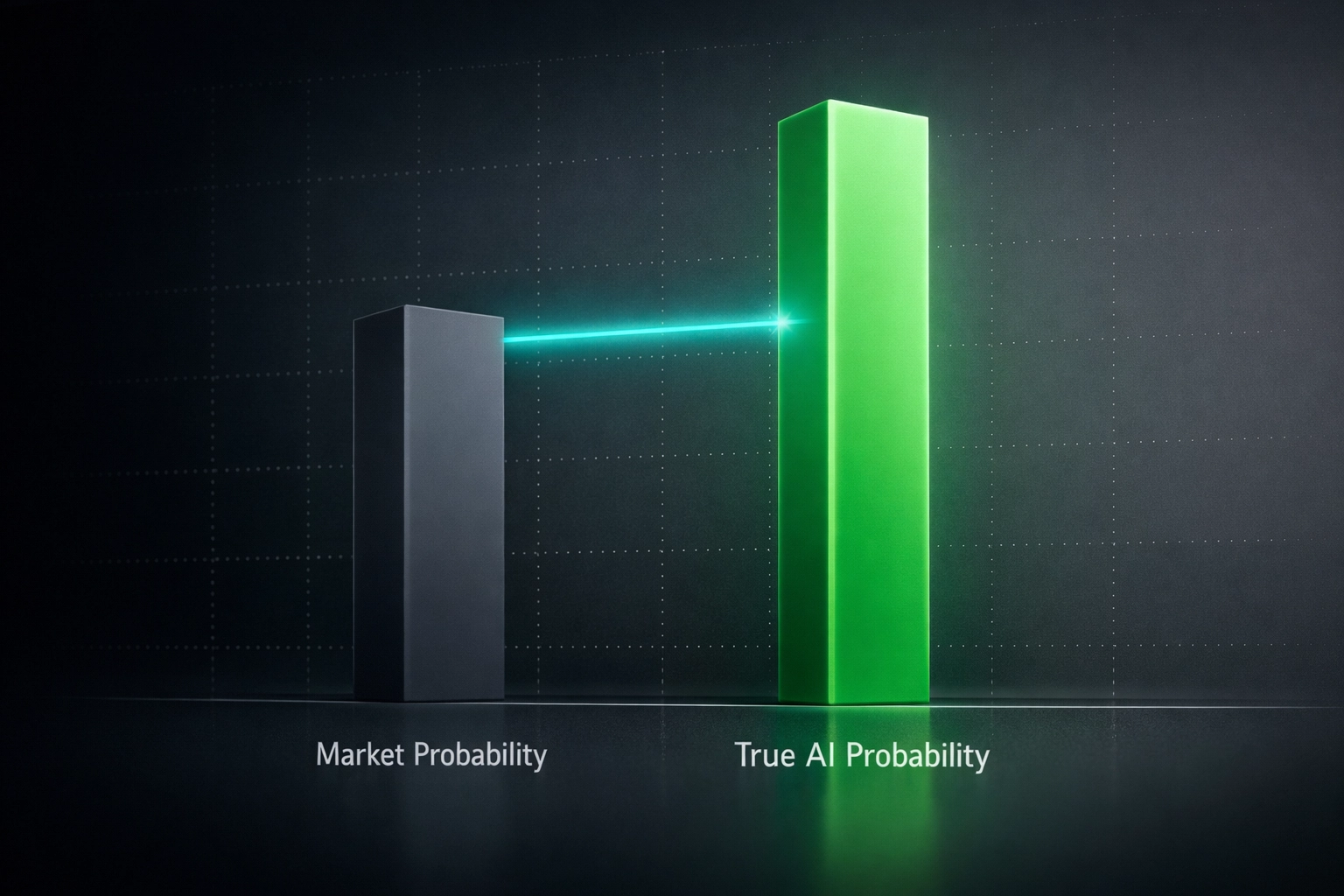
In this scenario, the EV is positive. A positive EV means that over time, this bet is mathematically guaranteed to make money. The bookie’s odds suggest Liverpool only has a ~47% chance of covering that line (1 / 2.10). Because our AI has identified the “true” probability is 65%, we’ve found a massive discrepancy.
Smarter betting starts here: we don’t bet on who we think will win; we bet when the probability is in our favour.
Asian vs. European: Which Should You Choose?
At Gecko Edge, we generally lean toward Asian Handicaps. The reasons are simple:
- Lower Margin: Asian markets usually have a lower “overround” (the bookie’s built-in profit), meaning you get better prices.
- Reduced Variance: The ability to “Push” or win half-stakes protects your bankroll from the volatility of late, meaningless goals.
- Flexibility: You can fine-tune your risk. If you’re confident but want a safety net, you take the -0.75. If you want to go for blood, you take the -1.5.
However, the European Handicap has its place, especially when our AI identifies a high probability of a “clinch” win (exactly one goal). If the data shows a team is defensively rock-solid but lacks a clinical edge up front, the “Handicap Draw -1” in the European market often holds hidden value that the Asian market misses.
Final Thoughts: Complexity is Your Friend
Handicap markets can feel daunting. The fractions and the different rules for “Pushes” take a bit of getting used to. But in the world of betting, complexity is a filter. It scares away the casual punters who just want to bet on a “Home Win” and go to the pub.
By mastering these markets: and using a tool like Gecko Edge to handle the heavy lifting of EV calculations: you are already ahead of 95% of the market.
We aren’t here to gamble. We’re here to find price inefficiencies using the best technology available. Whether it’s a -0.25 line in the J-League or a +2.0 line in the Champions League, the goal remains the same: ask the data, analyse the probability, and act when the value is clear.
Built For Bettors, Powered By AI. That’s how we do things at Gecko Edge. If you’re ready to stop guessing and start calculating, you’re in the right place.
Learn more about our approach at https://geckoedge.ai or dive into our Knowledge Base to sharpen your skills further.