Match Timing; the Saturday 12:30 PM kick-off is the fixture everyone loves to hate. Managers complain about recovery times, fans grumble about early trains, and bettors often approach the early window with a sense of dread. There is a persistent narrative in the football world that early starts lead to “sleepy” matches: low-intensity, low-scoring affairs that kill the entertainment value and, more importantly, the betting value.
But at Gecko Edge, we don’t trade in narratives. We trade in data.
The “early kick-off curse” is a classic example of cognitive bias. When a 12:30 game ends in a 0-0 draw, it reinforces the myth. When it’s a 4-3 thriller, we treat it as an outlier. If we want to find a genuine edge, we need to separate the sporting reality from the commercial economics. Does the time on the wall actually dictate the number of times the ball hits the back of the net?
Gecko Edge has tracked 8,439 AI-generated bets and recorded +398pts of profit across 66 competitions. See how the model works →
The Myth of the Morning Snooze
The argument against early kick-offs usually centres on physiology. The idea is that players’ circadian rhythms are disrupted. They aren’t used to peak physical exertion at lunch time. Travel schedules are compressed, and the pre-match meal: the “pre-match pasta”: is consumed at an hour most of us are still considering a second coffee.
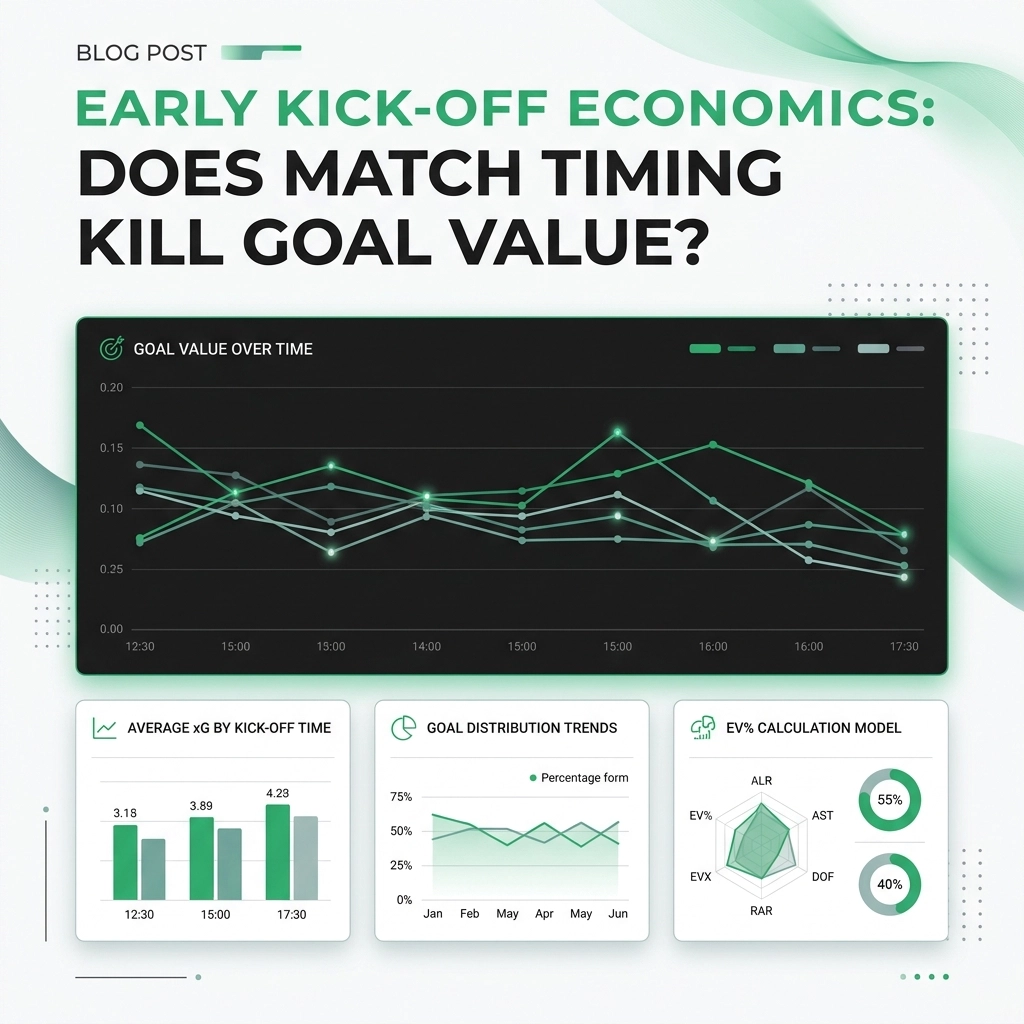
From a purely statistical perspective, there is a grain of truth here, but it’s thinner than you might think. Data across the last several Premier League seasons suggests that early kick-offs produce slightly fewer goals on average than evening games. We are talking about a difference of roughly 0.1 to 0.15 goals per game.
In the world of professional betting, that is a margin, but it isn’t a “killer.” It’s a nudge. The intensity might start lower as teams feel each other out, but the fundamental sporting value of a goal remains unchanged. A goal scored at 12:45 PM is worth exactly the same three points as one scored at 8:15 PM.

Sporting Value: The Clock on the Wall vs. The Clock on the Pitch
When we talk about “goal value,” we have to distinguish between sporting value and market value. Sporting value is the impact a goal has on the probability of a win, draw, or loss.
Economically, the sporting value of a goal is dictated by the match clock, not the wall clock. A goal scored in the 10th minute has a moderate impact on the final result because there is still 80 minutes of “noise” and recovery time for the opposition. A goal scored in the 85th minute has massive marginal value because it effectively kills the game.
Gecko Edge treats every minute with the same analytical precision. Whether it’s an early kick-off or a late-night cup tie, the ultimate guide to xG stats remains your best friend. The value of a goal is a function of time remaining and current scoreline. The fact that the sun is at its zenith doesn’t change the mathematics of win probability.
If the “early kick-off effect” exists, it manifests in the timing of goals within the game. We often see a slower first half in 12:30 starts as players find their legs. For the smart trader, this isn’t a reason to stay away; it’s a reason to look for late-game value when the initial lethargy wears off and the tactical shape of the match begins to break down.
The Economics of Global Eyeballs
If early kick-offs are unpopular with players and local fans, why do they exist? The answer is simple: Economics. Specifically, the economics of the Asian and Middle Eastern markets.
A 12:30 PM start in London is prime-time viewing in Beijing, Tokyo, and Bangkok. From a commercial perspective, the “value” of a goal in an early kick-off is arguably higher for the league and its sponsors than a 3:00 PM game that isn’t televised domestically.
More eyeballs mean more advertising impressions, more betting volume in global markets, and higher sponsorship valuations. While a local fan might feel the atmosphere is “flat,” the commercial engine is purring. This global demand ensures that the biggest teams: the ones most likely to score goals: are frequently scheduled for these slots.
This creates a paradox. While the “early start” might slightly depress scoring rates, the “quality of teams” selected for these slots often pulls the average back up. You are seeing the league’s best assets being showcased to the world’s largest audience.

Market Bias: Where the Value Lives
For a bettor, the most important question isn’t “are there fewer goals?” but “does the market overestimate how many fewer goals there will be?”
The betting public is heavily influenced by narratives. If the media spends all week talking about how “the 12:30 game is always a bore,” the casual money starts flowing toward the ‘Under’. When the market overcorrects, the value flips to the ‘Over’.
At Gecko Edge, we use AI to strip away the noise. Our AI betting playbook doesn’t care about what a pundit said on a Friday night preview show. It looks at real-time performance data.
If two high-pressing teams with high Expected Goals (xG) outputs are playing at 12:30, the “early start” factor is often negligible compared to their tactical setup. If the market has dropped the goal line because of the time of day, that is an inefficiency. And in this game, inefficiency is where the profit is hidden.
Atmosphere and the Away Fan Factor
One legitimate factor that impacts early games is the crowd. A 12:30 PM kick-off often means a smaller or quieter away following. Travel disruptions are common, and the lack of “pre-match liquid refreshment” for the home fans can lead to a more sterile environment.
Crowd energy influences refereeing decisions and player intensity (the “home field advantage” effect). In our analysis, we’ve seen that the home advantage can be slightly diluted in these early windows. The game becomes more of a tactical chess match and less of an emotional battle.
If you are a fan of Asian Handicap betting, this is a crucial variable. A dominant away team might find it easier to control a game at 12:30 PM without a raucous home crowd breathing down their necks. The “match timing” doesn’t kill goal value; it redistributes it.

Smarter Betting Starts with Data, Not Narratives
So, does match timing kill goal value? No. It slightly alters the conditions under which that value is generated.
The sporting value of a goal is a mathematical constant relative to the match clock. The commercial value of a goal is actually higher in early slots due to global reach. The only thing that truly “kills” value for a bettor is following the herd into a biased narrative.
Instead of worrying about the kick-off time, focus on the variables that matter:
- Tactical match-ups: Does the early start favour the more disciplined, tactical side?
- Squad depth: Teams playing in Europe on Wednesday night will struggle more with a Saturday 12:30 start than those who have had a full week of rest.
- Market sentiment: Is the ‘Under’ being hammered just because it’s lunch time?
Gecko Edge was built for bettors and powered by AI to handle exactly these kinds of complexities. We process thousands of data points: from player fatigue to historical match timing trends: so you don’t have to guess.
The Final Verdict
The 12:30 PM kick-off is an economic necessity in the modern game. While it might occasionally produce a sluggish start, the idea that it “kills” value is a myth. For the analytical bettor, these games offer a unique window into market psychology.
When the world is complaining about their “boring” Saturday lunch-time match, we are busy looking for the edge that the narrative has left behind. Don’t let the clock dictate your strategy. Let the data do the talking.
Whether it’s 12:30 PM or 8:00 PM, the goal remains the same: find the value, manage your risk, and trust the numbers. Smarter betting starts here.

Meta Title: Early Kick-Off Economics: Does Match Timing Kill Goal Value? | Gecko Edge
Meta Description: Does the 12:30 PM kick-off actually lead to fewer goals? Explore the data behind the early kick-off myth and learn how to find betting value in early starts with Gecko Edge.
Meta Keywords: early kick-off betting, 12:30 kick-off stats, goal value, football betting economics, AI betting strategies, Gecko Edge, match timing impact, Premier League data.