

Predictive Football Models; every Saturday morning, the ritual is the same. You turn on the television or open a social media feed and encounter the “experts.” They are former players with storied careers, speaking with absolute certainty about how a team “wants it more” or why a specific manager has “lost the dressing room.” It is compelling television. It is high drama.
But for those of us looking for an edge in the markets, it is mostly noise.
In the world of professional betting, we have moved past the era of the “gut feeling.” We have entered a space where Gecko Edge thrives: a space defined by cold, hard numbers and the relentless application of the scientific method. This is the realm of predictive football models. While the pundits focus on the narrative, the data focuses on the probability.
If you want to understand why the smartest people in the room are consistently outperforming the loud voices on the screen, you have to understand the maths behind the match.
The Flaw in Human Punditry: Narrative Bias
Human beings are wired for stories. We love a comeback. We love a “bogey team” narrative. Pundits capitalise on this because their job is to entertain, not to be accurate. When a pundit says a team is “due a win,” they are falling for the gambler’s fallacy. When they claim a player is “clutch,” they are often just observing a small sample size of positive variance.
Predictive models do not have feelings. They do not remember the “glory days” of a specific club, and they certainly don’t care about a manager’s charisma during a press conference. They look at thousands of data points to find the signal within the noise. At Gecko Edge, we believe that smarter betting starts with acknowledging our own biases and replacing them with algorithms that don’t blink.

The Foundation: From Poisson to Probability
The science of predicting football isn’t new, but it has become significantly more sophisticated. It started with simple statistical distributions. The most famous is the Poisson distribution.
In its simplest form, a Poisson model takes the average number of goals a team scores and concedes and calculates the likelihood of various scorelines. It’s a solid starting point for any beginner, but it has a major flaw: it assumes goals are independent events. We know they aren’t. A red card, a tactical shift, or the scoreline itself changes the probability of the next goal.
Modern predictive football models have evolved. We now use rating systems like Elo or pi-ratings to assess team strength over time. Unlike a pundit who might change their mind based on one bad result, these systems look at long-term performance, adjusting slightly after every match. They recognise that beating the league leaders 1-0 is worth far more than beating a relegation-bound side 4-0.
The Game Changer: xG Football Analysis
If you’ve spent any time in the knowledge base, you’ll know that xG football analysis (Expected Goals) has revolutionised how we view the game.
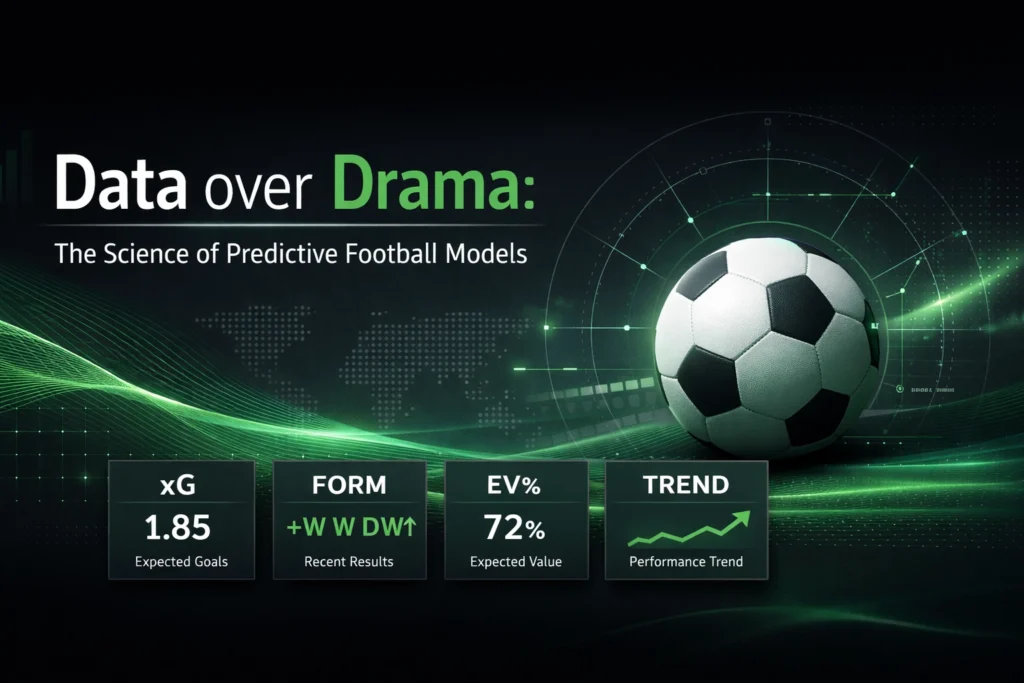
Before xG, we looked at shots on target. But all shots are not created equal. A header from the edge of the box under pressure is fundamentally different from a tap-in at the back post. xG assigns a value to every single shot based on historical data: thousands of similar shots: to determine the probability of it resulting in a goal.
Why does this outperform pundits? Because pundits react to the result. If a team wins 1-0 despite having only one lucky shot, the pundit calls it a “gritty performance.” The data scientist looks at the xG and sees a team that was lucky and is likely to regress to the mean. By focusing on the quality of chances created rather than just the goals scored, we can see the future more clearly than those who only look at the scoreboard.

The Frontier: Machine Learning and Ensemble Methods
This is where Gecko Edge truly differentiates itself. We aren’t just looking at averages; we are looking at complex patterns.
The current gold standard in football prediction involves machine learning models like XGBoost and CatBoost. These are “ensemble methods”: they build hundreds of “decision trees” to find the most accurate prediction.
Imagine asking 1,000 different experts to predict a match, but each expert only looks at one specific thing: one looks at home advantage, one looks at player fatigue, one looks at the weather, and another looks at the specific referee’s tendency to award penalties. Machine learning does this simultaneously, weighting each factor based on its historical importance.
Research shows that “feature engineering”: the act of choosing which data to feed the model: is more important than the model itself. At Gecko Edge, we refine these inputs constantly. We don’t just feed the machine “goals”; we feed it shot distance, defender proximity, and even player-level plus-minus ratings.
Simulating the Madness: Monte Carlo Methods
Football is a low-scoring game, which means it is prone to high levels of randomness. A ball hitting the inside of the post instead of the outside can change a season.
To account for this, professional models use Monte Carlo simulations. Instead of predicting a result once, the model simulates the match 10,000 or 15,000 times. This doesn’t give us a “win” or a “loss.” It gives us a probability distribution.
If a model says a team has a 65% chance of winning, it doesn’t mean they will win. It means that if that game were played 100 times under the exact same conditions, they would win 65 of them. This distinction is vital for responsible betting. We aren’t looking for certainties; we are looking for value where the market’s probability is lower than our model’s probability.

Why AI Always Wins the Long Game
Pundits have “good weeks” and “bad weeks.” They are prone to recency bias: giving too much weight to what happened yesterday and forgetting what happened last month.
AI doesn’t have a memory in the emotional sense. It has data. By using predictive football models, we can maintain a level of consistency that a human brain simply cannot match. We can process the data for every game in every league simultaneously, finding opportunities that no human “expert” would ever have the time to uncover.
At Gecko Edge, we believe in the philosophy of “Ask, Analyse, Act.”
- Ask: What does the data say about this specific matchup?
- Analyse: How do the xG trends and rating systems align?
- Act: Place the bet only when the maths supports the move.

Building Your Own Edge
You don’t need a PhD in statistics to benefit from this science. That is why we built Gecko Edge. We do the heavy lifting: the feature engineering, the machine learning, the 15,000 simulations: so you can focus on making informed decisions.
Whether you are looking for AI betting tips or want to dive deeper into AI betting education, the goal is the same: to move away from the drama of the pundit and toward the clarity of the data.
The “experts” will keep talking. They will keep telling stories about “passion” and “desire.” Let them. While the world watches the drama, we will keep our eyes on the data. Because in the long run, the science of prediction isn’t about being loud: it’s about being right more often than you are wrong.
Built for bettors, powered by AI. That is the Gecko Edge way. If you’re ready to stop guessing and start calculating, you’re in the right place. Explore our blog to stay ahead of the curve.