Correlation Risk; the dream is always the same. A five-fold accumulator, a modest stake, and a payout that looks like a phone number. It is the classic allure of the multi-bet. You feel you have diversified your risk across different matches or markets, but often, the opposite is true.
In the world of professional trading, we talk a lot about “correlation risk.” For the casual bettor, it is the silent bankroll killer. It is the moment you realise that by adding more legs to your slip, you haven’t actually increased your edge, you have simply compounded your mistakes.
At Gecko Edge, we look at data through a sharp lens. We don’t see a “lucky parlay.” We see a series of mathematical dependencies. If you want to move from a hobbyist to a professional mindset, you need to understand why your multi-bet might be working against you.
Gecko Edge has tracked 8,439 AI-generated bets and recorded +398pts of profit across 66 competitions. See how the model works →
The Mechanics of Correlation
In simple terms, correlation is how much two events rely on each other. In football, almost nothing happens in a vacuum.
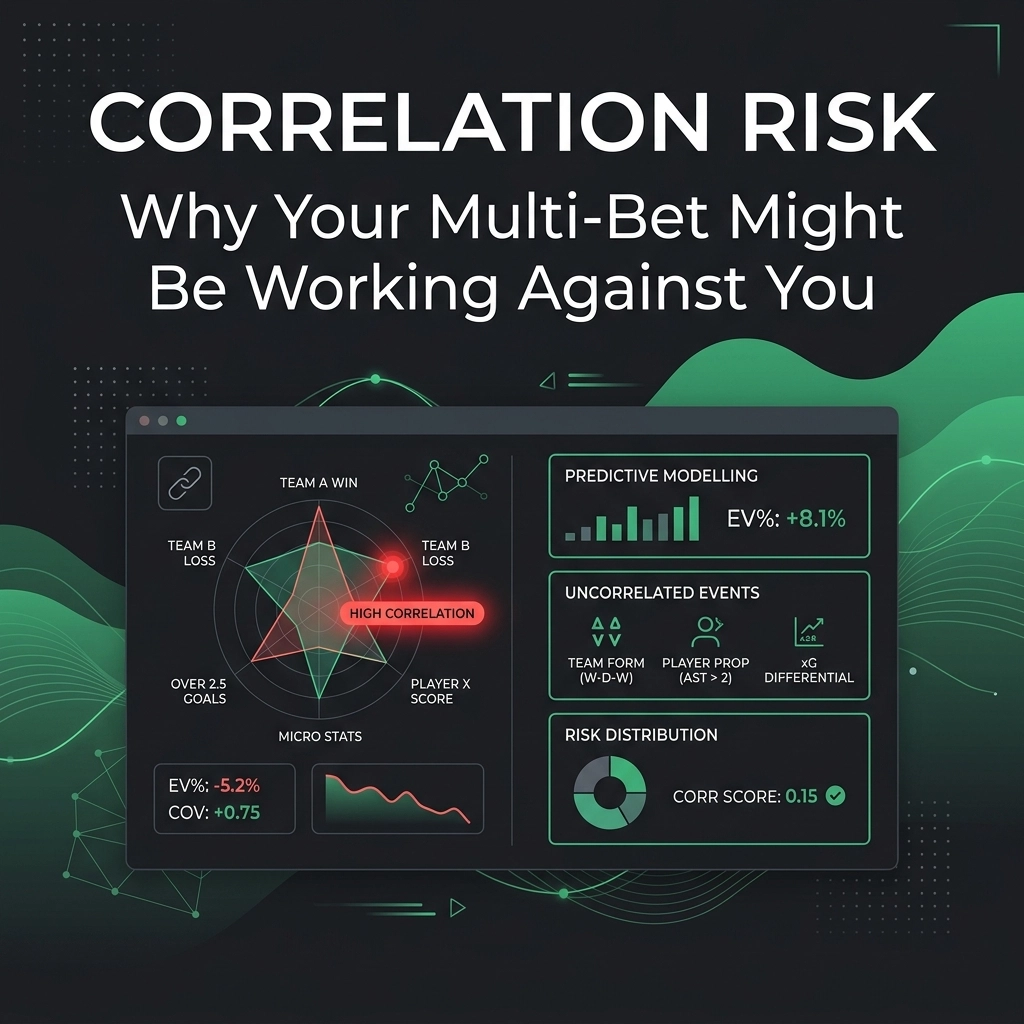
If you bet on a team to win and also bet on them to score over 2.5 goals, those two events are highly correlated. If they win 3-0, both bets land. If they lose 1-0, both bets fail. You might think you are doubling your fun, but you are actually just concentrating your risk on a single outcome: that team’s offensive performance.
Bookmakers are experts at identifying these “related contingencies.” This is why they won’t let you put certain combinations into a standard accumulator, or why the odds for a “Bet Builder” always seem slightly lower than the sum of their parts. They are accounting for the fact that if Event A happens, Event B is significantly more likely.
When you build a multi-bet without accounting for this, you are often paying the bookmaker’s margin multiple times for what is essentially the same risk.

The Redundancy Trap in Football Betting Strategy
A common mistake in a football betting strategy is redundancy. This happens when a bettor adds “bankers” to a multi-bet to boost the odds.
Imagine you have a strong conviction that Manchester City will beat a lower-league side. You then add “City to score in the first half” or “Over 1.5 match goals” to the slip. You feel like you are being clever. In reality, you are often adding legs that don’t offer any extra value.
If City are going to win comfortably, they are almost certainly going to score goals. By adding these correlated legs, you are introducing more ways to lose without a proportional increase in the reward. If City wins 1-0 with a goal in the 89th minute, your “win” bet is safe, but your “first half goal” leg has killed the entire ticket.
You have taken a high-probability outcome and tethered it to a specific narrative that might not unfold, even if the primary result is correct. This is the definition of poor risk management.
Identifying Negative Correlation
Negative correlation is even more dangerous. This is when one leg of your bet actively makes the other leg less likely.
Consider a multi-bet where you back a team to win, but also back the “Under 2.5 Goals” market for that same match. While a 1-0 or 2-0 win is possible, you have effectively eliminated a huge portion of the winning paths (3-0, 3-1, 4-2). You are betting against yourself.
Professional bettors use Gecko Edge to strip away these emotional narratives and focus on the raw probability. If the data suggests a team has a 60% chance of winning, but their goal-scoring efficiency is low, we don’t guess. We analyze.
The Math: EV Betting Calculations and Multi-Bets
To win long-term, you must understand Expected Value (EV) betting calculations.
The formula for Expected Value is:
(Probability of Winning * Amount Won) – (Probability of Losing * Amount Lost)
When you place a single bet with a +EV, you have an edge. When you combine two independent +EV bets into a multi-bet, your edge compounds. This is where the big wins come from.
However, if those bets are correlated, the math changes. You can no longer just multiply the probabilities.
Let’s say Bet A has a 50% chance and Bet B has a 50% chance. If they are independent, the chance of both happening is 25%. But if they are positively correlated, the chance might be 40%. The bookmaker knows this. They will adjust the “true” odds of the multi-bet to ensure they aren’t giving you an accidental gift.
The danger for most bettors is that they over-calculate their edge. They assume that five “likely” events added together still represent a likely outcome. They don’t. They represent a mathematical mountain that is incredibly difficult to climb once the bookie’s vig is applied to every single leg.

Why Diversification is Often a Myth
In the stock market, diversification is about spreading risk so that one failure doesn’t ruin you. In betting, many people use multi-bets and think they are doing the same. “I’ve picked five different games, surely they won’t all go wrong?”
But in a multi-bet, one failure does ruin you.
True diversification in betting is placing five separate, independent single bets. If four win and one loses, you are in profit. In a multi-bet, if four win and one loses, you have nothing.
When you stack legs into a single ticket, you aren’t diversifying risk; you are concentrating it. If those legs are also from the same league or involve similar styles of play (for example, backing five “Over 2.5 Goals” results on a rainy Saturday in the Premier League), you are exposed to systemic factors. A league-wide trend of low scoring that day will wipe out your entire portfolio in one go.
The Smart Way to Use Data
Smarter betting starts with acknowledging that we are bad at judging probability intuitively. We see patterns where there are none. We assume that because a team is “due” a win, it’s a safe addition to an accumulator.
At Gecko Edge, we use AI to identify where the value actually lies. Often, the highest value isn’t in the five-fold multi-bet. It’s in the single, high-confidence market that the rest of the world has overlooked.
If you are going to play multi-bets, the goal should be to find “un-correlated” value. This means finding events that have no bearing on each other. A win in the Brazilian Serie A has no correlation with a corner count in the Bundesliga. By combining these, you are actually using the power of multiplication to your advantage, provided each leg is a +EV bet on its own.

Auditing Your Betting Slips
Before you hit “place bet” on your next multi, ask yourself three sharp questions:
- Is this leg redundant? Does the success of Leg 1 basically guarantee the success of Leg 2? If so, the bookmaker has already priced that in, and you are just adding a point of failure for no real gain.
- Am I betting against myself? Does Leg 3 require a scenario that makes Leg 4 impossible or highly unlikely?
- Would I bet on this leg as a single? If the answer is no, then it has no business being in your multi-bet. A chain is only as strong as its weakest link. Adding a “weak” leg just to see the potential payout number go up is a gambler’s trap, not a trader’s strategy.
Moving Forward with Gecko Edge
The transition from a losing bettor to a profitable one is rarely about finding more winners. It is about eliminating the structural errors that drain your bankroll. Correlation risk is one of those structural errors.
By focusing on independent value and rigorous EV betting calculations, you stop being the person who “almost won” and start being the person who consistently finds the edge.
We built Gecko Edge to provide that clarity. Whether you are looking for niche market mastery or deep-dive AI betting tips, the goal is the same: smarter decisions, powered by data.
The multi-bet isn’t the enemy. The lack of awareness is. Understand the correlation, respect the math, and keep your risk calculated.
Smarter betting starts here. Stop building slips that work against you, and start building a strategy that works for you.
For more insights into professional trading and AI-driven analysis, explore our knowledge base or check out the AI betting playbook.