

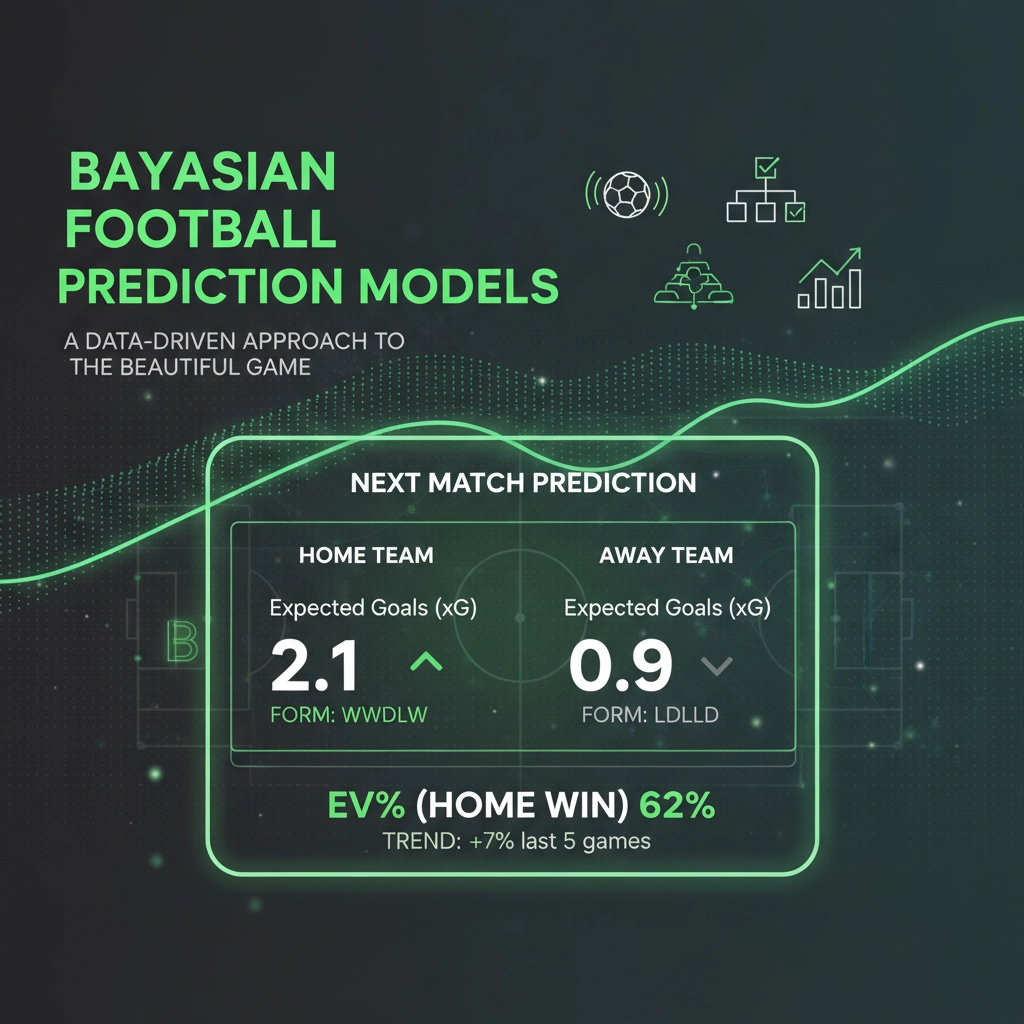
Most football prediction models work like a snapshot. They take historical data, crunch the numbers, and give you a prediction. But what happens when new information arrives during a match? Traditional models can’t adapt. They’re stuck with their original assessment.
Bayesian football prediction models are different. They learn and evolve. When fresh data arrives: a goal, a red card, team news: these models update their predictions in real time. That’s why smart bettors and platforms like Gecko Edge favour them for dynamic, in-play analysis.
What Makes Bayesian Models Different
Think of traditional models as rigid calculators. Feed them data about Manchester City vs Liverpool, and they’ll tell you City has a 45% chance of winning. That number stays fixed until the final whistle.
Bayesian models work more like a knowledgeable friend watching the match with you. They start with that same 45% prediction, but when City scores in the 15th minute, they immediately recalculate. The win probability might jump to 65%. When Liverpool equalises ten minutes later, it drops back to 52%.
The key difference lies in how these models handle uncertainty. Traditional models assume their initial assessment is final. Bayesian models embrace uncertainty and use new evidence to refine their predictions continuously.
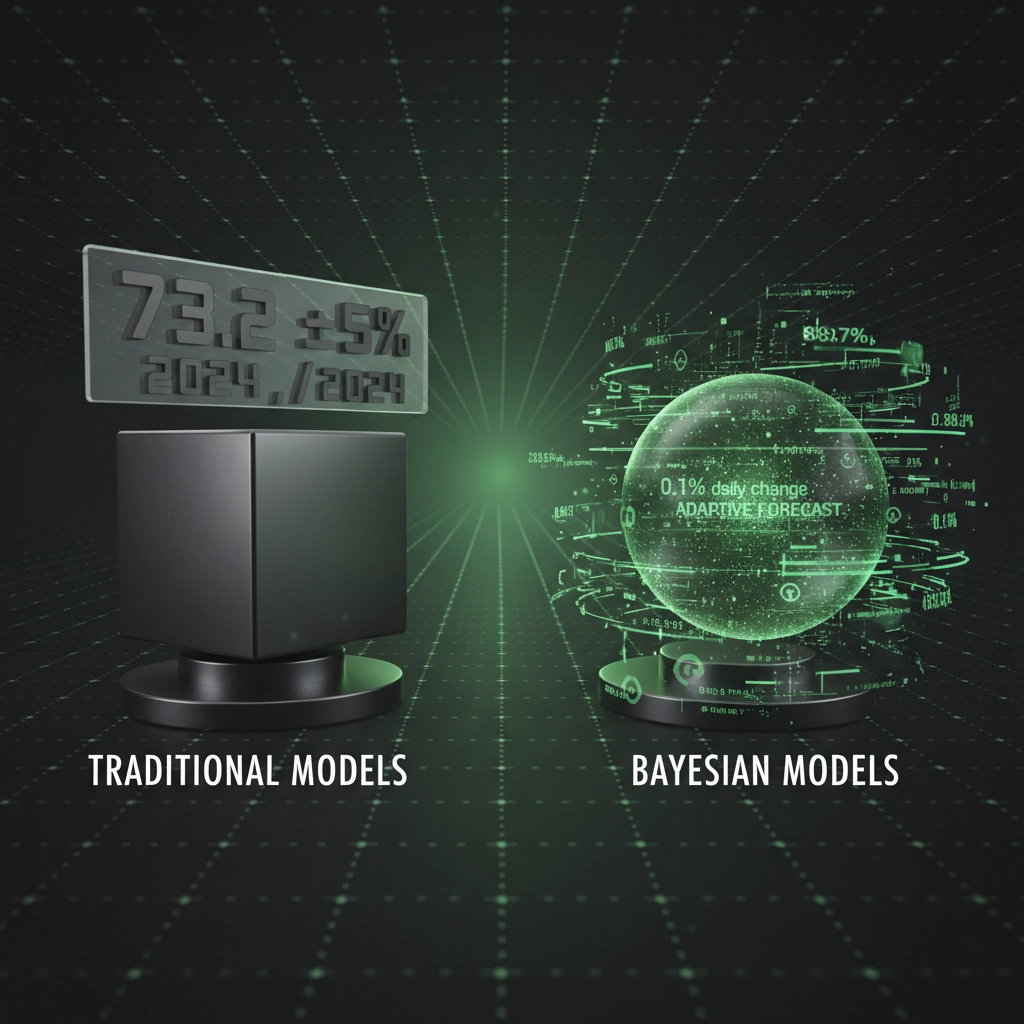
This approach stems from Bayes’ theorem, a mathematical principle that shows how to update probabilities when new information becomes available. In football terms, it means your model gets smarter as the match unfolds.
How Live Data Updates Work
Bayesian models treat each piece of new information as evidence that either supports or challenges their current prediction. The mathematics behind this process is elegant but the practical application is straightforward.
Before kickoff, your model considers:
- Historical head-to-head records
- Recent form and performance metrics
- Team strength ratings
- Home advantage factors
Once the match starts, it incorporates live data streams:
- Goals scored and timing
- Shots on target and xG accumulation
- Possession statistics
- Cards, substitutions, and tactical changes
- Injury updates and player removals
Each data point triggers a recalculation. The model doesn’t just add new information: it weighs how significant each update is and adjusts accordingly.
A goal in the 5th minute carries different weight than one in the 85th minute. The model understands context and adjusts predictions with nuanced precision.
Why They Excel in In-Play Betting
In-play betting demands rapid, accurate assessment of changing match dynamics. Static models become obsolete the moment play begins. Bayesian models thrive in this environment.
Consider the practical advantages:
Real-time probability updates: As match events unfold, you get continuous probability refreshes rather than outdated pre-match assessments.
Context-aware adjustments: The model understands that a red card in the 20th minute has massive implications, while a booking in the 89th minute barely registers.
Momentum recognition: Unlike traditional models, Bayesian systems can detect and quantify momentum shifts, identifying when the flow of play changes significantly.
Multi-market accuracy: These models excel across different betting markets: match result, total goals, both teams to score: because they understand how events affect multiple outcomes simultaneously.
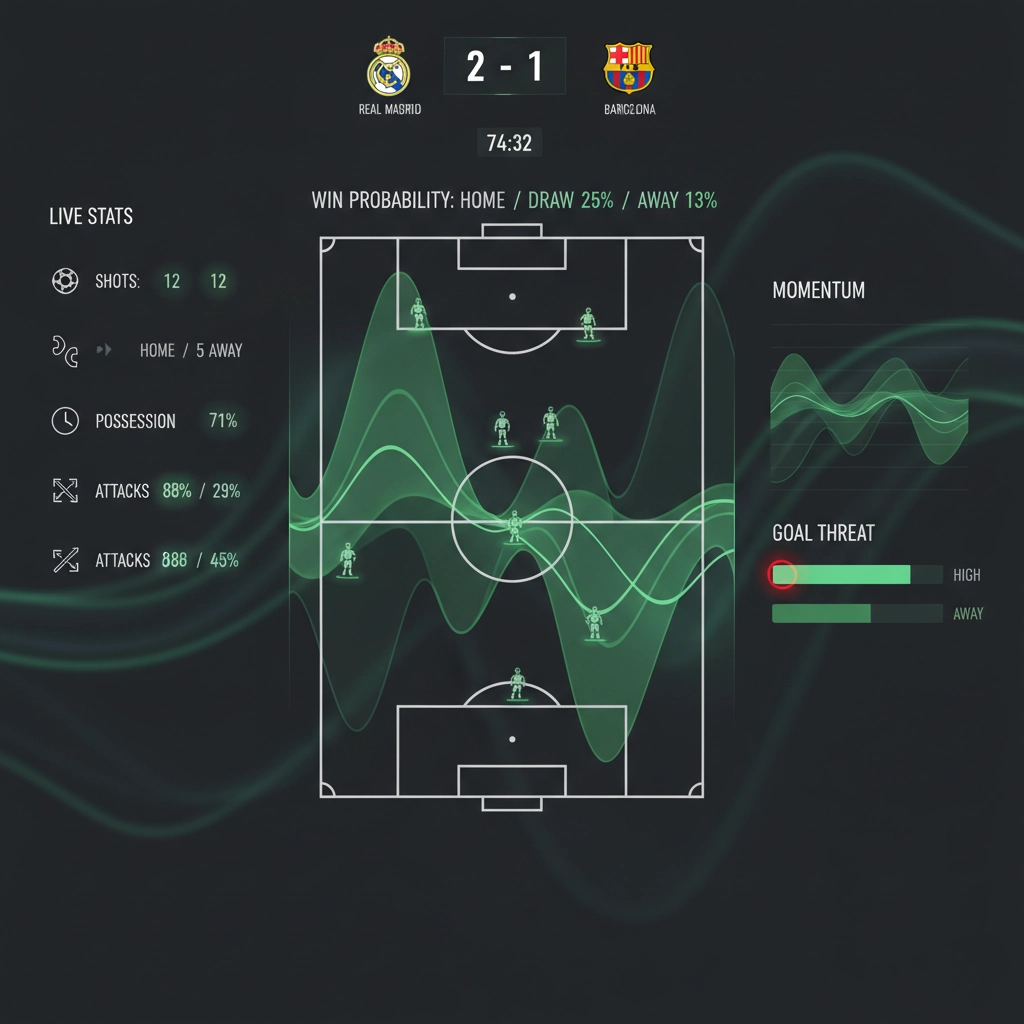
The speed of calculation matters enormously in live betting. Markets move fast. Odds change by the second. Bayesian models provide the rapid, intelligent analysis needed to identify value opportunities as they emerge.
A Practical Example
Let’s walk through a real scenario. Arsenal host Chelsea in a Premier League match. Pre-match, your Bayesian model calculates:
- Arsenal win: 45%
- Draw: 28%
- Chelsea win: 27%
These probabilities reflect historical performance, current form, and home advantage. But football is unpredictable.
15th minute: Arsenal score. The model immediately updates:
- Arsenal win: 68%
- Draw: 20%
- Chelsea win: 12%
32nd minute: Chelsea equalise. New calculation:
- Arsenal win: 48%
- Draw: 31%
- Chelsea win: 21%
65th minute: Arsenal’s key midfielder receives a red card. Updated probabilities:
- Arsenal win: 25%
- Draw: 35%
- Chelsea win: 40%
78th minute: Chelsea score, taking the lead:
- Arsenal win: 8%
- Draw: 15%
- Chelsea win: 77%
Each update incorporates not just the immediate event but its broader implications. The red card affects multiple future scenarios. The late goal changes everything.
Traditional models couldn’t make these adjustments. They’d maintain their original 45% Arsenal win probability throughout, becoming increasingly irrelevant as events unfolded.

Strengths and Limitations
Bayesian models offer compelling advantages but aren’t perfect. Understanding both sides helps you use them effectively.
Key Strengths:
- Adaptive intelligence: They learn from new information rather than remaining static
- Uncertainty quantification: They provide confidence intervals, not just point predictions
- Multi-layered analysis: They consider various factors simultaneously and weight their importance
- Real-time relevance: Predictions remain current throughout dynamic situations
Notable Limitations:
- Data dependency: They require quality data streams to function effectively
- Computational intensity: Real-time updates demand significant processing power
- Model complexity: More sophisticated than traditional approaches, requiring careful setup
- Overfitting risk: Without proper calibration, they can react too strongly to small sample events
The most important limitation involves data quality. Feed a Bayesian model poor or delayed information, and it will produce unreliable predictions. Garbage in, garbage out remains true regardless of mathematical sophistication.
How Gecko Edge Applies Bayesian Intelligence
At Gecko Edge, we’ve built our platform around Bayesian principles because we understand their power in live football analysis. Our AI systems continuously process multiple data streams, updating predictions as matches evolve.
Our approach combines traditional statistical analysis with dynamic Bayesian updating. Pre-match, we establish baseline probabilities using historical data, team ratings, and contextual factors. Once play begins, our models integrate live data feeds covering:
- Match events and timings
- Expected goals (xG) accumulation
- Possession and territorial advantages
- Player performance metrics
- Tactical adjustments and substitutions
This creates a comprehensive, evolving picture of match dynamics that traditional models cannot match.

We’ve found Bayesian models particularly effective for identifying value opportunities in fast-moving in-play markets. When significant events occur, markets often overreact or underreact. Our models help identify these discrepancies quickly.
The key insight? Football prediction isn’t about finding one perfect model. It’s about building systems that adapt intelligently to changing circumstances. Bayesian frameworks provide that adaptability.
Getting Started with Bayesian Thinking
You don’t need advanced mathematics to benefit from Bayesian principles. Start by changing how you think about predictions and probability.
Instead of viewing predictions as fixed facts, treat them as working hypotheses that improve with new evidence. When watching matches, ask yourself: “How does this event change the likely outcome?”
Practice updating your mental probabilities as matches unfold. When a team scores early, don’t just think “they’re ahead.” Consider how much more likely they are to win and why.
Look for patterns in how different events affect match outcomes. Goals scored in different time periods carry different predictive weight. Red cards impact matches differently depending on timing and score.
Most importantly, embrace uncertainty. The best predictions acknowledge what they don’t know. Bayesian models excel because they quantify uncertainty rather than pretending it doesn’t exist.
Football prediction is ultimately about making better decisions under uncertainty. Bayesian models provide the mathematical framework to do exactly that. They turn unpredictable football matches into manageable probability assessments that update intelligently as events unfold.
That’s the power of thinking like a Bayesian bettor. Your predictions become living, breathing assessments that evolve with the match. In a game as dynamic as football, that adaptability makes all the difference.