



You’ve got the data. You’ve got the models. You’ve even spotted value the market hasn’t priced in yet. But Bankroll Management is where most punters fall apart: they simply don’t know how much to stake.
Bet too much on a marginal edge, and variance will destroy your bankroll. Bet too little on a genuine opportunity, and you’re leaving money on the table. In the data era, bankroll management isn’t about gut feel anymore. It’s about sizing your bets to match the strength of your information.
Let’s break down how confidence intervals should shape your stake size: and how tools like Gecko Edge make this process simpler with real-time predictive modelling.
The Old School Methods Still Matter
Before we dive into confidence intervals, you need to understand the foundations.
Flat betting is the simplest approach. You stake the same amount on every bet, usually 1-2% of your total bankroll. It’s safe, it’s disciplined, and it completely ignores the quality of your information. A 60% confident pick gets the same stake as an 80% confident one. That’s inefficient.
Percentage-based models are better. You allocate 1-5% of your bankroll depending on how strong you feel about a selection. The problem? “Feel” is subjective. Two punters might look at the same data and arrive at wildly different stake sizes.
Then there’s the Kelly Criterion. This is the mathematician’s favourite. The formula calculates optimal stake size based on your edge and the odds you’re getting. It maximises long-term growth while minimising risk of ruin. The issue with Kelly is that it assumes you know your exact edge: and in football betting, you rarely do.
That’s where confidence intervals come in.
What Are Confidence Intervals (And Why Should You Care)?
A confidence interval tells you the range within which the true value of something likely sits.
Let’s say your model predicts Manchester United have a 55% chance of beating Fulham. That’s a point estimate. But how confident are you in that 55%? Is it somewhere between 50-60%? Or could it realistically be anywhere from 45-65%?
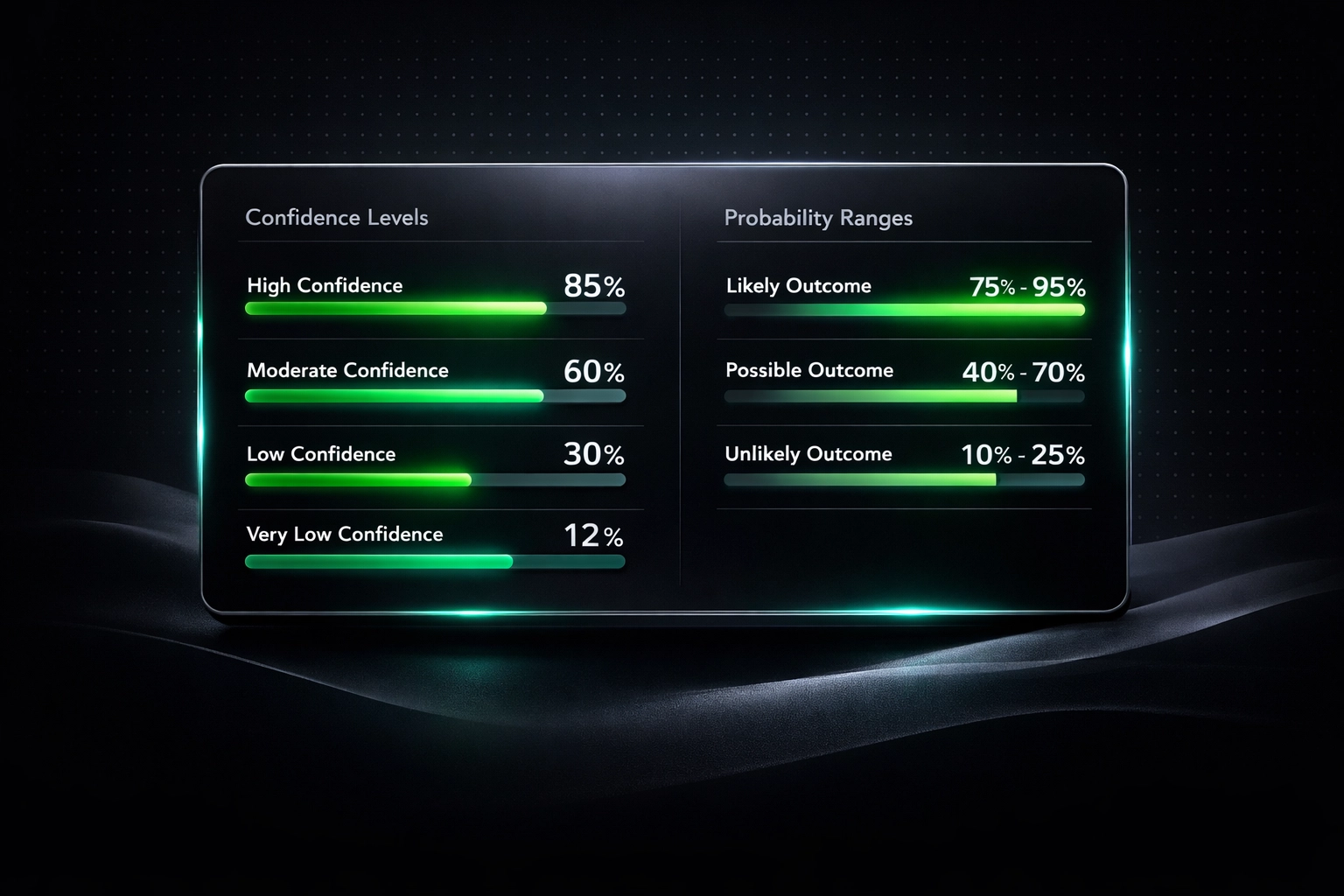
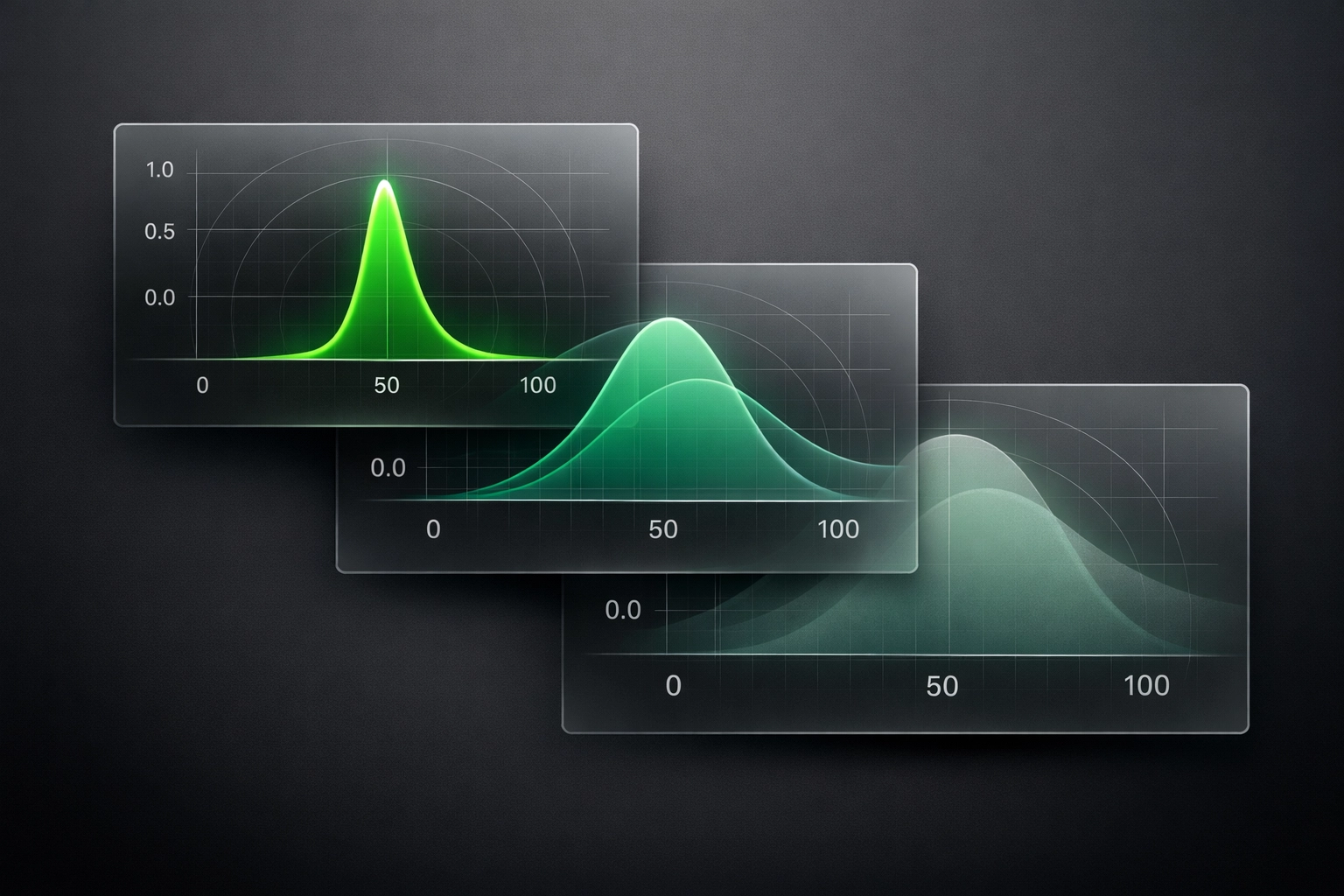
The width of your confidence interval reflects the strength of your data. Narrow intervals mean high confidence. Wide intervals mean uncertainty.
In practical terms: if your model says United have a 55% win probability with a tight confidence interval (say, 52-58%), you should stake more than if the interval is wide (say, 48-62%). The tighter the range, the more reliable your edge.
This is how professionals size bets in 2026. Not on hunches. On statistical confidence.
How Confidence Should Influence Stake Size
Think of your bankroll management as a sliding scale.
At one end, you have maximum confidence: narrow intervals, large sample sizes, multiple models agreeing, recent form aligning with historical data. These are your 3-5% bankroll bets.
At the other end, you have marginal confidence: wide intervals, small sample sizes, conflicting signals, or limited match context. These are your 0.5-1% bets: or skip them entirely.
Here’s a simple framework:
High confidence (tight intervals): 3-5% of bankroll. Your model shows clear value, the interval is narrow, and multiple data sources confirm the edge.
Moderate confidence (medium intervals): 1-2% of bankroll. You’ve got value, but there’s some uncertainty in the underlying data or recent form creates ambiguity.
Low confidence (wide intervals): 0.5-1% or pass. The edge exists on paper, but the confidence interval is too wide to justify meaningful exposure.
The key is aligning your risk with your information quality. Kelly Criterion does this mathematically. Confidence intervals help you understand why the maths works.
Where Gecko Edge Fits Into All This
Here’s the problem: calculating confidence intervals manually is time-consuming. You need historical data, variance metrics, recent performance trends, and the statistical chops to pull it all together.
Gecko Edge handles this for you.
The platform runs predictive models that don’t just give you a probability: they show you the confidence behind it. You’re not just seeing “Liverpool 65% to win.” You’re seeing the range, the historical accuracy of similar predictions, and how tight or loose the interval is based on current form and data quality.
This matters because not all 65% probabilities are created equal. One might come from a rock-solid model with months of clean data. Another might be based on limited fixtures and missing key player stats. Gecko Edge shows you the difference.
And when you know the difference, you can size your stakes properly.
Let’s say you’re looking at an Asian Handicap market. Gecko Edge runs the numbers and tells you there’s value at the current line, with a confidence interval of ±3%. That’s tight. You can comfortably stake 3-4% of your bankroll.
Compare that to a lower league match where the model shows value, but the interval is ±8% due to limited data. You drop to 1% or skip it. Same perceived edge, different confidence, different stake.
That’s bankroll management for the data era.
A Practical Example: In-Play Adjustments
Confidence intervals aren’t static. They change as new information comes in.
Imagine you’ve backed the over 2.5 goals pre-match based on xG models showing both teams averaging high shot volumes. Your confidence interval was tight because you had 15+ matches of data for both sides.
Then the match kicks off. One team goes ultra-defensive after conceding early. Suddenly, the data shifts. Your confidence interval widens because the game state no longer reflects your pre-match model.
Gecko Edge updates in real time. You can see the confidence dropping, the interval widening, and make a call: hold, hedge, or get out.
This is where most punters mess up. They treat pre-match analysis as gospel and ignore how live context reshapes the probabilities. With real-time modelling, your stake decisions adapt as the data does.

Common Mistakes to Avoid
Even with solid data, people still blow their bankrolls. Here’s why:
Overbetting on gut feel. You “like” a team, so you stake 10% of your roll despite wide confidence intervals. Emotional staking kills bankrolls faster than bad models.
Ignoring variance. Just because you have an edge doesn’t mean you’ll win. Tight confidence intervals reduce variance, but they don’t eliminate it. Size accordingly.
Chasing with larger stakes. You lose a few bets and bump your stake to “win it back.” Confidence intervals don’t care about your recent results. Stick to the data.
Not tracking actual performance. If your model says you should win 58% of the time, track whether you actually do. If your real-world results don’t match your confidence intervals, your model needs recalibrating.
Bankroll management isn’t about never losing. It’s about losing less when you’re wrong and winning more when you’re right.
The Bottom Line
Flat betting is safe but inefficient. Kelly is powerful but assumes perfect information. Confidence intervals bridge the gap: they let you size bets based on how strong your data actually is.
In 2026, you don’t need a PhD in statistics to do this. Gecko Edge does the heavy lifting: predictive modelling, real-time updates, and confidence metrics that show you not just what to bet, but how much.
Stake smart. Bet with confidence. Let the data do the talking.