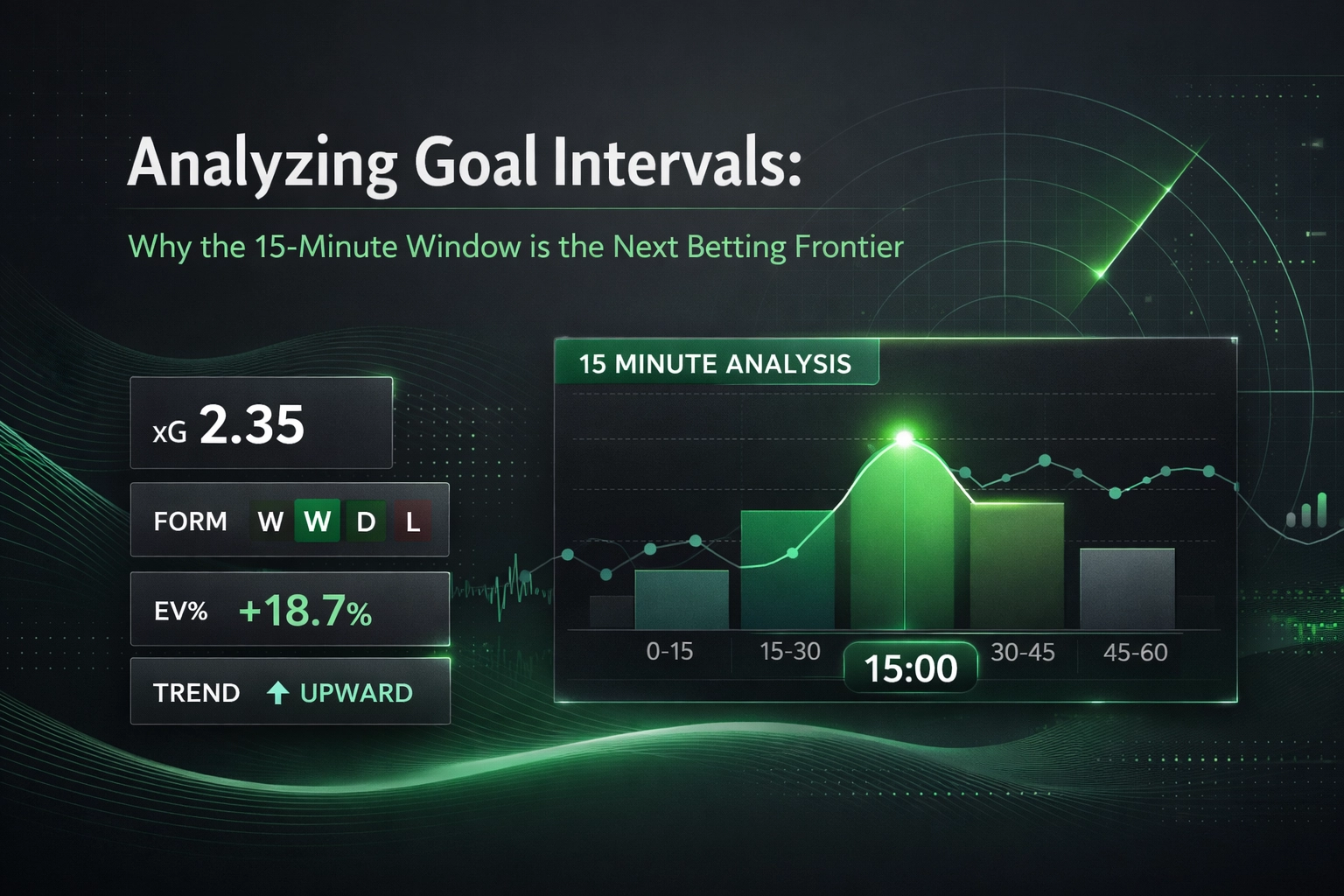
15-Minute Interval Market. Most bettors focus on the full-time result. Will the home team win? Will both teams score? How many goals total? But there’s a quieter market that’s been sitting in plain sight. One that bookmakers are still figuring out. One where patterns repeat themselves week after week, and the odds haven’t quite caught up yet.
It’s the 15-minute interval market.
Instead of betting on the match as a whole, you’re betting on when goals happen. And the data tells a surprisingly clear story once you know where to look.
Gecko Edge has tracked 8,439 AI-generated bets and recorded +398pts of profit across 66 competitions. See how the model works →
What the 15-Minute Interval Market Actually Is
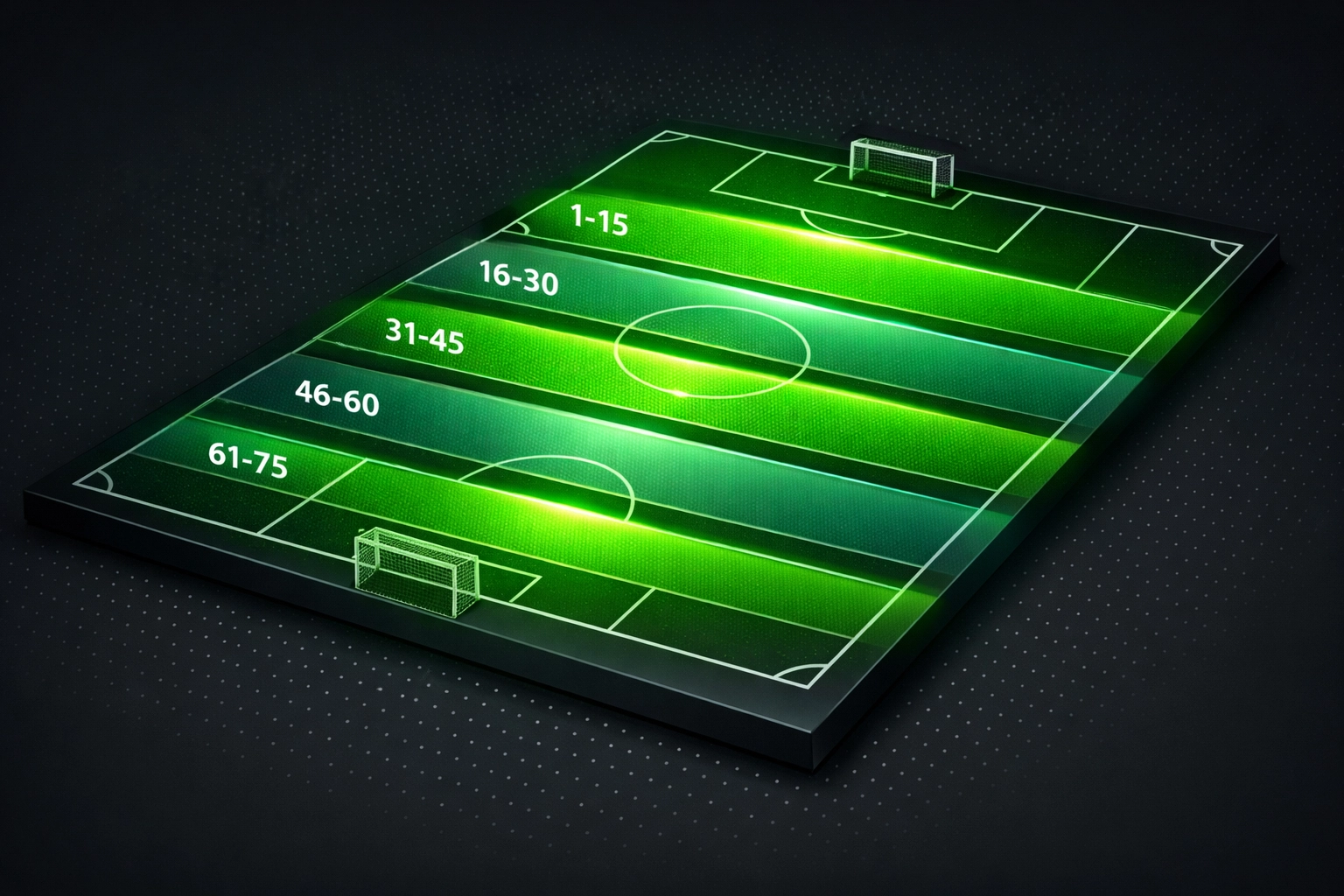
Most bookmakers divide a football match into six windows of fifteen minutes each. You’ll see them listed like this:
- 1–15 minutes
- 16–30 minutes
- 31–45 minutes (including first-half stoppage)
- 46–60 minutes
- 61–75 minutes
- 76–90 minutes (including second-half stoppage)
Within each window, you can bet on whether a specific team will score. Or concede. Or whether any goal will be scored at all during that period.
It’s a niche market. Not many people pay attention to it. Which is exactly why it’s worth your time.
The bookmakers track home scoring percentages, away scoring percentages, home conceding, and away conceding across these intervals. But they don’t always adjust the odds quickly enough when patterns emerge.
That’s the gap.
When Goals Actually Fly In
Here’s where it gets interesting.
You’d think goals would be evenly distributed across a match. Random. Chaos. But the numbers tell a different story.
The first fifteen minutes are usually the quietest. Teams are feeling each other out. Settling into shape. Testing the press. Around 30% of all goals happen in the opening window across large data sets, but that’s still lower per-minute than later stages when fatigue and tactical adjustments kick in.
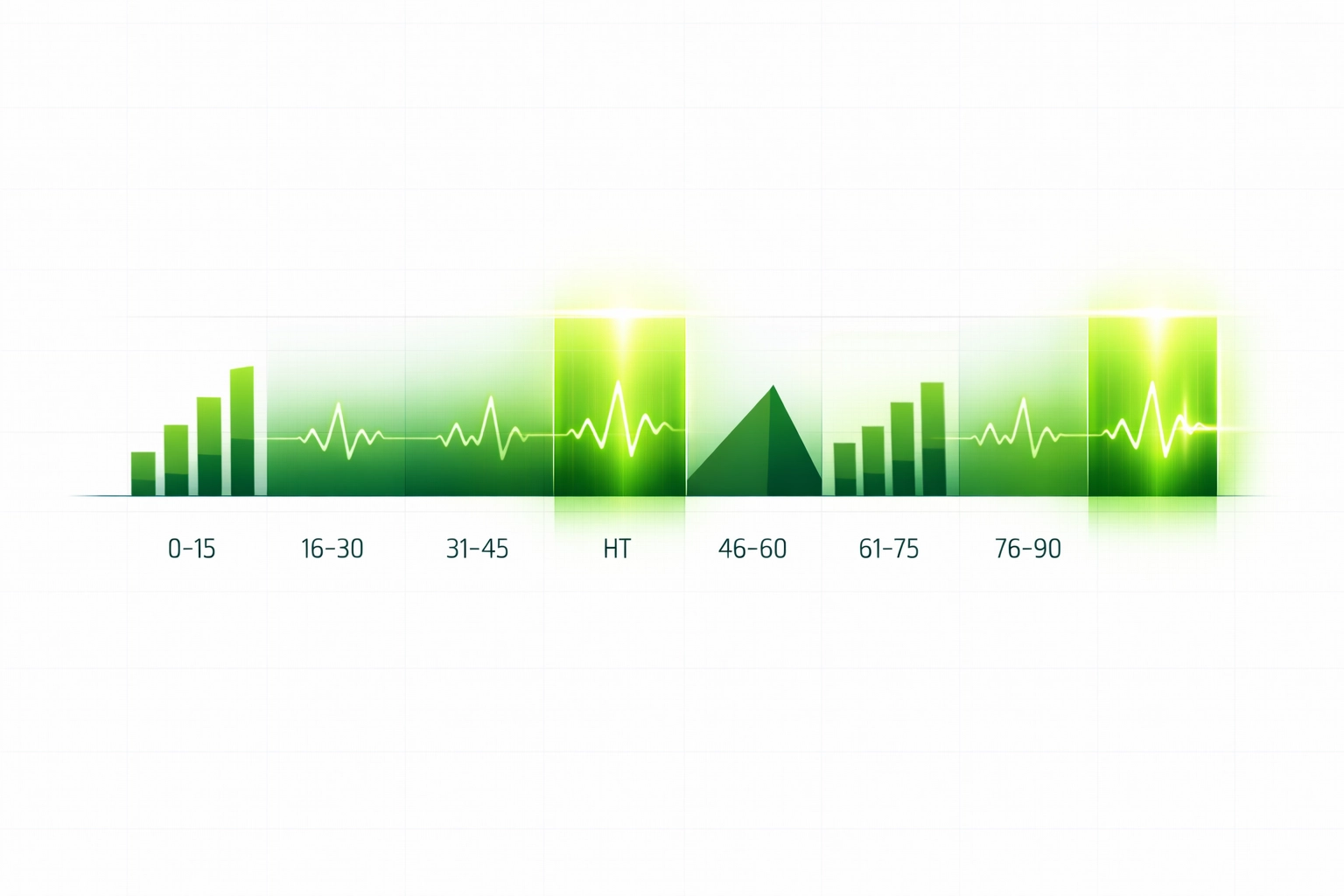
Then you’ve got the 31–45 minute window. Just before half-time. This is where goals tend to cluster. Concentration dips. Players start thinking about the break. One lapse and the ball’s in the net. Managers hate it. Bettors who know this pattern can find value in it.
The same thing happens at the end of matches. The 76–90 window is a goldmine of goals. Tired legs. Desperate tactics. Teams chasing results throw caution out the window. Defenders make mistakes. Substitutes come on fresh and exploit the gaps.
But here’s what most people miss: these patterns aren’t the same for every team.
Some sides are fast starters. Others take thirty minutes to wake up. Some defend brilliantly until the 70th minute, then collapse. If you’re betting blind on general trends, you’re missing half the story.
Why This Market Is Different
The 15-minute interval market rewards patience and pattern recognition.
Traditional match betting asks you to predict an outcome over 90 minutes. Anything can happen in that time. A red card. A VAR decision. A deflection. You’re trying to predict chaos.
But with interval betting, you’re isolating smaller windows. You’re betting on behaviour patterns that repeat themselves. Teams that concede early goals tend to keep conceding early goals. Teams that score late tend to keep scoring late.
It’s about structure, not luck.
And because it’s a niche market, the bookmakers don’t have the same sharp algorithms pricing every angle. They’re focused on the big markets where the money flows. That leaves inefficiencies.
The other advantage? You can layer this market with others. Back an early goal window and hedge with an opposing total goals market. If the odds shift after the goal, you can lock in profit regardless of the final score. It’s not about picking winners. It’s about exploiting market movement.
How to Actually Approach It
You can’t just pick random intervals and hope for the best. You need data.
Start by tracking specific teams. Look at their last 10-15 matches. When do they score? When do they concede? Are there consistent patterns across home and away fixtures?
Some questions to ask:
- Does this team consistently concede in the first 15 minutes at home?
- Do they score more often in the second half when chasing a result?
- Is there a pattern around the 31–45 window, just before the break?
- How do they perform in the final 15 minutes when protecting a lead versus chasing one?
Once you’ve identified a pattern, you need to cross-reference it with the odds. Are the bookmakers pricing this window accurately? Or is there value sitting there, waiting to be taken?
The challenge is doing this manually. You’re looking at hundreds of matches. Thousands of data points. Spreadsheets on spreadsheets. And by the time you’ve finished your analysis, the match has already kicked off.
That’s where the right tools change everything.
Where Gecko Edge Fits In
This is exactly what Gecko Edge was built for.
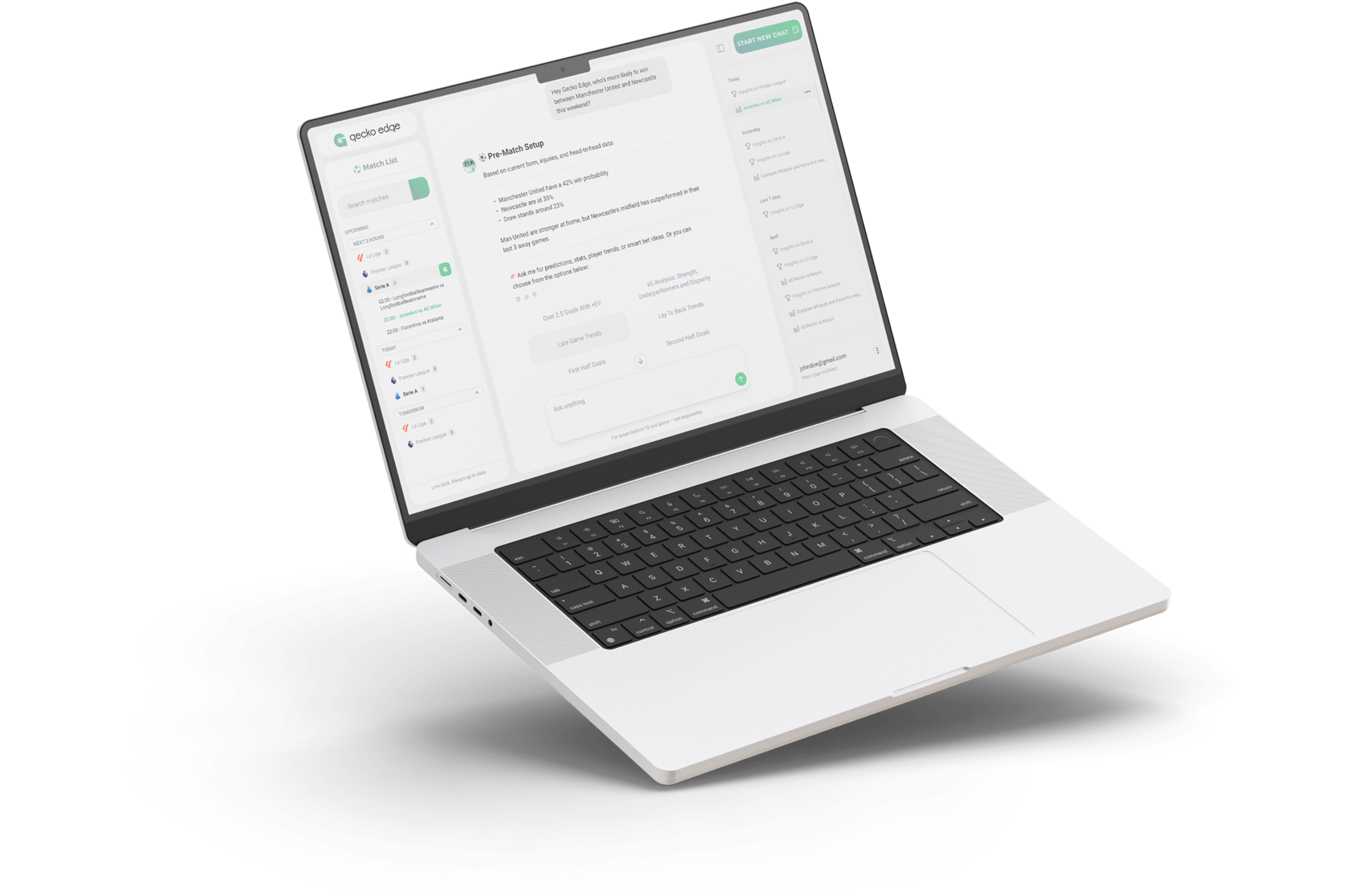
Instead of manually trawling through match data, Gecko Edge does the heavy lifting. It tracks goal intervals across leagues and teams in real time. It identifies which teams have consistent patterns in specific 15-minute windows. And it flags when the bookmaker odds don’t match the historical data.

The AI analyses thousands of matches. It spots the teams that score early. The teams that collapse late. The ones that defend well until the 60th minute, then leak goals when they make substitutions.
And it does it faster than any human ever could.
You’re not guessing. You’re not relying on gut feel. You’re using predictive modelling that’s already identified the value before you’ve even opened the odds page.
Let’s say you’re looking at a mid-table Championship side playing at home. Gecko Edge pulls their last 20 matches and shows that they’ve conceded in the 1–15 minute window in 45% of home games. The bookmaker is pricing that window at 3.50. The data suggests it should be closer to 2.80.
That’s value.
Or you’re tracking a League Two team that consistently scores in the 76–90 window when chasing a deficit. The bookmaker hasn’t adjusted for this pattern yet. Gecko Edge flags it. You act on it.
It’s not magic. It’s pattern recognition at scale. And in a niche market like goal intervals, that edge compounds quickly.
Final Thought
The 15-minute interval market isn’t for everyone.
It requires discipline. It requires data. And it requires patience to wait for the right opportunities instead of forcing bets on every match.
But if you’re willing to put in the work: or use the tools that do it for you: it’s one of the most consistent ways to find value that the bookmakers haven’t fully priced yet.
The traditional markets are sharp. The interval markets? Still finding their footing.
And that’s where the opportunity sits.
What is the 15-minute interval betting market?
Bookmakers divide a football match into six 15-minute windows (1-15, 16-30, 31-45, 46-60, 61-75, 76-90 including stoppage). Within each window you can bet on whether a specific team will score, concede, or whether any goal will be scored at all. It’s a niche market that gets less analytical attention than match-level markets, which is exactly why pricing inefficiencies persist there longer than in the main markets.
When do goals actually happen most often in football matches?
Goals aren’t evenly distributed. The opening 15 minutes are typically the quietest as teams settle into shape. The 31-45 window before half-time is where goals tend to cluster — concentration dips and one lapse becomes a goal. The 76-90 window is the biggest goldmine — tired legs, desperate tactics, defenders making mistakes, and fresh substitutes exploiting gaps. These aren’t team-specific patterns; they’re structural to how the sport unfolds.
Why does the 15-minute interval market reward AI analysis more than 1X2?
Interval betting rewards pattern recognition rather than outcome prediction. Some teams concede early consistently; others collapse late; others score in specific windows when chasing. Traditional 1X2 asks you to predict chaos over 90 minutes. Intervals isolate smaller windows where behaviour patterns repeat — exactly the kind of repeating signal AI excels at finding. The market also moves more slowly than 1X2 because liquidity is lower.
What patterns should you look for in team scoring history?
Pull a team’s last 10-15 matches. Track which window goals scored happened in, which window goals conceded happened in, and home/away splits. Questions to ask: Does this team consistently concede in the first 15 minutes at home? Do they score more often in the second half when chasing? Is there a pattern around the 31-45 window? How do they perform in the final 15 minutes protecting a lead versus chasing one? Patterns are usually clearer than people expect.
How does Gecko Edge help with goal interval betting specifically?
Gecko Edge processes match data across leagues and teams in real time, identifying which teams have consistent patterns in specific 15-minute windows and flagging when bookmaker odds don’t match the historical data. Manual tracking takes hours per match; AI does it in seconds across hundreds of fixtures. In a niche market like goal intervals where pricing lags real performance, pattern recognition at scale is exactly the kind of edge that compounds.
2 comments