What Is Draw No Bet?
Draw No Bet (DNB) is a football betting strategy that removes the draw from the equation entirely. You pick a team to win. If they win, you collect your payout. If the match ends in a draw, your stake comes back to you in full. If the other team wins, you lose.
That’s it. Three possible match outcomes reduced to two betting outcomes.
Think of it as insurance. You’re paying a small premium (in the form of lower odds) to eliminate one entire losing scenario. For value hunters who understand expected value, this trade-off can be incredibly powerful when applied correctly.
Gecko Edge has tracked 8,439 AI-generated bets and recorded +398pts of profit across 66 competitions. See how the model works →
The draw is the great unpredictable. It accounts for roughly 25-30% of football matches across most leagues. By removing it as a losing outcome, you’re fundamentally changing the risk profile of your bet.
How Draw No Bet Actually Works
Here’s the mechanics laid out clearly:
| Match Outcome | Traditional 1X2 Bet | Draw No Bet |
|---|---|---|
| Your team wins | You win | You win |
| Draw | You lose | Stake returned |
| Other team wins | You lose | You lose |
The key difference sits in that middle row. A draw doesn’t hurt you anymore.
Let’s say Manchester City are playing away at a tricky opponent. The 1X2 odds might be:
- City to win: 1.65
- Draw: 3.80
- Home win: 5.50
The Draw No Bet odds on City might sit around 1.35. Lower, yes. But now you’re protected if City dominate possession, create chances, but somehow fail to convert and the match ends 0-0.
Your stake comes home safe.

The Asian Handicap Connection
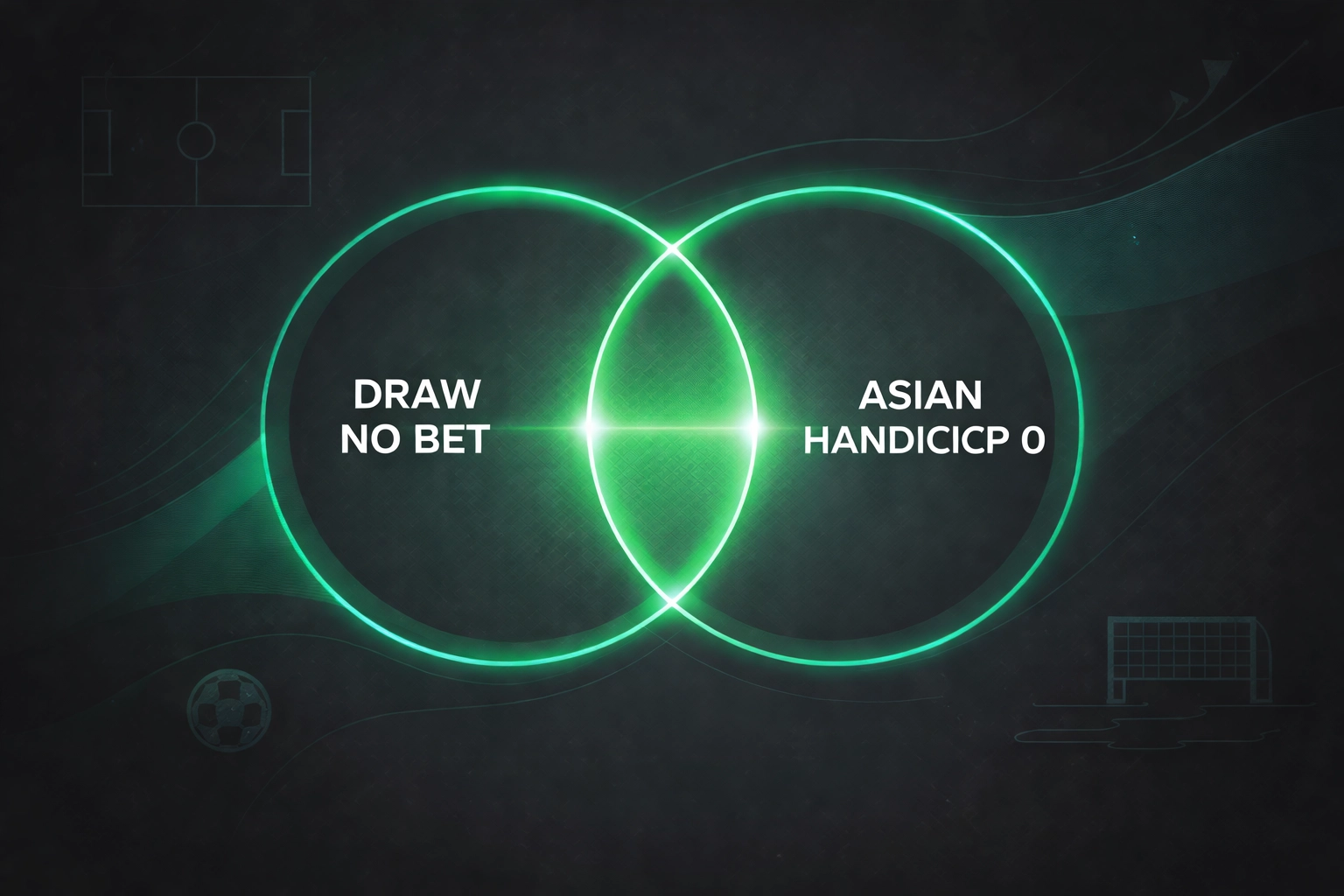
Here’s something many bettors don’t realise: Draw No Bet is essentially the same as an Asian Handicap 0 (zero) line.
When you place an Asian Handicap 0 bet, you’re backing a team with no handicap applied. If they win, you win. If the match draws, you get your stake back. Sound familiar?
Understanding this connection matters for two reasons:
First, it opens up more markets. Some bookmakers offer better DNB odds, others have sharper Asian Handicap lines. Knowing they’re equivalent means you can shop for the best price across both markets.
Second, it helps you understand handicap betting more broadly. DNB is your entry point into Asian Handicap markets. Once you’re comfortable here, moving to -0.5 or -0.25 lines becomes intuitive.
If you’re making EV calculation mistakes with Asian Handicaps, understanding the DNB foundation helps correct them.
Finding Value with Draw No Bet
Value betting isn’t about picking winners. It’s about finding odds that exceed the true probability of an outcome.
DNB creates value opportunities in specific situations:
When draws are underpriced in the main market. If bookmakers are offering generous odds on a team to win but the draw probability is higher than the market suggests, DNB lets you back that team while sidestepping the draw risk entirely.
When backing away teams. Away wins are harder to predict. Draws happen more frequently on the road. DNB protects you in exactly these situations where uncertainty is highest.
When form suggests dominance but not necessarily goals. Some teams control matches without converting. They’re good bets to not lose, even when the win isn’t guaranteed. DNB captures this nuance.
The expected value calculation shifts with DNB. You’re no longer asking “will they win?” You’re asking “will they avoid defeat?” That’s a fundamentally different question with different probabilities attached.
Gecko Edge uses AI models to assess these exact probabilities: identifying where the true likelihood of avoiding defeat exceeds what the DNB odds suggest. That’s where edge lives.
When to Use Draw No Bet
DNB isn’t always the right choice. Here’s when it makes sense:
Tight Matchups
When two evenly-matched sides meet, the draw becomes a genuine threat. If you fancy one team but can’t ignore the possibility of a stalemate, DNB gives you exposure with protection.
Accumulator Insurance
This is where DNB quietly shines. In a parlay or accumulator, a drawn match voids that leg rather than killing your entire bet. Your remaining selections stay alive.
Say you’ve got four legs. Three win and one draws. With traditional 1X2, you lose everything. With DNB on that drawn leg, it’s voided and you still collect on a three-leg winner.
Backing Favourites at Poor Odds
When a heavy favourite is priced at 1.20 or lower, the risk-reward feels wrong. DNB might offer 1.08: still low, but now you’re only losing if the underdog actually wins outright. For favourites expected to dominate, this trade-off often makes sense.
Away Games in Lower Leagues
Lower league markets are where draws hide. Less quality often means more cagey matches, defensive setups, and fewer goals. DNB protects you in these unpredictable environments.

When to Avoid Draw No Bet
DNB has its limits. Recognise them.
Lopsided matchups. If a team has an 80% win probability, taking DNB at significantly reduced odds usually destroys value. The draw protection isn’t worth the price when draws are unlikely anyway. Take the straight win.
When you’ve identified true value on the 1X2 market. If your analysis shows the win odds exceed fair probability, diluting that edge with DNB makes no sense. Back your conviction.
High-scoring expected matches. When both teams are likely to score multiple goals, draws become less probable. DNB loses its protective appeal.
Practical Tips for Implementation
Here’s how to use DNB effectively:
Line Shop Relentlessly
DNB odds vary significantly between bookmakers. A few points difference compounds over hundreds of bets. Check both DNB markets and Asian Handicap 0 lines: take whichever offers better value.
Track Your Draw Rate
Keep records of how often your backed teams draw. If your selections are drawing 30%+ of the time, DNB might be saving you money you haven’t even noticed. Data reveals patterns your memory misses.
Combine With Proper Bankroll Management
DNB reduces variance, but it doesn’t eliminate risk. Stake sizing still matters. The safety net of returned stakes shouldn’t encourage reckless bet sizing.
Use AI to Assess True Probabilities
This is where modern tools earn their place. Gecko Edge analyses match data to estimate true outcome probabilities. When the AI suggests a team’s probability of avoiding defeat exceeds what DNB odds imply, you’ve found potential value.
If you’re curious about how AI models compare to traditional approaches, the difference often shows most clearly in these risk-adjusted markets.
The Bottom Line
Draw No Bet isn’t flashy. It won’t deliver massive payouts or dramatic swings.
What it offers is something more valuable for serious bettors: controlled risk and consistent methodology.
By removing the draw as a losing outcome, you change the fundamental maths of football betting. You trade potential upside for reduced downside. For value hunters who think in terms of expected value over hundreds of bets, this trade-off often makes sense.
The strategy works best when combined with sharp analysis: understanding when draws are genuinely threatening, when the odds fairly reflect the reduced risk, and when you’re better served taking the straight win.
DNB is a tool. Like any tool, its effectiveness depends on knowing when to use it.
Start small. Track results. Let the data guide you.
Smarter betting starts with understanding your options. Draw No Bet is one worth mastering.

1 comment