


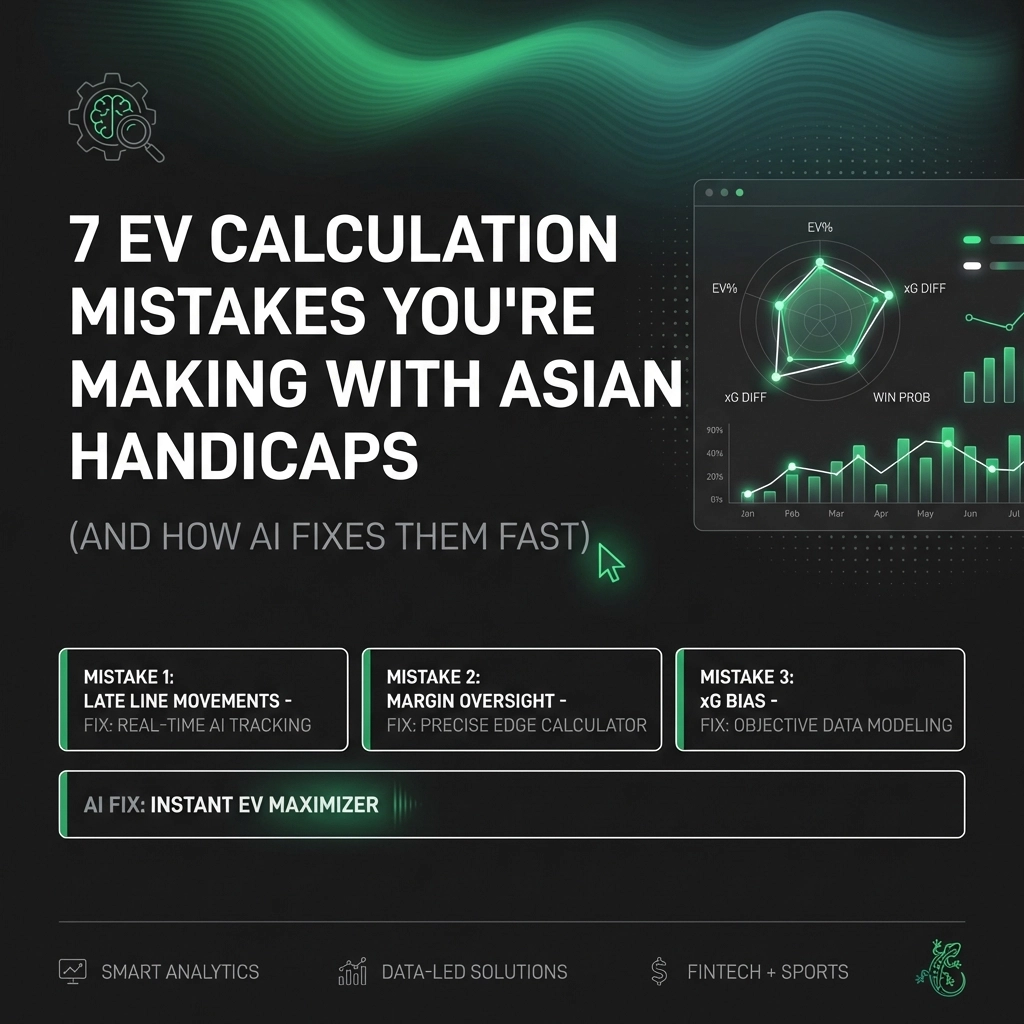
Betting on Asian Handicaps offers some of the sharpest value in football markets. But here’s the thing: most bettors are calculating Expected Value (EV) completely wrong.
You’re treating handicaps like simple win-lose bets. You’re ignoring quarter-line mechanics. You’re applying the same EV threshold to vastly different scenarios.
The result? You’re leaving money on the table every single week.
Gecko Edge has analysed thousands of Asian Handicap bets to identify the seven most costly EV calculation mistakes. More importantly, we’ve built AI systems that eliminate these errors entirely.
Let’s fix your approach.
Mistake 1: Treating Asian Handicaps Like 1X2 Bets
Most bettors calculate Asian Handicap EV using simple win-lose probability. This is wrong.
Traditional 1X2 betting has three outcomes. Asian Handicaps have multiple scenarios including pushes, half-wins, and half-losses. When you ignore these nuances, your EV calculations become meaningless.
Take Manchester City -1.5 goals against Brighton. You might calculate a 70% win probability and think you’ve found 5% EV at 1.50 odds. But you haven’t factored in that City winning 1-0 means you lose your entire stake, not just half.
How AI fixes this: Gecko Edge processes all possible scorelines and their probabilities. Our models calculate true EV by weighing every potential outcome – full wins, full losses, pushes, and partial returns. No guesswork. Just precise mathematics.

Mistake 2: Misunderstanding Quarter Handicap Mechanics
Quarter handicaps (-0.25, -0.75, +1.25) split your stake between two lines. Most bettors treat them as single bets.
This creates massive EV calculation errors.
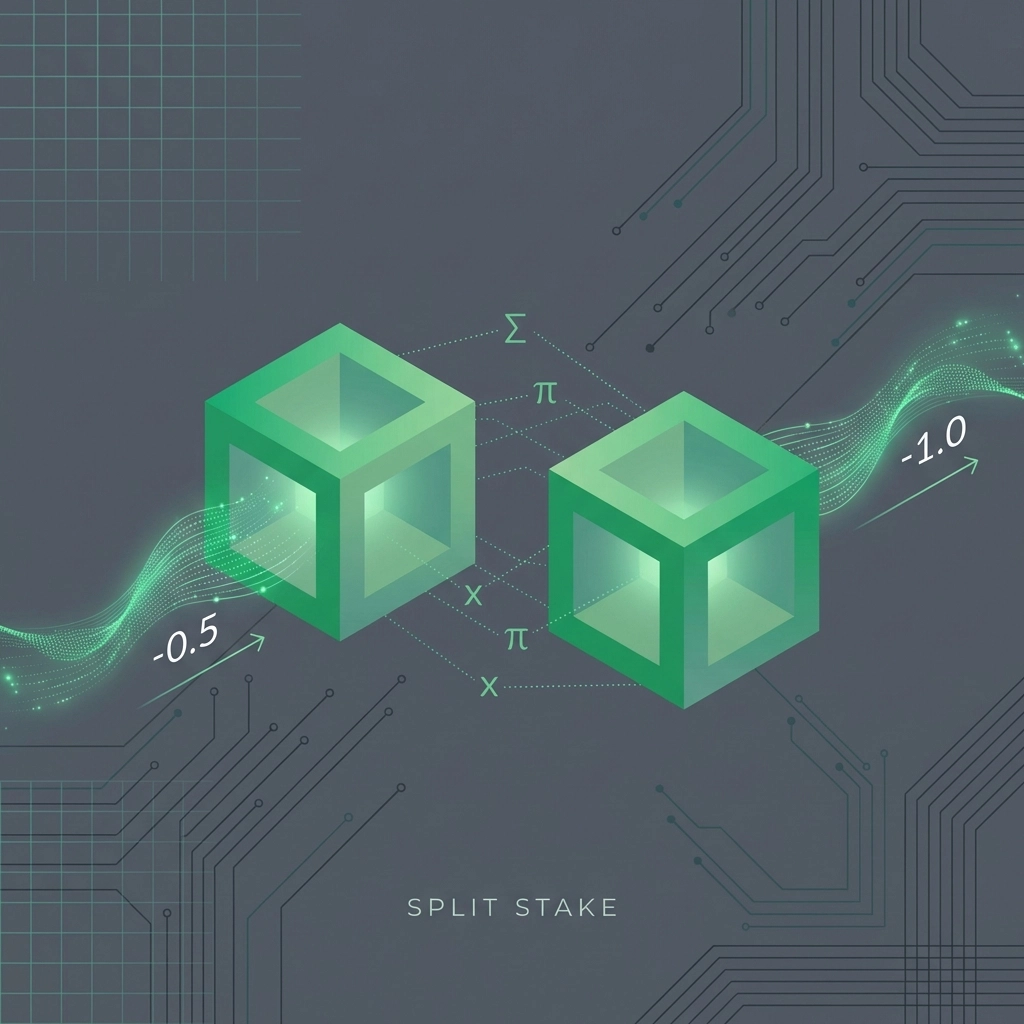
Betting Arsenal -0.75 means half your stake goes on -0.5 and half on -1.0. If Arsenal win 1-0, you win half your stake and push half. Your return isn’t the full odds – it’s 50% of the odds plus your returned stake.
Yet most bettors calculate EV as if they’re getting full odds on a simple outcome. They’re not. They’re getting a weighted return across two different lines.
How AI fixes this: Gecko Edge automatically splits quarter handicap calculations. Our system models the exact probability for each half of your bet, calculates the weighted returns, and delivers true EV. Every quarter handicap is processed as the two-line split it actually represents.
Mistake 3: Using Uniform EV Thresholds Across All Lines
Here’s where most sharp bettors go wrong: they use the same minimum EV threshold for every bet.
5% EV on a -0.25 line isn’t the same as 5% EV on a +2.5 line. The risk profiles are completely different. Your margin of error on probability estimates varies dramatically.
A small error in your win probability estimate has minimal impact on short odds. The same error destroys your edge on longer odds. Yet most bettors apply uniform thresholds like 3% EV across all handicap lines.
How AI fixes this: Gecko Edge uses dynamic EV thresholds based on line difficulty and payout risk. Short handicaps require lower EV minimums. Longer handicaps need higher thresholds to account for probability estimation error. Our system adjusts automatically for every line.
Mistake 4: Poor Goal Margin Probability Distribution
Most EV calculations assume linear probability distributions for different winning margins. This is fundamentally flawed.
Football scores follow specific patterns. 1-0 and 2-1 wins are far more common than 4-0 and 5-2 wins. But amateur calculations often treat 2-goal wins and 4-goal wins as equally likely within their “winning by 2+” bucket.
This creates systematic errors in Asian Handicap EV calculations, especially for lines around -1.5 and -2.5 where goal margin precision matters most.
How AI fixes this: Gecko Edge uses historical goal distribution data across 50+ leagues. Our models understand that specific scorelines have different probabilities based on team styles, league characteristics, and match situations. Every EV calculation reflects true goal margin probability, not crude approximations.
Mistake 5: Ignoring Line Movement Impact on EV
You calculate 4% EV on Liverpool -1.0 at morning prices. The line moves to -1.25 by kick-off. You still think you have 4% EV.
You don’t.
Line movement reflects new information – team news, weather, sharp money. When handicap lines move, the probability distributions shift. Your original EV calculation becomes outdated within hours.
Most bettors calculate EV once and assume it holds until kick-off. They’re betting on stale mathematics while the market updates in real-time.
How AI fixes this: Gecko Edge recalculates EV continuously as lines move. Our system processes new information, adjusts probability estimates, and updates EV calculations every few minutes. You see current edge, not historical estimates.
Mistake 6: Miscalculating Push Probabilities
Push outcomes in Asian Handicaps aren’t rare events. They’re regular occurrences that significantly impact EV.
Take Tottenham +1.0 against Arsenal. If the match ends 1-0 to Arsenal, your bet pushes – you get your stake back. But most bettors either ignore push probability entirely or assign it arbitrary values like 10-15%.
Real push probabilities vary dramatically based on the handicap line, team characteristics, and match context. Getting this wrong skews your entire EV calculation.
How AI fixes this: Gecko Edge calculates precise push probabilities for every handicap line using historical data and current match factors. Our models know that certain scorelines are more likely for specific team matchups, giving you accurate push probability in every EV calculation.
Mistake 7: Relying on Outdated Team Performance Data
Your EV calculations use team statistics from the last 6 matches. But football form isn’t linear. Recent performance against similar opposition matters more than season-long averages.
Most bettors use crude data inputs: goals scored per game, goals conceded per game, win percentages. They miss crucial context like performance against similar handicap lines, recent form trends, and head-to-head patterns specific to Asian Handicap betting.
How AI fixes this: Gecko Edge uses dynamic performance metrics that weight recent form, opponent strength, and handicap-specific historical performance. Our models understand that a team’s ability to cover -1.5 lines differs from their general winning ability. Every EV calculation uses the most relevant, current data available.
The Real Cost of These Mistakes
These aren’t small errors. They’re systematic flaws that compound over hundreds of bets.
Miscalculating quarter handicap mechanics alone can turn a profitable 3% EV bet into a losing proposition. Poor goal margin distributions might show 5% EV where none exists. Outdated thresholds lead to bets with negative true EV disguised as positive opportunities.
The mathematics of Asian Handicap betting demand precision. Approximations and shortcuts destroy your edge faster than bad luck ever will.

How Gecko Edge Eliminates These Errors
Our AI systems don’t make these mistakes because they’re built specifically for Asian Handicap complexity.
Every calculation accounts for quarter-line splits. Dynamic thresholds adjust for line difficulty. Goal distribution models reflect real football patterns, not statistical assumptions. Line movement triggers automatic recalculations.
Gecko Edge processes the mathematical complexity so you can focus on finding value. Our EV calculations are precise, current, and account for every factor that impacts Asian Handicap returns.
Built for bettors, powered by AI. Smarter betting starts here.
Ready to see what accurate EV calculations look like? Gecko Edge eliminates guesswork and delivers mathematical precision for every Asian Handicap bet.