Not all football leagues are created equal. At least, not when it comes to finding value. Enter Predictive Football Models.
If you’ve ever wondered why sharp bettors spend their weekends watching Finnish second division football instead of the Premier League, this is the post that explains it. The truth is simple: some leagues are significantly easier to beat than others. Understanding why can transform your entire approach to football betting.
Let’s break it down.
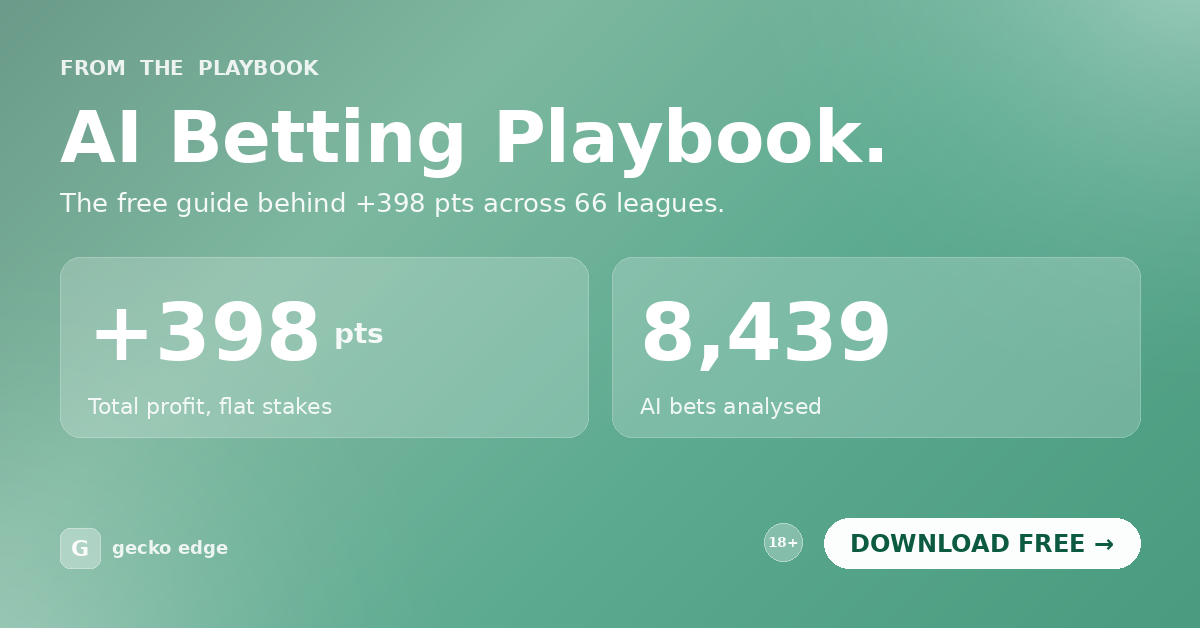
Gecko Edge has tracked 8,439 AI-generated bets and recorded +398pts of profit across 66 competitions. See how the model works →
The Premier League Problem
The English Premier League is the most watched football competition on the planet. Millions of eyes. Billions in betting volume. Every match dissected by thousands of analysts, journalists, and punters.
Here’s the issue: when everyone is watching, the market gets smart. Fast.
Bookmakers dedicate their best traders to Premier League matches. They have access to the same data you do: often more. The odds are razor-sharp. The margins are thin. Finding genuine value becomes incredibly difficult.
This doesn’t mean it’s impossible. But it does mean you’re competing against the most efficient market in football betting.
Think of it like fishing. The Premier League is a heavily fished lake. The fish are still there, but they’re educated. They’ve seen every lure. You need something special to catch them.

Why Lower Leagues and Obscure Markets Are Different
Now compare that to the Norwegian Second Division. Or the Cypriot First Division. Or the Paraguayan Primera División.
These leagues attract a fraction of the betting volume. Bookmakers allocate fewer resources to pricing them. The odds are often set using automated models with minimal human oversight.
This creates inefficiencies. Gaps between the true probability of an outcome and what the odds suggest.
For bettors using predictive football models, these inefficiencies are opportunities. The fish haven’t seen as many lures. They’re easier to catch.
Research consistently shows that predictive accuracy varies significantly depending on league characteristics. Leagues with unpredictable scorelines require different modelling approaches than ultra-defensive, low-scoring competitions. This variation isn’t a bug: it’s a feature you can exploit.
What Makes a League “Beatable”?
Several factors determine how easy or difficult a league is to predict: and profit from.
1. Market Attention
The less attention a league receives, the softer the odds tend to be. Bookmakers can’t dedicate equal resources to every competition. They prioritise where the money flows.
Premier League? Maximum attention.
Swedish Allsvenskan? Moderate attention.
Latvian Higher League? Minimal attention.
Less attention means more pricing errors. More pricing errors mean more value for those paying attention.
2. Data Availability and Quality
Some leagues have excellent data coverage. Others barely track basic statistics.
Predictive football models thrive on data. Expected goals, shot locations, pressing intensity, defensive actions: these inputs feed the algorithms that generate predictions. When data is sparse or unreliable, models struggle.
Interestingly, this cuts both ways. Leagues with limited data also have limited bookmaker modelling. If you can source quality data for an under-covered league, you gain an edge over both the market and other bettors.

3. Competitive Balance
Leagues with extreme competitive imbalance: where a few clubs dominate consistently: can be tricky. The outcomes are predictable, but the odds reflect this. Backing Bayern Munich at 1.10 doesn’t offer value even if they win 95% of matches.
Conversely, leagues with high competitive balance create more uncertainty. More uncertainty means bookmakers make more mistakes. And more mistakes mean more opportunities.
The sweet spot is often mid-tier European leagues or strong second divisions. Enough quality and data to model accurately, but not so much attention that the market is perfectly efficient.
4. Scoring Patterns
Different leagues score differently. Some are goal-heavy affairs. Others are tactical slogs ending 0-0.
Your predictive model needs to account for this. Predictive football models calibrated on the Eredivisie (historically high-scoring) will struggle in Serie A (historically defensive). Choosing the right predictive football models type: whether that’s a standard Poisson distribution, a Negative Binomial approach for volatile leagues, or a Zero-Inflated model for defensive competitions: matters enormously.
This is where many bettors go wrong. They apply one-size-fits-all models and wonder why results vary wildly across different leagues.
The Hundreds of Leagues Advantage
Here’s where things get practical.
Gecko Edge covers hundreds of leagues worldwide. From the Premier League to the Peruvian Segunda División. From the J1 League in Japan to the Slovenian PrvaLiga.
Why does this matter?
Because value doesn’t announce itself. It hides in obscure corners. The bettor who only watches top-five European leagues is fishing in the most crowded waters. The bettor who scans hundreds of leagues: armed with AI-powered models: finds value others miss entirely.
This isn’t about becoming an expert in Icelandic football. It’s about letting data do the heavy lifting while you focus on the opportunities with genuine edge.

A Practical Framework for League Selection
If you’re serious about using predictive football models profitably, consider this approach:
Step 1: Identify leagues with sufficient data quality. You need reliable statistics to feed your models. If a league doesn’t track basic metrics, move on.
Step 2: Assess market efficiency. Look at betting volumes. Check how quickly odds move. High liquidity and fast line movements suggest sharp markets. Lower liquidity and stable lines suggest softer markets.
Step 3: Evaluate your model’s historical performance. Backtest across different leagues. Some leagues will suit your approach better than others. That’s not failure: it’s useful information.
Step 4: Focus your energy where edge exists. There’s no prize for betting on famous matches. The goal is profit, not entertainment. If the Finnish Veikkausliiga offers better value than the Champions League, follow the value.
Step 5: Stay humble. Edges erode. Markets learn. What works today might not work in two years. Keep testing. Keep adapting.
For a deeper dive into finding value in less-covered competitions, check out our guide on lower league betting secrets.
The Mental Shift Required
Most bettors chase excitement. They want to bet on the matches they’re watching. The matches their friends are talking about.
Profitable bettors chase value. They bet where the edge exists, regardless of glamour.
This requires a mental shift. You’re not watching football as entertainment anymore: you’re treating it as a market. And markets reward those who go where others don’t.
Gecko Edge makes this shift easier. By analysing hundreds of leagues simultaneously, you don’t need to become an expert in every competition. The AI identifies potential value. You make the final decision.

Bringing It Together
Some leagues are genuinely easier to beat than others. This isn’t theory: it’s how markets work.
The Premier League offers thin margins and fierce competition. Lower divisions and obscure leagues offer softer odds and more opportunities for those willing to look.
The keys to success:
- Understand that market efficiency varies by league
- Use predictive football models appropriate to each league’s scoring patterns
- Prioritise data quality and coverage
- Follow value, not prestige
- Let tools like Gecko Edge expand your range without expanding your workload
Football betting rewards patience, discipline, and a willingness to go against the crowd. The crowd watches the Premier League. The smart money watches everywhere else.
Ready to explore beyond the obvious? Start with these lower league betting ideas and see what value looks like when nobody else is paying attention.