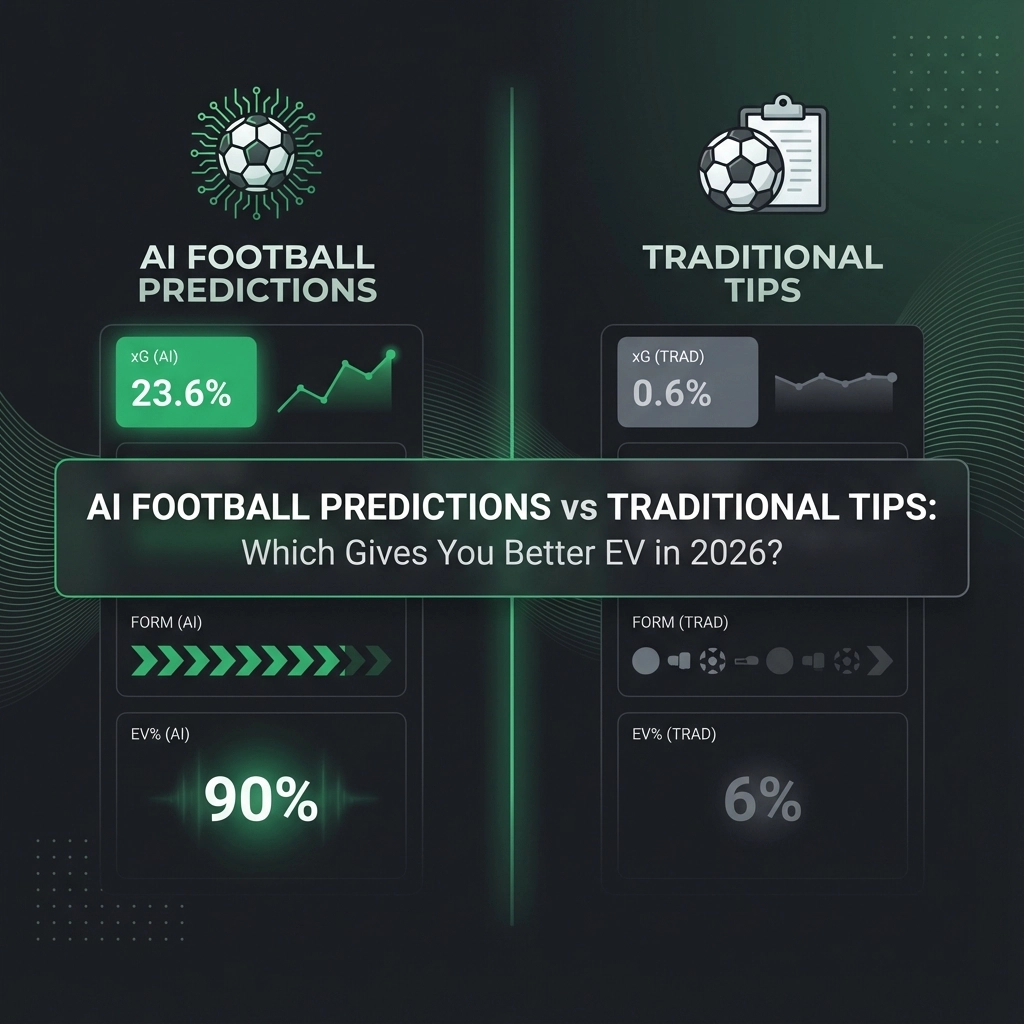
The betting landscape has shifted. What worked in 2015 doesn’t cut it in 2026. Traditional football tips: those weekend newsletters, pundit predictions, and “expert” picks: are competing against machines that process thousands of data points per second. The question isn’t whether AI Football Predictions are impressive. It’s whether they actually give you better expected value.
Let’s look at the numbers.
What Traditional Tips Actually Deliver
Traditional football predictions rely on human expertise, intuition, and pattern recognition. A good tipster watches matches, follows team news, understands tactical setups, and builds predictions from experience.
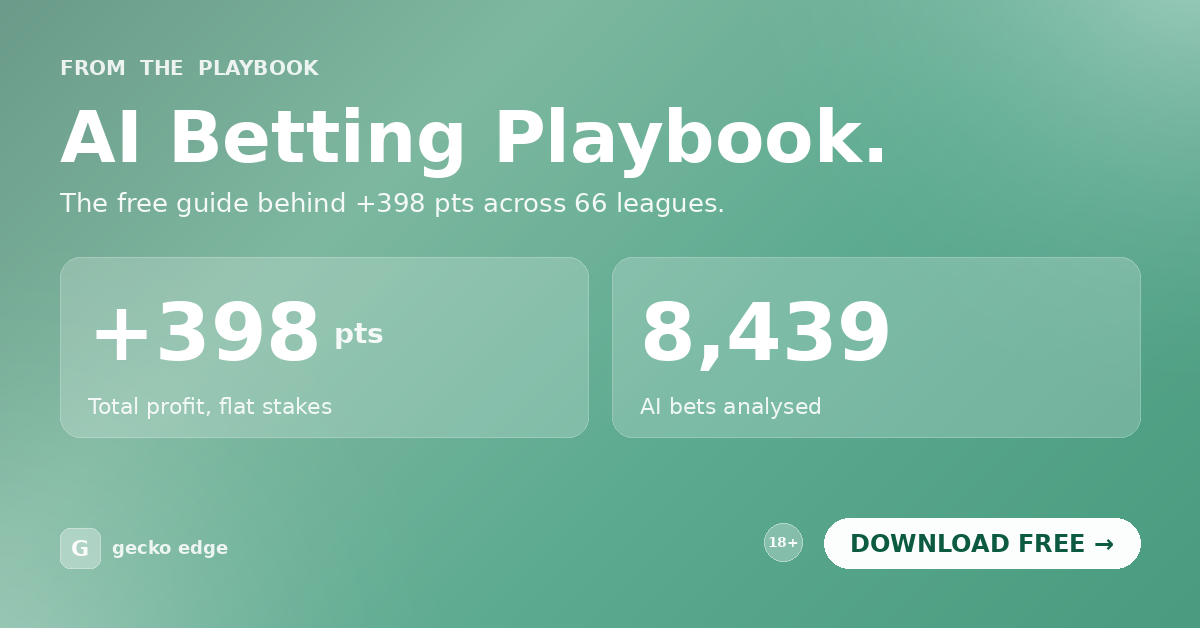
Gecko Edge has tracked 8,439 AI-generated bets and recorded +398pts of profit across 66 competitions. See how the model works →
The accuracy? Around 50-60% on game winners.
That sounds reasonable until you realise it’s barely above random chance. For betting markets where the bookmaker’s edge is already 5-8%, a 55% hit rate often means you’re losing money over time.
Here’s the maths: if you place 100 bets at evens (2.0 odds) with a 55% strike rate, you win 55 bets (£55 profit) but lose 45 bets (£45 loss). Net profit: £10 on £100 staked. That’s a 10% return: before accounting for the bookmaker’s margin.
Traditional tips also suffer from human bias. Tipsters overvalue recent form, get swayed by media narratives, and struggle with cognitive load when analysing multiple matches simultaneously.
How AI Football Predictions Work Differently
AI Football Predictions models process everything: player statistics, team performance metrics, weather conditions, rest days, injury reports, historical head-to-head records, and real-time betting market movements.
The difference is systematic data processing versus human intuition.
Modern AI achieves 75-85% accuracy on straight game winner predictions. Against more complex markets like Asian handicaps and total goals, the edge drops but remains significant at 62-68% accuracy.
One documented case showed a betting platform achieving a 28% accuracy improvement after implementing AI analysis across 50+ variables. Users reported a 62% boost in betting accuracy compared to traditional methods.
The key advantage isn’t just accuracy: it’s consistency. AI doesn’t have bad days, doesn’t get influenced by yesterday’s shock result, and doesn’t chase losses.
The Expected Value Reality
Expected value calculations reveal the true picture.
Traditional tipster scenario:
- Strike rate: 55%
- Average odds: 2.0
- EV per bet: (0.55 × 2.0) – 1 = 0.10 or +10%
AI prediction scenario:
- Strike rate: 68%
- Average odds: 1.85 (finding value in shorter-priced markets)
- EV per bet: (0.68 × 1.85) – 1 = 0.26 or +26%
The EV difference compounds rapidly. Over 100 bets, the traditional approach nets £10 profit while AI Football Predictions deliver £26. Over 1,000 bets, that’s £100 versus £260.

Where Traditional Tips Fall Short
Traditional football predictions have structural problems:
Limited data processing: A human analyst might consider 10-15 key factors per match. AI systems evaluate 200+ variables including micro-statistics like passing accuracy in the final third, defensive actions per 90 minutes, and injury impact modelling.
Emotional bias: Tipsters often favour big teams, dramatic storylines, or recent memories. AI treats Manchester United’s poor form the same as any other statistical pattern.
Static analysis: Pre-match tips can’t adapt when team news breaks two hours before kick-off. AI systems update probabilities in real-time as information emerges.
Inconsistent methodology: Different tipsters use different approaches. One might focus on form, another on head-to-head records. AI maintains consistent analytical frameworks.
Volume limitations: A good tipster might analyse 20-30 matches per weekend. AI can process every fixture across multiple leagues simultaneously.
Real-World Performance Gaps
The professional betting market reveals the performance gap clearly.
Successful betting syndicates use AI models as their primary prediction engine, not traditional analysis. Sharp money: the bets that actually move market prices: comes from algorithmic systems processing vast datasets.
Consider Asian handicap markets, where margins are tighter. AI systems consistently achieve 52-55% accuracy against the spread, while traditional handicappers struggle to document similar performance over extended periods.
The market itself validates AI effectiveness. Odds compilers at major bookmakers use machine learning models to set initial prices, then adjust based on betting action. You’re essentially competing against AI even when following traditional tips.
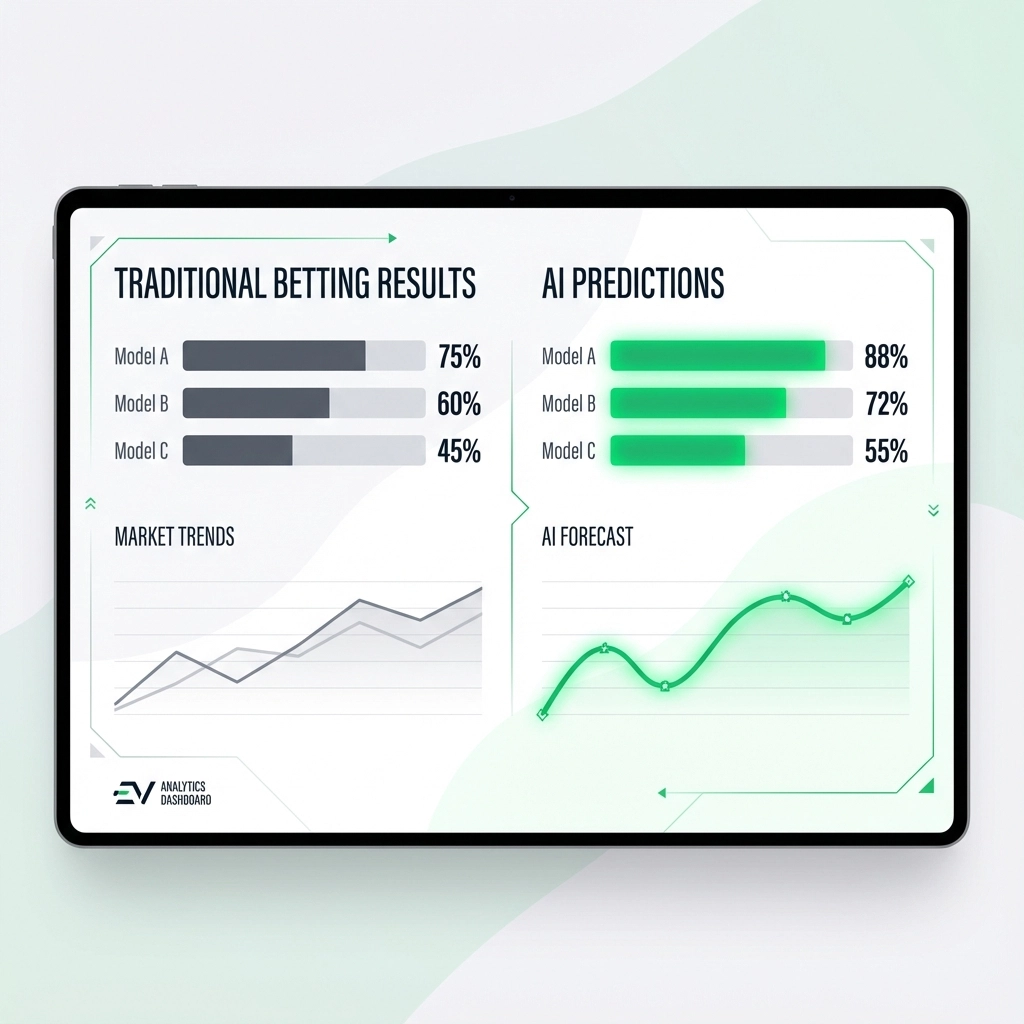
How Gecko Edge Changes the Game
Gecko Edge bridges the gap between complex AI analysis and practical betting decisions.
Instead of building your own predictive models or relying on outdated tipster methods, Gecko Edge delivers AI-powered insights that focus specifically on expected value opportunities.
The system processes real-time data across multiple leagues, identifies value discrepancies between AI predictions and bookmaker odds, and presents actionable betting opportunities with clear EV calculations.
This isn’t about replacing football knowledge with blind algorithmic following. It’s about enhancing your analysis with data-driven insights that traditional methods simply cannot match.
Our AI-powered football betting guide explains how to integrate algorithmic analysis with practical betting strategy.
Realistic Expectations
AI predictions aren’t magic. Claims of 70%+ accuracy against point spreads are typically overfitted models using future information.
Professional AI systems realistically achieve:
- 75-85% accuracy on game winners
- 62-68% accuracy on Asian handicap markets
- 52-55% accuracy against tight spreads
These numbers represent significant edges, but betting success still requires proper bankroll management, disciplined staking, and understanding market dynamics.
AI also struggles with low-sample events: cup finals, playoff matches, or fixtures involving newly-promoted teams with limited historical data.

Making the Switch
The transition from traditional tips to AI predictions doesn’t require abandoning football knowledge. The best approach combines AI accuracy with situational awareness.
Use AI models for systematic value identification and probability assessment. Apply football knowledge for context: derby matches, managerial pressure, squad rotation during fixture congestion.
Start by comparing your current tipster performance against documented AI results. Track strike rates, average odds, and long-term profitability. Most bettors discover their traditional sources deliver worse results than they assumed.
Consider tools that integrate AI analysis with practical betting workflows. Gecko Edge provides exactly this combination: sophisticated predictive modelling with clear, actionable recommendations.
The future of profitable football betting isn’t about choosing between human expertise and artificial intelligence. It’s about using AI to identify opportunities that traditional analysis misses, then applying betting discipline to capitalise on those edges consistently.
Your profits depend on expected value, not prediction methods. AI simply delivers better EV more consistently than traditional alternatives.
The question isn’t whether to use AI Football Predictions. It’s whether you can afford not to.
How accurate are traditional football tipsters?
Traditional tipsters typically achieve 50-60% accuracy on game winners — barely above random for binary outcomes. For betting markets where the bookmaker’s edge is already 5-8%, a 55% strike rate often means losing money over time. Traditional analysis also suffers from human bias: overvaluing recent form, getting swayed by media narratives, and struggling with cognitive load when analysing multiple matches simultaneously.
How accurate are modern AI football prediction models?
Modern AI achieves 75-85% accuracy on straight game winner predictions. Against more complex markets like Asian Handicaps and total goals, accuracy drops to 62-68% — still a significant edge. Against tight spreads, AI realistically achieves 52-55%. These numbers reflect what serious systems deliver, not the inflated 70%+ claims you see from overfitted models using future information.
Why does expected value (EV) matter more than win rate?
Win rate alone tells you nothing about profitability. A 70% strike rate at odds of 1.40 is a losing system. A 55% strike rate at odds of 2.10 is profitable. EV — (probability × odds) − 1 — captures both pieces in a single number. Over 100 bets, a traditional approach at 55% / 2.00 nets £10 profit, while AI at 68% / 1.85 nets £26. The EV gap compounds rapidly across larger samples.
Where do traditional tipsters fall short structurally?
Five structural problems: limited data processing (humans handle 10-15 factors per match versus AI’s 200+); emotional bias (favouring big teams or dramatic storylines); static analysis (no real-time adjustment to team news or line movement); inconsistent methodology (different tipsters use different approaches); and volume limitations (manual analysis of 20-30 matches per weekend versus AI processing every fixture across multiple leagues simultaneously).
Can football knowledge still add value alongside AI?
Yes — the strongest approach combines AI’s systematic value identification with human situational awareness. AI handles probability assessment and price comparison at scale. Football knowledge adds context: derby pressure, managerial situation, squad rotation during fixture congestion, cup-final variance. Use AI as the foundation for value identification, then apply judgement for the edge cases where data alone underrepresents the situation.

3 comments