The summer transfer window is more than just a period of frantic fax machine activity and “here we go” tweets. For the serious bettor, it represents the single most significant annual reset of the footballing landscape. It is the moment when last season’s data: the very foundation upon which bookmakers build their models: begins to decay.
When a club undergoes a massive squad overhaul, the market often fails to keep pace. Bookmakers, by their very nature, are reactive. They rely on historical precedents and large datasets to set their prices. But how do you price a team that has replaced six starters and a manager in the space of eight weeks? This is where Gecko Edge thrives: identifying the gap between what the old data says and what the new reality reflects.
The Lag in Bookmaker Algorithms
Most professional oddsmaking relies on a concept called “power rankings.” These rankings are built over years, factoring in home-field advantage, historical xG (Expected Goals), and squad value. When the summer window opens, these models are adjusted manually, but the core weight remains tethered to the past.
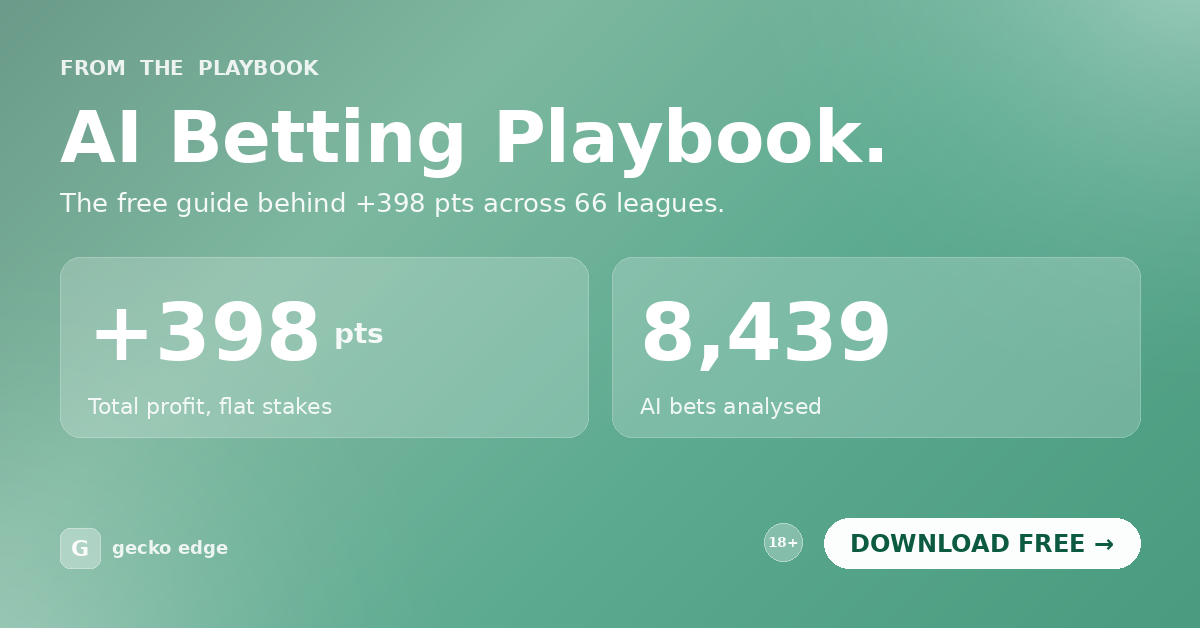
Gecko Edge has tracked 8,439 AI-generated bets and recorded +398pts of profit across 66 competitions. See how the model works →
The inefficiency arises because bookmakers are often slow to de-weight the previous season’s performance. If a top-tier side sells its midfield engine and replaces them with unproven talent from a different league, the “brand name” of the club often keeps the odds shorter than they should be. Conversely, a mid-table side that makes three “smart” signings: players whose underlying metrics are elite but whose profile is low: might see their odds remain static.
At Gecko Edge, we understand that “smarter betting starts here” because we don’t just look at the names; we look at the context-aware impact of those changes. A squad overhaul isn’t just about adding individual talent; it’s about how those pieces fit into a tactical ecosystem.
Manager Turnover: The Great Undervalued Variable

While the media focuses on £100m strikers, the more potent market inefficiency often lies in the dugout. A change in manager can fundamentally alter a team’s xG profile overnight.
Consider a team that played a low-block, counter-attacking style last season, consistently conceding possession but keeping games low-scoring. If they hire a manager obsessed with a high-intensity press and a high defensive line, their “Under 2.5 Goals” historical trend becomes irrelevant.
The market often underestimates the positive (or negative) impact of a head coach replacement in the short term. Academic research into European betting markets has shown a persistent semi-strong inefficiency here: odds after a coaching change tend not to move enough to reflect the actual shift in performance. By using the AI Betting Playbook and the real-time insights from Gecko Edge, you can identify these tactical pivots before the general public: and the bookies: have adjusted their spreadsheets.
Pre-season Friendlies: Filtering Signal from Noise
We’ve all seen it: a Premier League giant loses 3-0 to a League One side in July, and the “crisis” headlines begin. For most bettors, pre-season is a minefield of meaningless data. However, for those using a data-driven approach, pre-season is the first opportunity to see a new-look squad in motion.
The key is to ignore the final score and focus on the mechanics:
- Tactical Consistency: Is the new manager actually implementing the promised high press?
- Positioning: Where is the marquee signing actually playing? Is a traditionally defensive midfielder being pushed into a more creative #8 role?
- Substitution Patterns: Are the youth players filling gaps, or are they genuinely part of the first-team rotation?
Gecko Edge helps you filter this noise. Our AI understands that a friendly in 30-degree heat with ten substitutions isn’t a predictor of match results, but the underlying tactical “fingerprint” it reveals is invaluable for early-season value hunting.
Case Study: The Integration Risk

There is a common fallacy in the betting market: the “Transfer Window Winner” bias. When a club like Chelsea or Nottingham Forest signs a dozen players in a single window, the market often overreacts to the increase in nominal quality.
The reality is that mass overhauls come with an “integration tax.” Cohesion takes time. Defensive partnerships need hundreds of hours on the training ground to synchronise their movements. When five new players start in a back four and a holding midfield, the risk of “Expected Goals Against” (xGA) spikes, regardless of how much those players cost.
Smart bettors look for the “overreaction” in the outright markets. If a team’s title odds slash because they signed three star attackers but ignored their aging defence, there is often massive value in betting against them in the opening weeks. Gecko Edge‘s multi-market coverage, including Asian Handicaps and Draw No Bet, allows you to exploit these defensive fragilities with precision.
Bridging the Information Gap with AI
The transfer window creates a vacuum of reliable information. In this vacuum, most bettors fall back on gut feeling or media narratives. They bet on “hope” or “reputation.”
Ask. Analyse. Act.
That is the formula for navigating the post-transfer window landscape.
- Ask: How has the squad’s core identity changed?
- Analyse: Use Gecko Edge to compare the new tactical setup against the market’s pricing.
- Act: Identify the Expected Value (EV) where the bookies are still leaning on last season’s ghost data.

In the modern game, the speed of information is everything. While traditional tipsters are still talking about “form” from last May, the context-aware AI at Gecko Edge is already processing the implications of yesterday’s deadline-day deals.
We provide the in-play intelligence and predictive modelling needed to understand how a new signing in the 80th minute affects the probability of a late goal, or how a manager’s tactical switch in pre-season will play out against a low-block specialist in Week 1.
Final Thoughts: Smarter Betting Starts Here
The transfer window isn’t just about spending money; it’s about the redistribution of quality and the creation of uncertainty. Uncertainty is the bettor’s best friend, provided you have the tools to quantify it.
Don’t let the bookmakers dictate the narrative with their stale models. Whether you’re looking for value in the Premier League or finding an edge in the lower divisions where squad churn is even higher, Gecko Edge is built to give you that expert-level analysis without the guesswork.
The squads have changed. The tactics have evolved. The odds are lagging. Now is the time to act.