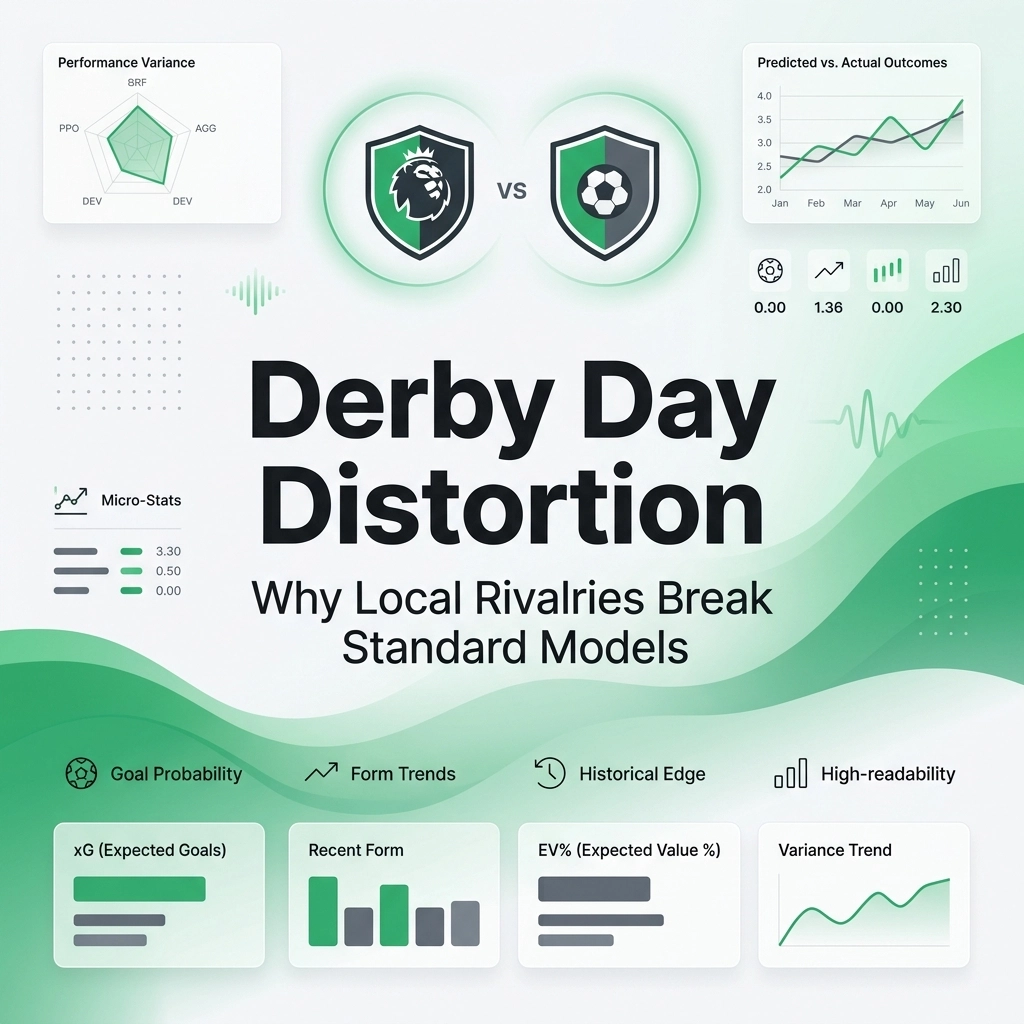
Standard football models often fail when local pride is on the line. Discover why Derby Day requires specialised AI context and how Gecko Edge navigates the volatility of rivalry matches.
You can feel it in the air long before the whistle blows. Whether it’s North London, the Ruhr Valley, or the streets of Glasgow, a derby day isn’t just another fixture on the calendar. For the fans, it’s about identity. For the players, it’s about legacy. But for the serious trader or the data enthusiast, it’s something else entirely: a statistical anomaly.
We’ve all seen it. A team sitting comfortably at the top of the table, boasting a perfect expected goals (xG) ratio and a rock-solid defensive line, suddenly collapses against a mid-table rival who hasn’t won in five weeks. In a standard match, the data would suggest a comfortable win. In a derby, that data often isn’t worth the paper it’s printed on.
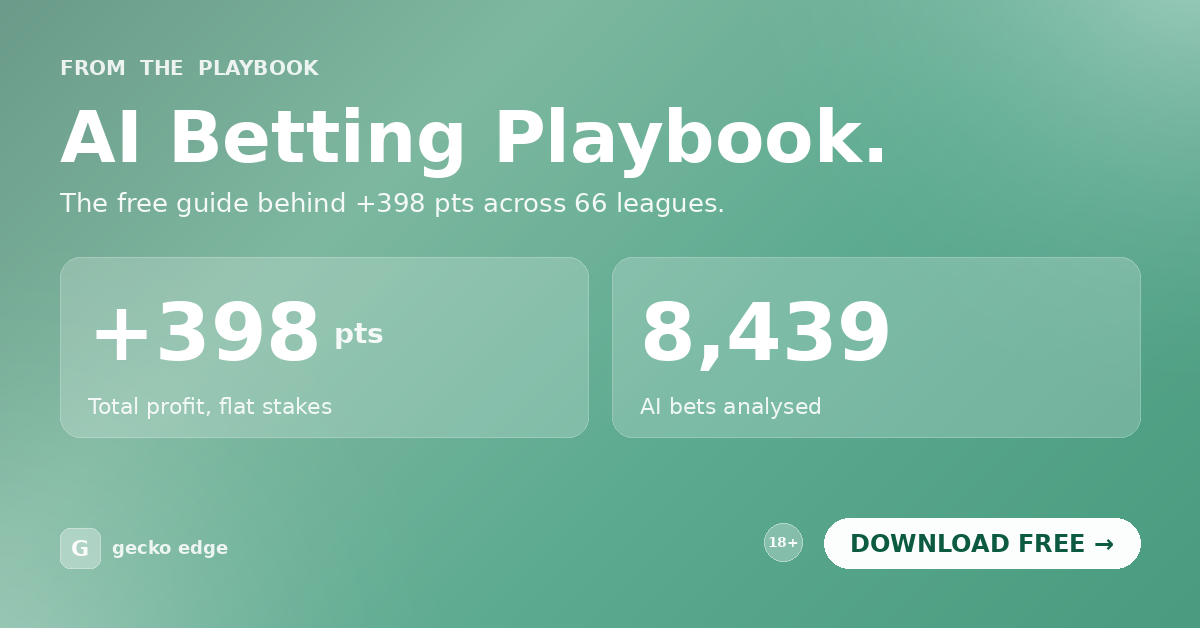
Gecko Edge has tracked 8,439 AI-generated bets and recorded +398pts of profit across 66 competitions. See how the model works →
At Gecko Edge, we spend a lot of time looking at why standard models break. If you’re relying on raw numbers alone to navigate a derby, you’re not just trading; you’re guessing. Here is why local rivalries distort the logic of the game and why specialized AI context is the only way to find clarity in the chaos.

The Noise in the Machine
Standard predictive models are built on the assumption of consistency. They look at the last six games, the historical performance of the striker, and the defensive efficiency of the back four. They work on the principle that a team will play to its average level of ability.
But a derby day introduces a level of “noise” that most models can’t filter. This isn’t just statistical variance; it’s a fundamental shift in how the game is played. When the stakes transition from “three points” to “local pride,” the physiological and psychological state of every player on the pitch changes.
Adrenaline spikes. Tactical discipline often takes a backseat to raw aggression. A player who usually avoids a 50/50 challenge might suddenly fly into a tackle that earns them a red card in the tenth minute. Standard models don’t have a “red card due to ancestral hatred” variable, but perhaps they should. This is where Gecko Edge steps in, looking beyond the raw output to the context that actually drives the result.
The Psychology of the “Must Not Lose”
In most league matches, the goal is to win. In a fierce local rivalry, the primary directive is often “do not lose.” This shift in objective changes the entire flow of the match.
Research into the psychological weight of derbies shows that the fear of failure often outweighs the desire for victory. This leads to what we call “Derby Day Distortion.” A high-scoring team might suddenly become ultra-conservative, terrified of being the group that loses to “them.” Conversely, a defensive team might be buoyed by a hostile home crowd, performing at 120% of their usual physical capacity.
Standard models see a defensive team and predict a low block. They don’t see the 50,000 fans screaming for blood, which can push a mediocre defender into a world-class performance for ninety minutes. This emotional “over-performance” is a nightmare for traditional statistics. It’s why we built Gecko Edge to account for more than just the scoreboard. Smarter betting starts with understanding that humans, not spreadsheets, play the game.

Why “Form” is a Dangerous Metric
We’ve all heard the cliché: “Form goes out the window on derby day.” While it’s a bit of a sports-writing trope, from a data perspective, it holds a kernel of truth.
When we analyze fixtures through the lens of Gecko Edge, we see that the predictive power of “recent form” drops significantly in local rivalries. A team’s performance in their last five matches against random league opponents has very little correlation with how they will perform against their biggest rival.
The reason is simple: the motivational floor is raised. In a standard Tuesday night away game in the rain, a tired squad might perform at 80%. In a derby, that same tired squad will find a second wind. The “form” isn’t gone; it’s just being overridden by a temporary surge in intensity. If your model doesn’t adjust its weighting for these specific fixtures, you are essentially looking at a map of the wrong city.
The Crowd as a Tactical Variable
Most models give a slight edge to the home team: the standard “home advantage” metric. But in a derby, the crowd isn’t just a background noise; it’s a tactical variable.
The intensity of a local rivalry can influence everything from refereeing decisions to the speed of the ball-boys. We’ve seen matches where the sheer volume of the home support has induced “referee bias,” leading to more lenient card-giving for the home side or a higher likelihood of a marginal penalty being awarded.
Traditional models struggle to quantify this. They see “Home Advantage: +0.3 goals.” At Gecko Edge, we know it’s more complex. It’s about how that specific atmosphere affects the specific personalities on the pitch. Some players thrive under the vitriol; others shrink. Without that level of context, your data is incomplete.

Specialised AI: Finding the Edge in the Chaos
So, how do you trade a match where the rules seem to change? The answer isn’t to ignore the data, but to use better data.
At Gecko Edge, we believe in Predictive Football Models Explained in Under 3 Minutes. We don’t just throw numbers at a wall; we provide the context that explains why those numbers are moving.
Our approach involves:
- Volatility Assessment: Recognizing which derbies have the highest historical “distortion” rates.
- Contextual Weighting: Reducing the reliance on standard form and increasing the weight of fixture-specific history and psychological factors.
- Real-Time Adaptation: Using AI to identify when a match is deviating from the “standard” script early on, allowing for better in-play decision making.
Built for bettors, powered by AI, Gecko Edge is designed to act as your mentor in these volatile markets. We don’t promise magic, but we do promise a sharper perspective.
Ask, Analyse, Act: Your Derby Strategy
If you’re looking at a big rivalry this weekend, don’t just follow the headlines. Take a leaf out of the Gecko Edge playbook and follow these three steps:
Ask: Is this a “standard” derby, or is there added weight? (Managerial changes, league positions, recent incidents).
Analyse: Look at the historical distortion. Does this fixture traditionally produce more cards, fewer goals, or unexpected results compared to the teams’ average seasons?
Act: Place your trades based on the context, not just the content. If the market is over-valuing a “form” team that always struggles in this specific stadium, that’s where your edge lies.

The beauty of football is its unpredictability, and nowhere is that more evident than on derby day. It’s the day when the underdog finds their teeth and the giant finds their nerves. By using the tools at Gecko Edge, you can stop being a victim of the distortion and start using it to your advantage.
If you want to dive deeper into how we handle these high-pressure scenarios, check out our AI Betting Playbook or browse our Case Studies to see how context beats raw data every time.
Remember, the goal isn’t just to bet; it’s to understand. And understanding starts here.

Smarter Betting Starts Here. Explore the About Gecko Edge page to learn more about our philosophy and how we’re changing the game for traders everywhere.