Stop guessing on “must-win” games. Learn how Gecko Edge uses AI and predictive models to quantify motivation and desperation in football betting.
Every April and May, the football world starts talking in clichés. You hear it on every broadcast and read it in every tabloid: “This is a must-win game.”
To the casual punter, “must-win” is a sign to pile onto the team with the most to lose. To a professional trader, it is a red flag. Motivation is perhaps the most overused and misunderstood variable in sports. We know it exists, but we rarely know how to measure it. We see a team fighting relegation and assume they will “want it more” than a mid-table side with nothing to play for.
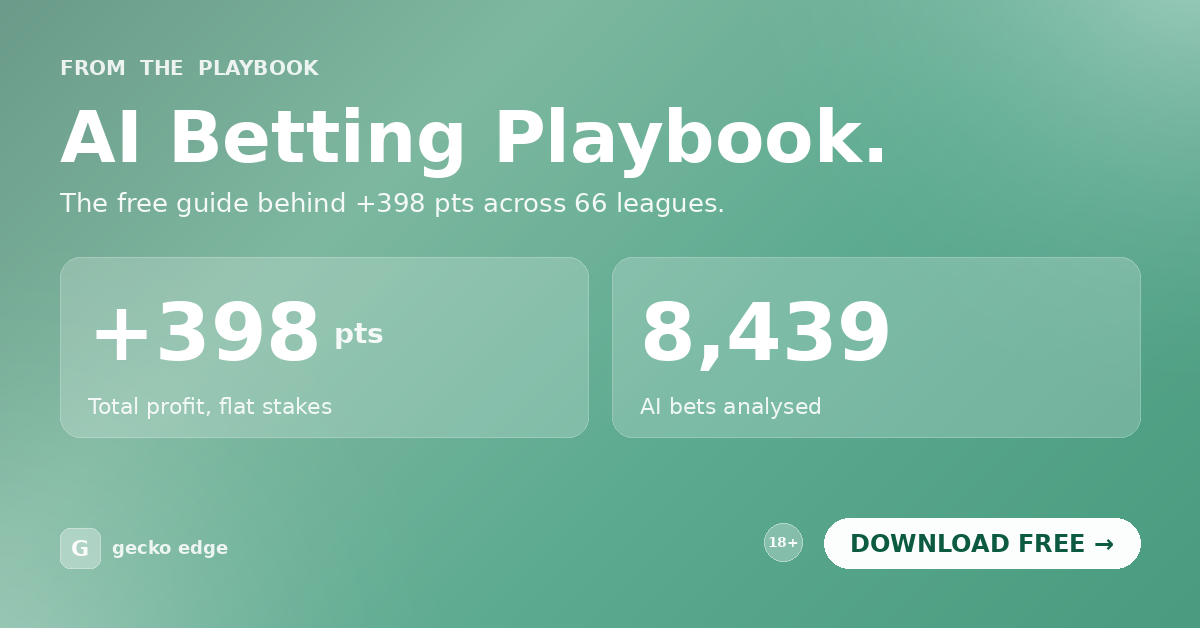
Gecko Edge has tracked 8,439 AI-generated bets and recorded +398pts of profit across 66 competitions. See how the model works →
But desire doesn’t always translate to goals. Sometimes, it translates to panic. At Gecko Edge, we don’t look at desire. We look at data. We treat motivation as a quantifiable metric: a shift in the expected performance levels based on the mathematical stakes of the match.
The Myth of “Trying Harder”
The problem with the “must-win” narrative is the assumption that players aren’t already trying. Professional athletes are inherently competitive. They don’t typically step onto the pitch intending to lose.
However, high-stakes situations change the way they play. This is where the psychology of loss framing comes in. Research shows that people are significantly more motivated to avoid a loss than they are to achieve a gain. In football terms, the fear of relegation is often a more powerful driver than the hope of moving from 8th to 7th place.
When we talk about the “Motivation Metric” at Gecko Edge, we are looking at how this psychological pressure affects a team’s baseline efficiency. Does the pressure lead to a tighter defence? Or does it lead to reckless attacking and defensive lapses?

Quantifying Desperation: The Gecko Edge Approach
To build a winning system, you have to move past the narrative and into the mechanics. We quantify “must-win” situations by looking at three distinct pillars of data:
1. Mathematical Necessity
This is the foundation. We calculate the “Points Pressure Index.” If a team needs three points to stay in a league and has two games left, their pressure index is at its peak. Our AI models compare these scenarios against thousands of historical matches. We look for patterns: do teams in this exact mathematical position tend to outperform their Expected Goals (xG), or do they crumble under the weight of the requirement?
2. The “Beach Mode” Variable
Motivation is relative. A “must-win” for Team A only matters if Team B is in “Beach Mode.” We identify teams that have reached safety or have no mathematical chance of moving up or down the table. Gecko Edge tracks performance decay in these scenarios. Often, the drop-off in intensity from a mid-table team is more significant than the uptick in intensity from a desperate team.
3. Tactical Rigidity vs. Fluidity
In high-pressure games, managers often revert to type. A conservative manager becomes even more defensive. A “must-win” situation might actually lead to a lower-scoring game because the fear of conceding outweighs the need to score: at least until the final twenty minutes. Our predictive models factor in these tactical shifts, adjusting the total goals market expectations based on the stakes.

The Loss-Framing Effect in Action
As our research suggests, loss framing creates more motivation than gain framing. This is why a relegation dogfight is often more predictable than a title race in the final weeks.
When a team is fighting for survival, their “Motivation Metric” is high, but their “Error Probability” also rises. At Gecko Edge, we’ve observed that “must-win” teams often start matches with high intensity but see a sharp decline in composure if they don’t score early.
If you are following our AI Betting Playbook, you know that timing is everything. We use the motivation metric to identify “In-Play” opportunities. If a desperate team is drawing at the 70-minute mark, the “Motivation Metric” tells us they will throw everyone forward. This either leads to a late winner or, more often, a clinical counter-attack goal for the opposition.
Built For Bettors, Powered By AI
Traditional statistics like possession and shots on target don’t capture the tension of a final-day decider. That’s where AI fills the gap. By processing historical outcomes of similar “high-stakes” scenarios, Gecko Edge provides a layer of context that the raw stats miss.
We aren’t just looking at who should win on paper. We are looking at who is mathematically forced to play outside of their comfort zone.
Smarter betting starts with acknowledging that football isn’t played in a vacuum. A team’s performance in August is not the same as their performance in May, even if the XI on the pitch is identical. The environment changes the output.

How to Use the Motivation Metric
If you want to move from a hobbyist to a professional mindset, you need to Ask, Analyse, and Act.
- Ask: What does this team actually need from this game? Is a draw enough? Does the goal difference matter?
- Analyse: Look at the Gecko Edge predictive models. See if the market has over-adjusted for the “must-win” narrative. Often, the “desperate” team is priced far too short, creating value on the other side.
- Act: Use the data to place your trade. If the Motivation Metric suggests a team will be reckless, look at the “Over” markets or the “Opposition Team Goals” markets.
The Danger of Over-Valuing Motivation
A common mistake is assuming that motivation can overcome a lack of quality. It can’t. A motivated League Two side will still lose to a “Beach Mode” Premier League side 99 times out of 100.
The Motivation Metric is a multiplier, not a base stat. It enhances the existing quality of a team or exposes their underlying flaws. At Gecko Edge, we use AI to ensure that the “story” of the match doesn’t blind us to the reality of the match.

Final Thoughts: Clarity over Chaos
The final weeks of the season are full of noise. Fans are screaming, pundits are speculating, and the markets are moving on emotion.
In this chaos, data is your only anchor. By quantifying the “must-win” situation, we remove the guesswork. We don’t care about the passion in the stadium; we care about the probability of the outcome.
Whether you are looking for an edge in the relegation battles or the race for Europe, understanding the Motivation Metric is essential. It’s about seeing the game as a series of mathematical pressures rather than a series of emotional moments.
Ready to see how our models handle the business end of the season? Explore our Knowledge Base to learn more about how we turn psychology into probability.
Smarter Betting Starts Here.
Check out the latest insights at Gecko Edge and stop betting on narratives. Start betting on the numbers.