Corners Market; most bettors spend their time obsessing over who will win the match. They look at the 1X2 market, the Asian Handicap, or maybe the Over/Under 2.5 goals. While these markets are the most popular, they are also the most efficient. Thousands of eyes and millions of pounds keep the prices sharp.
But if you look slightly to the side, toward the corner flags, you’ll find a different story.
The corners market is often an afterthought for the casual punter. It feels random. It feels like luck. To the untrained eye, a corner is just a deflected cross or a saved shot. But to us at Gecko Edge, it is a data-rich environment where bookmakers frequently get the math wrong.
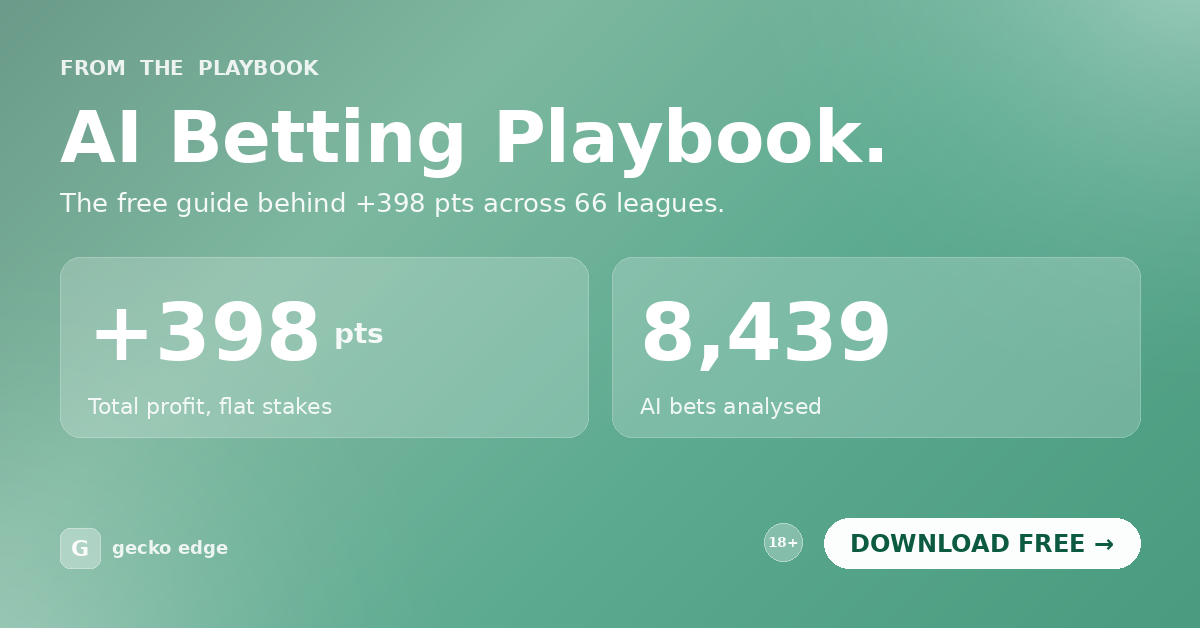
Gecko Edge has tracked 8,439 AI-generated bets and recorded +398pts of profit across 66 competitions. See how the model works →
If you want to find a consistent edge, you need to understand why these inefficiencies exist and how AI can help you exploit them.
Why the “Side Markets” Hold the Real Value
Bookmakers are experts at managing risk. They put their best analysts and most complex algorithms on the high-volume markets. Because so much money flows into the match winner markets, the bookies cannot afford to be wrong by even a fraction.
The corners market doesn’t get the same level of scrutiny. The limits are lower, the volume is smaller, and the variables are more volatile. This creates a gap.
At Gecko Edge, we see this as an opportunity. While a human trader might look at a team’s average corners per game, our AI looks at the reason behind those corners. Did they come from a desperate chase in the final ten minutes? Or are they a structural result of the team’s tactical setup?
When you stop looking at averages and start looking at intent, the inefficiencies begin to appear.

The Variables Most Bettors Ignore
Most people use “average corners” as their primary metric. This is a mistake. An average is a blunt instrument. It doesn’t tell you the story of the match. To predict set-piece value, Gecko Edge focuses on three specific pillars:
1. Tactical Width and Crossing Frequency
Teams that play with traditional wingers who stay wide tend to generate more corners. If a team prefers to “invert” their wingers: cutting inside to shoot: the corner count often drops. Our models track player positioning and crossing zones in real-time. If a team starts a specific full-back who thrives on overlapping runs, the probability of a high corner count shifts instantly.
2. Shot Volume and Deflections
You cannot have a corner without a shot or a cross that is blocked or saved. Teams with high “shots from distance” metrics often see higher corner counts. Even if the shots aren’t high-quality chances, they create the chaos required for a set-piece. Gecko Edge analyses the shooting patterns of every player on the pitch to forecast this “chaos factor.”
3. Defensive Style
Some teams are coached to concede corners rather than allow a cross into the box. They prefer to “clear their lines” out of play. Other teams try to play their way out of pressure. Knowing the defensive philosophy of a manager is vital.

How Game State Dictates the Corner Count
This is perhaps the most important factor in corner betting. The “game state” refers to the current scoreline.
Imagine a heavy favourite playing at home. They are expected to win easily. If they score two goals in the first twenty minutes, the match “settles.” They stop attacking with intensity, and the underdog stops over-committing to defense. The corner count usually plummets.
Now, imagine that same favourite is losing 1-0 at the 70th minute. They will throw everyone forward. They will cross the ball repeatedly. The underdog will defend deep and clear everything out for a corner. In this scenario, you might see five or six corners in the final ten minutes.
The Gecko Edge AI understands these “what if” scenarios. We don’t just predict the outcome; we predict the flow of the match under different scorelines. This allows us to identify value in the “In-Play” corners markets that most humans miss.
The Gecko Edge Approach: AI vs. Human Bias
Humans are prone to recency bias. If a team had 15 corners in their last match, the public will drive the price down for their next game. The bookmaker reacts to the money, not necessarily the reality.
Our AI doesn’t have feelings. It doesn’t remember the “exciting” match from last weekend. It looks at the data points that actually matter:
- Pitch Dimensions: Believe it or not, the width of a pitch affects crossing frequency.
- Weather Conditions: High wind or heavy rain can lead to more handling errors by keepers and more deflections.
- Referee Tendencies: Some referees are quicker to award a corner in a crowded box than others.
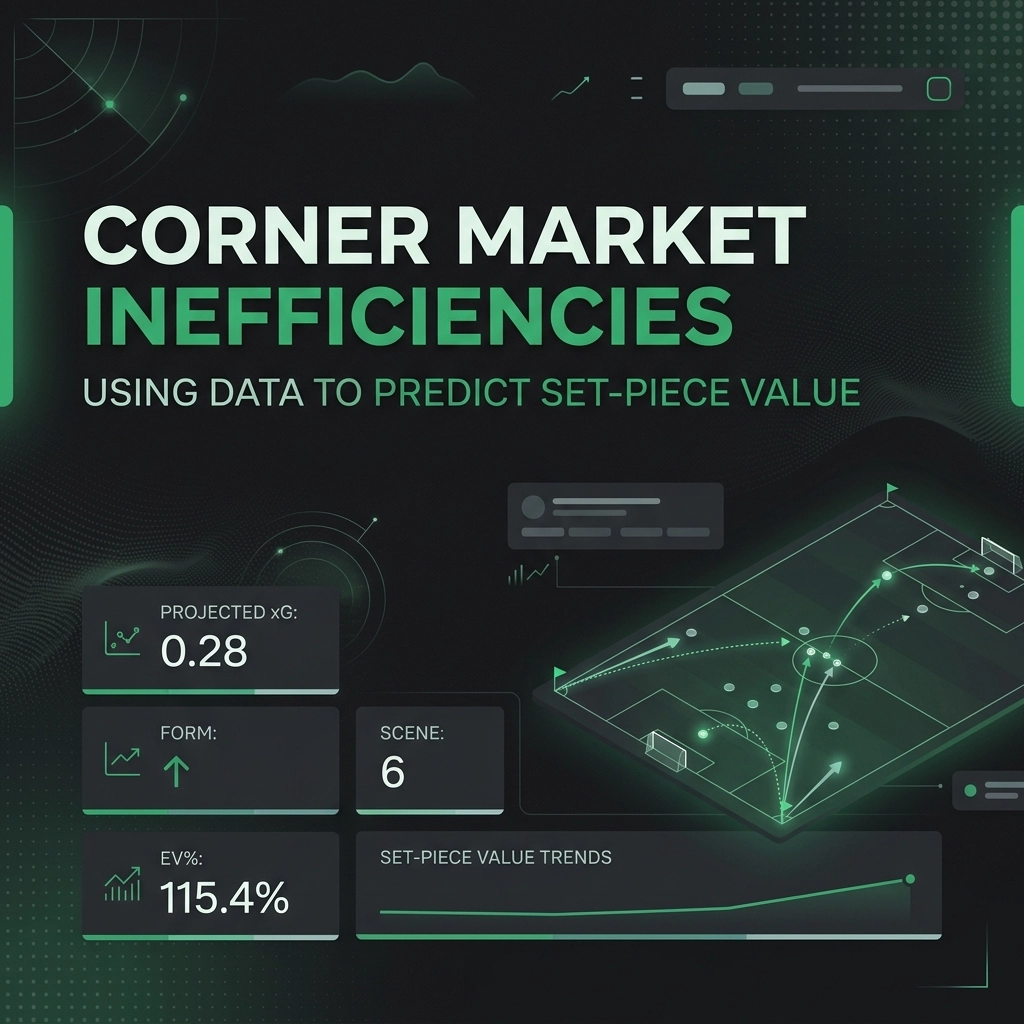
By processing thousands of matches across different leagues, Gecko Edge builds a profile for every team that goes far beyond a simple “corners per game” statistic. We look for the “Value Margin”: the difference between the bookmaker’s implied probability and our AI’s calculated probability.
If the bookmaker thinks there is a 48% chance of Over 10.5 corners, but our model shows 58%, that 10% gap is where the profit lives.

Building Your Own Corner Strategy
If you want to start finding value in set-pieces, you need to change how you watch the game. Stop following the ball and start watching the space.
Ask yourself these three questions:
- Who is providing the width? If the wingers are missing and the team is playing a narrow “diamond” midfield, the Over market is likely a trap.
- What is the motivation? Is this a cup game where one team must score? Or a late-season mid-table clash where both teams are happy with a draw?
- How does the underdog defend? Do they park the bus? If they sit deep, they invite pressure. Pressure leads to corners.
At Gecko Edge, we do this heavy lifting for you. We provide the clarity needed to navigate these markets without getting lost in the noise. Smarter betting isn’t about knowing more than everyone else; it’s about using better tools to interpret what everyone is already seeing.

The Bottom Line
The corners market isn’t a lottery. It is a mathematical puzzle. While the rest of the world is arguing over VAR decisions and league titles, the smart money is moving toward these smaller, less efficient markets.
Data allows us to see patterns that the naked eye misses. It allows us to predict set-piece value based on logic rather than hope. Whether you are looking for a predictive football model or just a better way to spend your Saturday afternoon, understanding corner inefficiencies is a vital skill.
The goal isn’t just to win a bet. The goal is to build a system that wins over time. Built For Bettors, Powered By AI. That is the Gecko Edge way.
If you’re ready to stop guessing and start analysing, take a look at our AI Betting Playbook. The edge is there. You just have to know where to look.