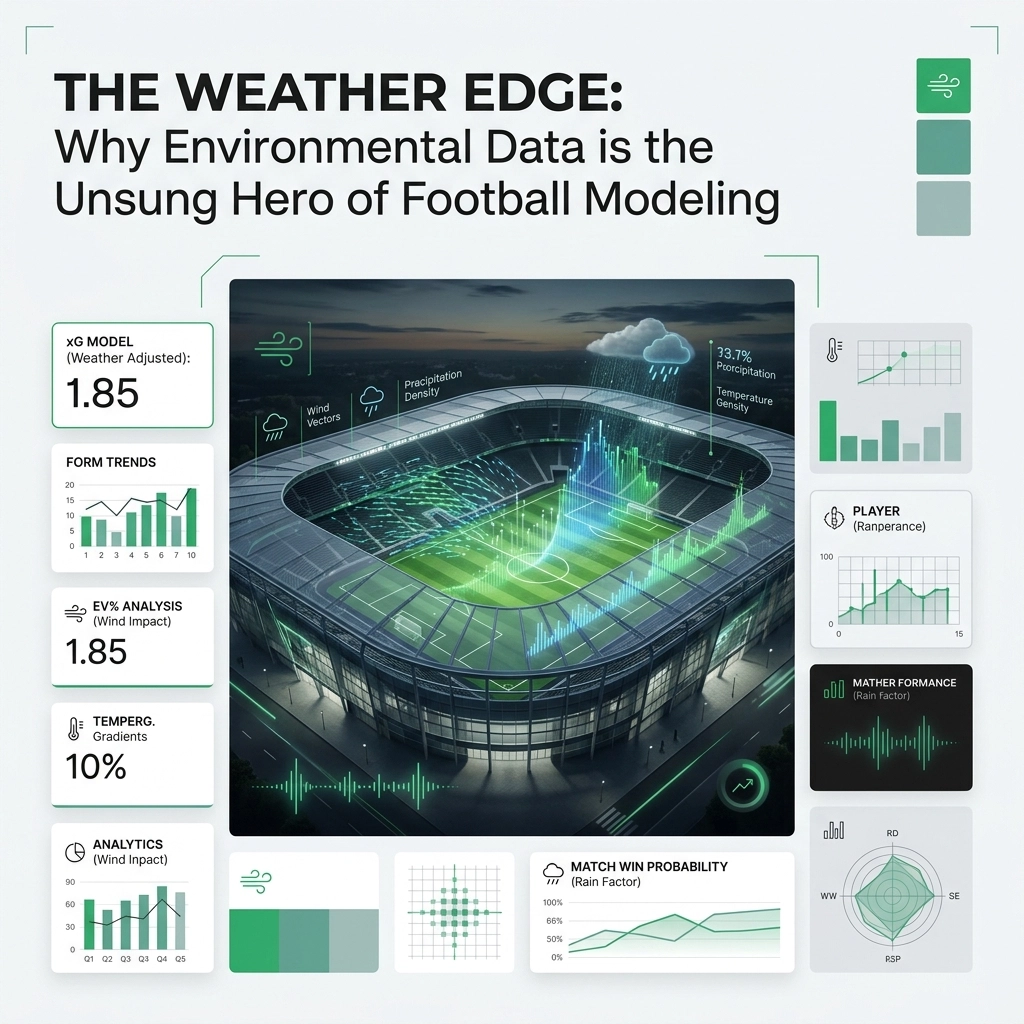
Most football modelling is done in a vacuum. They look at pass completion rates, historical Expected Goals (xG), and player availability as if the match is taking place in a sterile, temperature-controlled laboratory. But football is played outdoors, often in conditions that can turn a tactical masterclass into a chaotic scramble.
If you are looking for football betting tips, you have likely noticed that the markets are incredibly efficient at pricing in a star striker’s injury or a change in manager. However, the markets are surprisingly slow to react to a 25mph crosswind or a pitch that has been turned into a bog by a week of relentless British rain.
At Gecko Edge, we believe that environmental data isn’t just a “nice to have”: it is the invisible variable that separates a good model from a great one. Understanding how the elements affect the physics of the ball and the physiology of the players is how we find value where others see noise.
Gecko Edge has tracked 8,439 AI-generated bets and recorded +398pts of profit across 66 competitions. See how the model works →
The Invisible Hand: How Wind Disrupts Tactical Intent
Wind is perhaps the most underrated environmental factor in football modeling. While rain is visible and dramatic, wind is an invisible force that fundamentally alters the physics of the game.
When we talk about betting market trends, we often see the “Total Goals” market fluctuate based on attacking lineups. Rarely do we see it move significantly because of a high-velocity wind forecast. Yet, a strong wind can effectively neutralise a team’s primary tactical weapon.
Consider a team that relies on long, diagonal switches of play or a “route one” approach. In a 30km/h headwind, those balls hang in the air longer, giving defenders more time to recover and adjust. Conversely, a tailwind can cause through-balls to zip out of play before a winger can reach them.

From an xG perspective, wind creates “low-quality” chances out of high-potential situations. A cross that would usually land on a striker’s head is blown half a metre off course. In our AI betting playbook, we weigh wind speed against a team’s style of play. A high-pressing team that keeps the ball on the deck is less affected than a team that thrives on aerial duels and long-range distribution.
The Goalkeeper’s Nightmare
Wind also introduces a level of randomness to long-range shots. A ball that “wobbles” in the air due to gusty conditions is significantly harder for a goalkeeper to track. This often leads to parried saves and “second-chance” xG: rebounds that wouldn’t exist on a calm day. If you are tracking betting market trends, look for matches where high wind speeds coincide with teams that have a high volume of shots from outside the box.
The Friction Factor: Rain and Pitch Quality
There is a common misconception that rain always leads to fewer goals. The reality is more nuanced. The impact of rain depends entirely on the volume of water and the quality of the pitch’s drainage system.
A light drizzle on a modern, high-tech hybrid pitch actually increases the speed of the game. The ball “zips” across the surface, making passing sharper and more difficult to intercept. This often leads to a higher xG, as defenders struggle to keep up with the increased tempo.
However, once the rain becomes heavy enough to cause surface ponding, the game changes. The ball stops dead in puddles. Passing becomes a lottery. In these conditions, tactical complexity goes out the window, and physical strength becomes the dominant factor.
Pitch Degradation and Total Goals
Pitch quality is the “unsung hero” of the Under/Over markets. By mid-February, many lower-league pitches: and even some in the top flights: begin to show signs of wear. A “heavy” pitch saps the energy out of players’ legs much faster than a pristine surface.
When the ground is soft and muddy, the frequency of muscle injuries and general fatigue increases in the final 20 minutes of a match. This often leads to a spike in late goals as defensive structures crumble under physical exhaustion. At Gecko Edge, we integrate pitch condition reports into our models to identify matches where the “Total Goals” might exceed market expectations due to late-game fatigue.

Temperature and the Physiology of xG
Temperature doesn’t just affect the ball; it affects the humans kicking it. High heat and humidity are well-known to slow the pace of a match. In these conditions, teams are less likely to maintain a high-intensity press for 90 minutes. They “drop off,” allowing the opposition more time on the ball in non-threatening areas.
For a bettor, this is crucial. A team that usually generates high xG through high-turnover situations (winning the ball back near the opponent’s goal) will see their output drop significantly in 30°C heat. The market often remembers the team’s “average” performance but fails to discount for the metabolic cost of the weather.
Conversely, very cold temperatures can lead to “stiff” starts. We’ve observed in our data that matches played in sub-zero temperatures often have a lower xG in the first 15 minutes as players struggle to reach optimal operating temperature.
Why the Markets Miss the Edge
Why doesn’t the market perfectly price this in? Because environmental data is messy. It’s hard to quantify “pitch quality” on a scale of 1 to 10. It’s difficult to know exactly how a 20mph gust at pitch level differs from the reading at the local airport.
Most bettors look at the surface-level football betting tips: form, injuries, and motivation. They ignore the atmospheric variables because they are seen as “marginal gains.” But in the world of professional betting, marginal gains are the only gains that matter.

Gecko Edge uses AI to bridge this gap. By feeding historical weather data into our neural networks alongside performance metrics, we can see the “hidden” correlations. We know, for instance, how a specific stadium’s architecture might funnel wind in a way that disrupts long balls more than the stadium three miles down the road. This is the definition of “Smarter Betting Starts Here.”
Ask, Analyse, Act: Using Environmental Data
If you want to start incorporating this into your own strategy, we suggest a simple three-step framework:
- Ask: What are the forecasted conditions two hours before kick-off? Don’t just look at “Rain” or “Sun.” Look at wind speed, wind direction, and humidity.
- Analyse: How do these conditions interact with the teams’ styles? Does a slick pitch favour the technical underdog? Does a gale-force wind neutralise the favourite’s long-ball specialist? Use our betting glossary to understand the technical terms if you’re unsure.
- Act: Look for discrepancies between your analysis and the current betting market trends. If the market expects a high-scoring game but the pitch is a quagmire and the wind is howling, there is likely value in the “Under” markets.
The Future of Environmental Football Modelling
We are moving into an era where “environmental intelligence” will be a standard part of any serious betting toolkit. We are already seeing the integration of IoT sensors in stadiums providing real-time data on turf moisture and micro-climates within the bowl.
At Gecko Edge, we are at the forefront of this evolution. Our mission is to provide clarity in a world of noise. Football isn’t just a game of goals; it’s a game of physics played in an ever-changing environment.
Whether you are a seasoned trader or just starting your journey, remember that the sky above the stadium often tells you more about the result than the pundits in the studio. Stay analytical, stay disciplined, and always look for the edge that others are too busy to notice.
For more insights into how we use technology to redefine the game, visit our About Us page or explore the AI betting playbook for a deeper dive into our methodology.