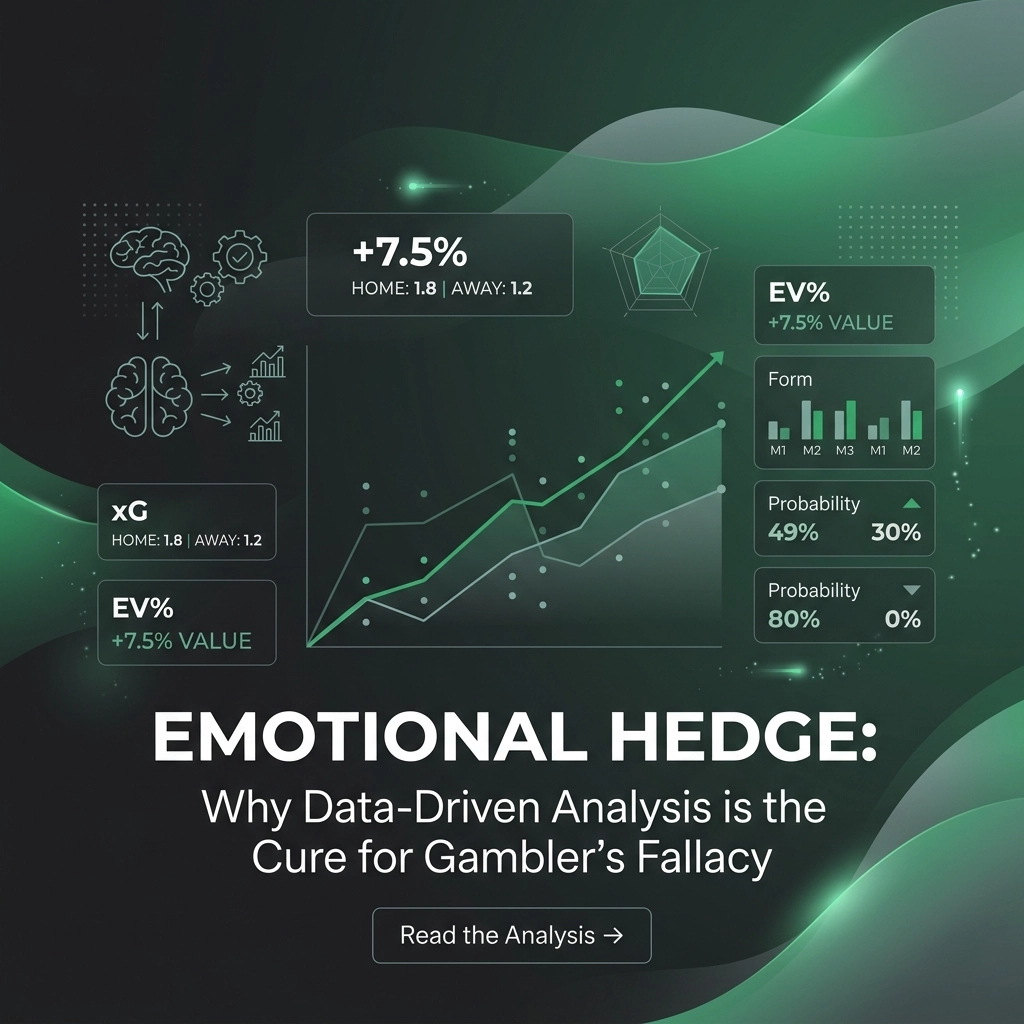
Gambler’s Fallacy; every bettor has felt it. That itch in the back of your mind after a team has lost four games in a row. “They’re due,” you tell yourself. “Probability says they have to win eventually.” You convince yourself that the universe is a giant set of scales, and right now, those scales are out of balance.
In the world of professional trading, we call this the Gambler’s Fallacy. It is the most common psychological trap in sports, and it’s where most bankrolls go to die. At Gecko Edge, we see it as the ultimate obstacle to a successful football betting strategy.
To survive in 2026, you don’t just need a better model; you need a better mindset. You need an emotional hedge. This isn’t about betting against your own team to feel better if they lose. It’s about using data-driven analysis to shield your decision-making from the flawed wiring of the human brain.
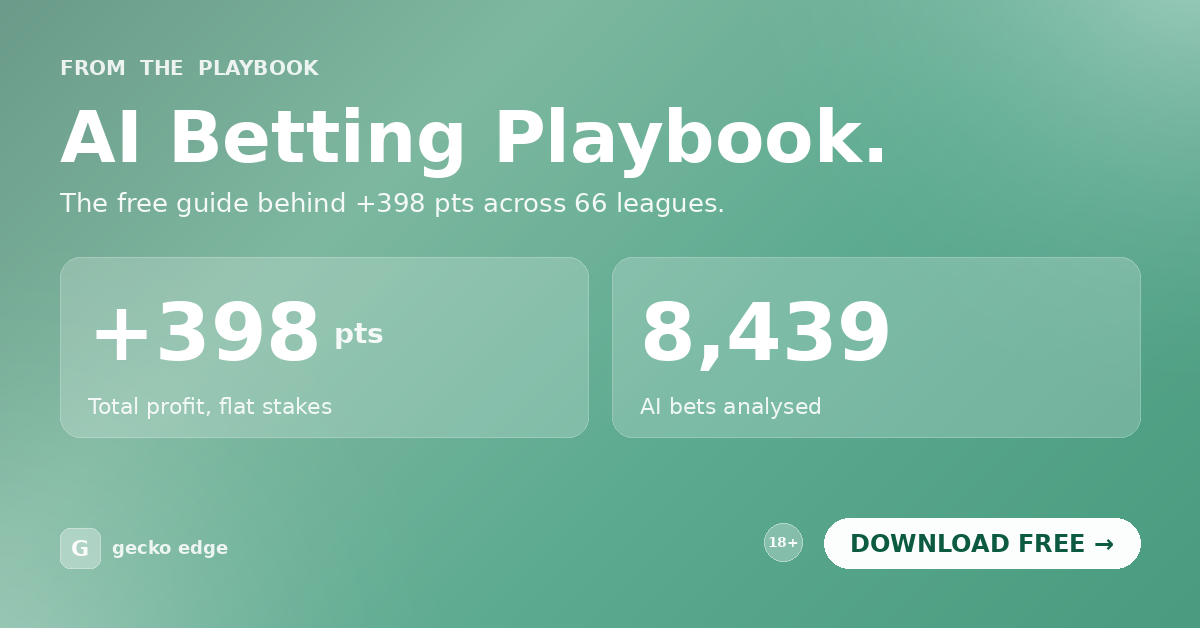
Gecko Edge has tracked 8,439 AI-generated bets and recorded +398pts of profit across 66 competitions. See how the model works →
The “Due” Delusion: Breaking the Gambler’s Fallacy
The Gambler’s Fallacy is the belief that if something happens more frequently than normal during a given period, it will happen less frequently in the future (and vice versa). In football, this manifests as a belief that a streak: whether winning, losing, or a run of “Over 2.5 Goals“: is a debt that the universe must soon repay.
But the pitch doesn’t have a memory. The ball doesn’t know it hit the post last week. Each match is, to a large extent, an independent event governed by specific variables: fitness, tactics, and variance.
When you start chasing a result because it’s “due,” you’ve stopped looking for betting value picks and started looking for narrative satisfaction. You aren’t analysing the match; you’re projecting your own need for symmetry onto a chaotic system.

Why Your Brain Loves Patterns That Aren’t There
Our ancestors survived by spotting patterns. Rustle in the grass? Probably a predator. Dark clouds? Rain is coming. This pattern-recognition software is hard-coded into us. However, it’s poorly suited for the high-variance world of ai football predictions.
We see a striker miss three sitters and assume he’s “in a slump.” Or we see a team win five games straight and assume they are “unstoppable.” Data tells a different story. By looking at expected goals, we can see if that striker is still getting into the right positions. If his xG is high but his actual goals are zero, he isn’t in a slump; he’s just experiencing a temporary dip in variance. He isn’t “due” a goal in a mystical sense, but his statistical profile suggests the goals will return if he keeps doing exactly what he’s doing.
Recency Bias and the “Hot Hand” Myth
Close cousin to the Gambler’s Fallacy is Recency Bias. This is the tendency to over-weight the most recent information while ignoring the larger data set.
If a team wins 4-0 on a Tuesday night, the market for their Saturday game will often overreact. The odds will shorten, the public will pile on, and the “value” will evaporate. Humans are suckers for “momentum.” We think the “Hot Hand” is a physical force.
At Gecko Edge, we use AI to strip away the “noise” of the last ninety minutes. Our ai betting systems don’t get excited by a 4-0 drubbing if that drubbing was the result of two lucky deflections and a soft red card. The data looks at the underlying performance, not the scoreboard.
The Noise of the Last Three Games
Ask yourself: when you look at a fixture, how much are you influenced by the “Last 5” column on a results site? Most bettors are heavily influenced by it. But a five-game sample in football is tiny. It’s a blink of an eye.
A data-driven approach treats those five games as five data points among thousands. It compares current performance against a long-term baseline. If the “gut feeling” says a team is on fire, but the xg football stats show they are being outplayed and just getting lucky, the data gives you the courage to bet against the crowd. That is how you find an edge.

The Emotional Hedge: Using Data as a Shield
So, how do we fix this? How do we stop our brains from sabotaging our bankrolls? You build an emotional hedge using ev betting principles.
An emotional hedge isn’t a feeling; it’s a process. It’s about creating a system where the “why” behind every bet is rooted in probability rather than prophecy. When you use Gecko Edge, you aren’t just getting a tip; you’re getting a calculation of Expected Value (EV).
How AI-Driven Analysis Neutralises Bias
AI is the ultimate cure for the Gambler’s Fallacy because machines don’t feel “due.” They don’t get frustrated by a losing streak, and they don’t get cocky after a win.
When we look at ai football predictions vs traditional tips, the difference is clarity. A traditional tipster might say, “Chelsea haven’t won at Anfield in six years, they are bound to break the streak today.” That is narrative-led.
An AI-driven model says, “Based on 10,000 simulations, Chelsea has a 32% chance of winning. The current market price implies a 25% chance. Therefore, there is a +7% edge.”
The AI doesn’t care about the six-year streak. It cares about the current line-ups, the tactical match-up, and the mathematical probability. By following the model, you are essentially “hedging” against your own emotional impulses.
Finding Betting Value Picks Without the Ego
The hardest part of betting is being wrong. When you lose a bet, your ego wants to win it back immediately. This leads to “chasing”: the most dangerous form of the Gambler’s Fallacy. You feel the market “owes” you.
The cure is to detach your ego from the outcome of a single match. If you’ve done your research and the expected value was on your side, the result is irrelevant. You did your job. The variance simply didn’t fall your way this time.
Ask, Analyse, Act
To implement a data-driven football betting strategy, we suggest a simple three-step process:
- Ask: Why am I making this bet? Is it because I feel a result is “due,” or is there a statistical reason?
- Analyse: Check the underlying data. Does the xg goals stats support the narrative? What does the ev ai betting model say about the price?
- Act: If the math shows an edge, place the bet. If you’re betting because of a “feeling,” walk away.

The Path to Smarter Betting
The transition from a recreational bettor to a serious trader is a journey from the heart to the head. It’s about accepting that you don’t know what will happen in the next 90 minutes, but you do know what will happen over the next 1,000 matches if you consistently find value.
The Gambler’s Fallacy is a ghost. It feels real, it haunts your decisions, but it has no substance. Data-driven analysis is the light that makes the ghost disappear.
At Gecko Edge, we aren’t just providing numbers. We’re providing the framework for a more disciplined, rational way to engage with the sport we love. Whether you are exploring asian handicap vs match result or diving into inplay trading, the goal is always the same: remove the emotion, find the edge.
Smarter betting starts with a simple admission: your brain is trying to trick you. Let the data set you straight.
Meta Title: Emotional Hedge: Curing the Gambler’s Fallacy with Data | Gecko Edge
Meta Description: Discover why data-driven analysis is the ultimate cure for the Gambler’s Fallacy. Learn how Gecko Edge uses AI to help you avoid emotional betting and find true value.
Meta Keywords: football betting strategy, betting value picks, gambler’s fallacy, recency bias, AI betting, expected value, Gecko Edge.

1 comment