Expected Value (EV) is the holy grail of sports betting. It is the simple mathematical bridge between a casual hobby and a professional pursuit. If you understand EV betting, you understand that you aren’t betting on winners; you are betting on prices.
However, the math that looks so elegant on a spreadsheet often crumbles in the real world. Many bettors find themselves “doing the work”: calculating edges and placing value bets: only to see their bankroll dwindle over months of activity. Usually, the fault doesn’t lie with the concept of EV itself, but with how it is calculated and applied.
In this guide, we’ll look at the seven most common pitfalls in EV calculations and how you can sharpen your process using the same logic we apply at Gecko Edge.
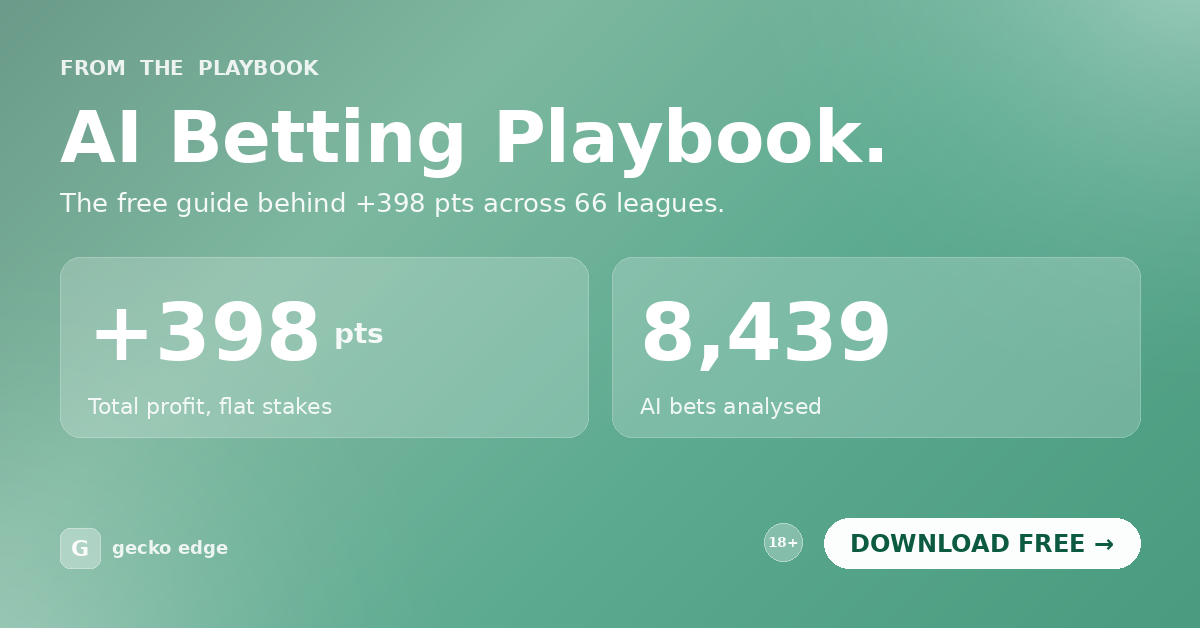
Gecko Edge has tracked 8,439 AI-generated bets and recorded +398pts of profit across 66 competitions. See how the model works →
1. Confusing Implied Probability with True Probability
The biggest mistake is the most basic one. Most bettors look at a bookmaker’s odds, convert them to a percentage, and treat that as the “true” probability of an event. For example, if Manchester City are priced at 1.50, they assume the bookie believes City has a 66.7% chance of winning.
This is fundamentally wrong.
The odds offered by a bookmaker are a retail price, not a statistical prediction. They include the “vig” or “overround”: the bookmaker’s profit margin. When you sum up the implied probabilities of all outcomes in a market, you’ll find they add up to 105%, 107%, or even 110%.
The Fix: You must strip the vig to find the “no-vig” probability. Only then can you compare your calculated probability to the market to find real value. If you don’t account for the margin, you are essentially calculating your edge against a moving target.

2. Relying on “Gut Feel” for Probability Estimates
I see this often. A bettor thinks, “Arsenal looked brilliant last week, they must be at least 70% likely to beat Brighton.”
Human intuition is a poor tool for probability. We are biologically hardwired to suffer from recency bias (overweighting the last game), confirmation bias (ignoring data that says we’re wrong), and the law of small numbers. When you guess a percentage, you aren’t calculating EV; you are quantifying a feeling.
The Fix: Move away from subjective assessments. Professional betting requires a systematic approach. You should be looking at hard data: Expected Goals (xG), team strength metrics, and historical performance under similar conditions.
At Gecko Edge, we believe that smarter betting starts with removing the human element where it is weakest. By using AI to process thousands of data points, you get a probability estimate grounded in reality, not emotion. If you want to see how data transforms betting, check out The Ultimate Guide to xG Stats.
3. Overbetting on Thin Edges
In the world of EV betting, not all “green” is equal. You might find a bet where your model says the true probability is 52% and the bookie’s odds imply 51%. That is technically a +EV bet.
However, betting heavily on a 1% edge is a recipe for disaster. Why? Because your model isn’t perfect. If your estimate is off by even a tiny fraction, that 1% positive edge becomes a 1% negative edge.
The Fix: Incorporate a “Margin of Safety.” Most professional traders won’t touch a play unless the calculated EV is at least 2% to 4%. This buffer protects you against the natural imperfections of any model or data set. Think of it as an insurance policy for your bankroll.

4. Claiming False Precision
If a bettor tells me a team has exactly a 64.28% chance of winning, I know they don’t understand the nature of sports. Sports are chaotic, fluid, and influenced by a million variables: from a sudden rain shower to a referee’s mood.
Claiming that kind of precision is a mistake because it leads to overconfidence in your staking. If you believe your number is “perfect,” you’ll bet more than you should.
The Fix: Acknowledge the range. Every probability estimate has an error band. Instead of thinking “this is 60%,” think of it as “this is likely between 57% and 63%.” When you accept that your calculations are estimates rather than certainties, you naturally become more disciplined with your bankroll management. This level of calm expertise is what separates the winners from the dreamers.
5. The “Bet Everything” Fallacy
When bettors first discover EV, they often go on a spree. They find a tool or a model, see fifty +EV opportunities in one Saturday, and bet on all of them.
The problem is that many of these opportunities are “trap” value. They might be in low-liquidity markets where the bookmaker has information you don’t, or they might be based on outdated team news.
The Fix: Be selective. EV is a filter, not a command. You should combine your mathematical edge with context. Are the lineups confirmed? Is there a reason the market is moving against you? Quality will always beat quantity in the long run. Use the resources in our AI Betting Education section to learn how to filter the noise from the signal.

6. Ignoring the Impact of Variance
You can make a perfect EV calculation, place a bet with a massive +10% edge, and still lose. In fact, you can lose five of those in a row. This is variance.
Many bettors make the mistake of thinking that because they lost a few +EV bets, their math must be wrong. They then start tweaking their formulas or, worse, chasing losses. This is the “Gambler’s Fallacy” in a math-heavy coat.
The Fix: Focus on the process, not the outcome. The only way to beat variance is through a large sample size and a disciplined staking plan. We recommend using a Fractional Kelly Criterion: a mathematical formula that scales your bet size based on the size of your edge and the probability of winning. It’s built for bettors who want to stay in the game for the long haul.
7. Failing to Track Closing Line Value (CLV)
If you want to know if your EV calculations are actually working, don’t look at your profit/loss statement for the week. Look at your Closing Line Value.
CLV is the difference between the odds you took and the final odds right before the game starts. If you consistently bet at 2.00 and the game closes at 1.80, you have found “value.” The market has agreed with you. If you bet at 2.00 and it closes at 2.20, your “EV calculation” was likely wrong, even if the bet won.
The Fix: Every serious bettor must track their CLV. It is the single most accurate predictor of future profit. If you are consistently beating the closing line, the money will eventually follow. It is simply a matter of time and mathematics. At Gecko Edge, we focus on helping you find that edge before the market reacts.

The Path to Smarter Betting
Calculating Expected Value isn’t about being a math genius. It’s about being disciplined enough to avoid the common errors that eat away at your edge.
Stop guessing. Stop ignoring the bookie’s margin. Stop letting a three-game losing streak dictate your strategy.
Professional betting is a marathon, not a sprint. It requires a combination of technology, data, and a calm, analytical mindset. When you align your calculations with the reality of the market, you stop gambling and start trading.
Built for bettors, powered by AI: that is the philosophy we live by. If you’re ready to stop making these mistakes and start using data to your advantage, explore our Knowledge Base or dive into our latest AI Betting Tips.
The math doesn’t lie, provided you know how to talk to it. Let’s make sure you’re asking the right questions.