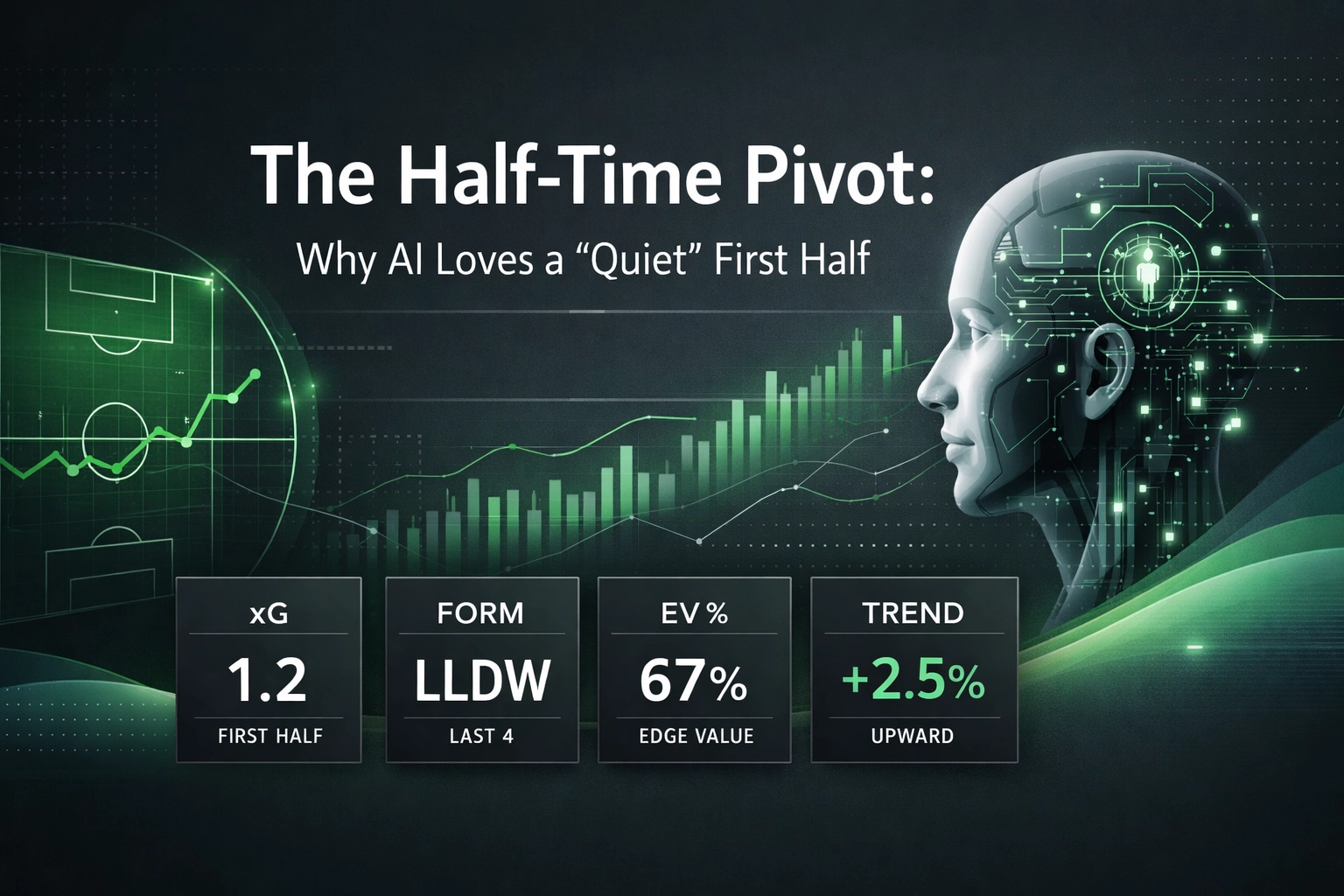
Half-Time Pivot; there is a specific kind of silence that happens during a football match. You know the one. It’s the 40th minute, the score is 0-0, and the commentator is starting to talk about what they had for lunch. To the average punter, this is a “boring” game. It’s a match to skip, a televised snooze-fest that offers nothing but a wasted Saturday afternoon.
But at Gecko Edge, we don’t see boredom. We see a pressure cooker with a stuck valve.
In the world of professional betting, the first half is often just the setup. While the crowd is getting restless and the casual bettors are closing their apps, the AI is just getting started. It’s analysing the rhythm, the expected goals (xG), and the subtle shifts in momentum that the human eye tends to miss.
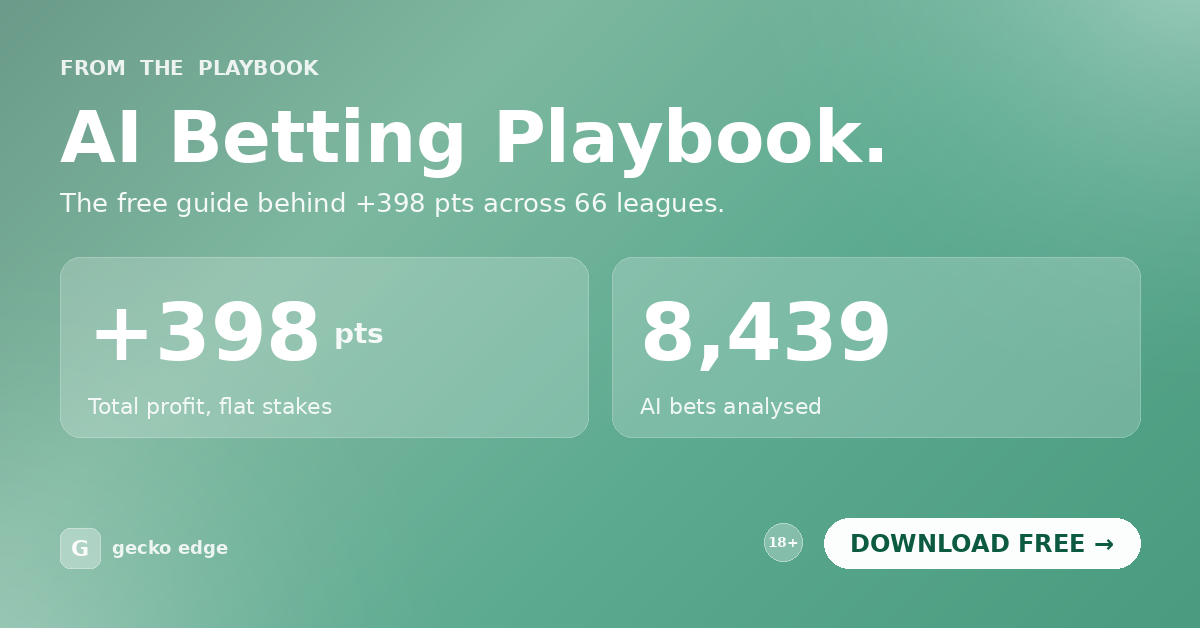
Gecko Edge has tracked 8,439 AI-generated bets and recorded +398pts of profit across 66 competitions. See how the model works →
A “quiet” first half is often the most profitable time to find value. Here is why the second half is where the real money is made, and why our AI loves it when the scoreboard says nothing.
The Illusion of the Stalemate
Humans are hardwired to look for patterns. If a game has been quiet for 45 minutes, our brains tell us it will stay quiet for the next 45. We call this “recency bias.” It’s the reason why the odds for “Under 2.5 Goals” often plummet during a goalless first half. The market assumes that because goals haven’t happened, they won’t happen.
However, football is a game of accumulating fatigue and tactical erosion. A 0-0 at half-time doesn’t mean nothing happened. It means the breakthrough hasn’t arrived yet.

When we look at xG football data, we often see a completely different story. A team might have zero goals but an xG of 1.45. They’ve hit the post, the keeper has made a world-class save, and they’ve had six corners. The scoreline is a lie. The underlying data is the truth.
Why AI Prefers the ‘Quiet’ Phase
In many ways, an AI’s approach to a football match mirrors how businesses handle new technology. Think of the first half as the “experimentation phase.” You are gathering data, testing the waters, and seeing how the opponent reacts.
Just as a company might have a “quiet” first phase of AI adoption to gain clarity before scaling, a football team often spends the first half probing. Our models at Gecko Edge use this quiet period to build a profile of the match.
By the time the whistle blows for half-time, the AI has analysed:
- Shot Quality: Not just how many shots, but where they came from.
- Field Tilt: Which team is spending the most time in the final third?
- Substitution Patterns: Who is warming up? How will the fresh legs change the dynamic?
- Defensive Fatigue: Are the full-backs starting to drop deeper?
This “quiet” period provides the essential context needed for a sharp in-play betting strategy. Without the data from a calm first half, the second half is just a coin flip. With it, it’s a calculated move.
Decoding the Pressure Cooker: xG and Beyond
To find value in the second half, you have to look at pressure. At Gecko Edge, we talk a lot about “Dangerous Attacks.” A dangerous attack is more than just a team having the ball; it’s about intent.
Imagine a game where Team A has 60% possession but most of it is in their own half. Now imagine Team B has 40% possession but has had 10 entries into the opposition box. The casual observer sees Team A dominating. The AI sees Team B as the one likely to pivot and score.
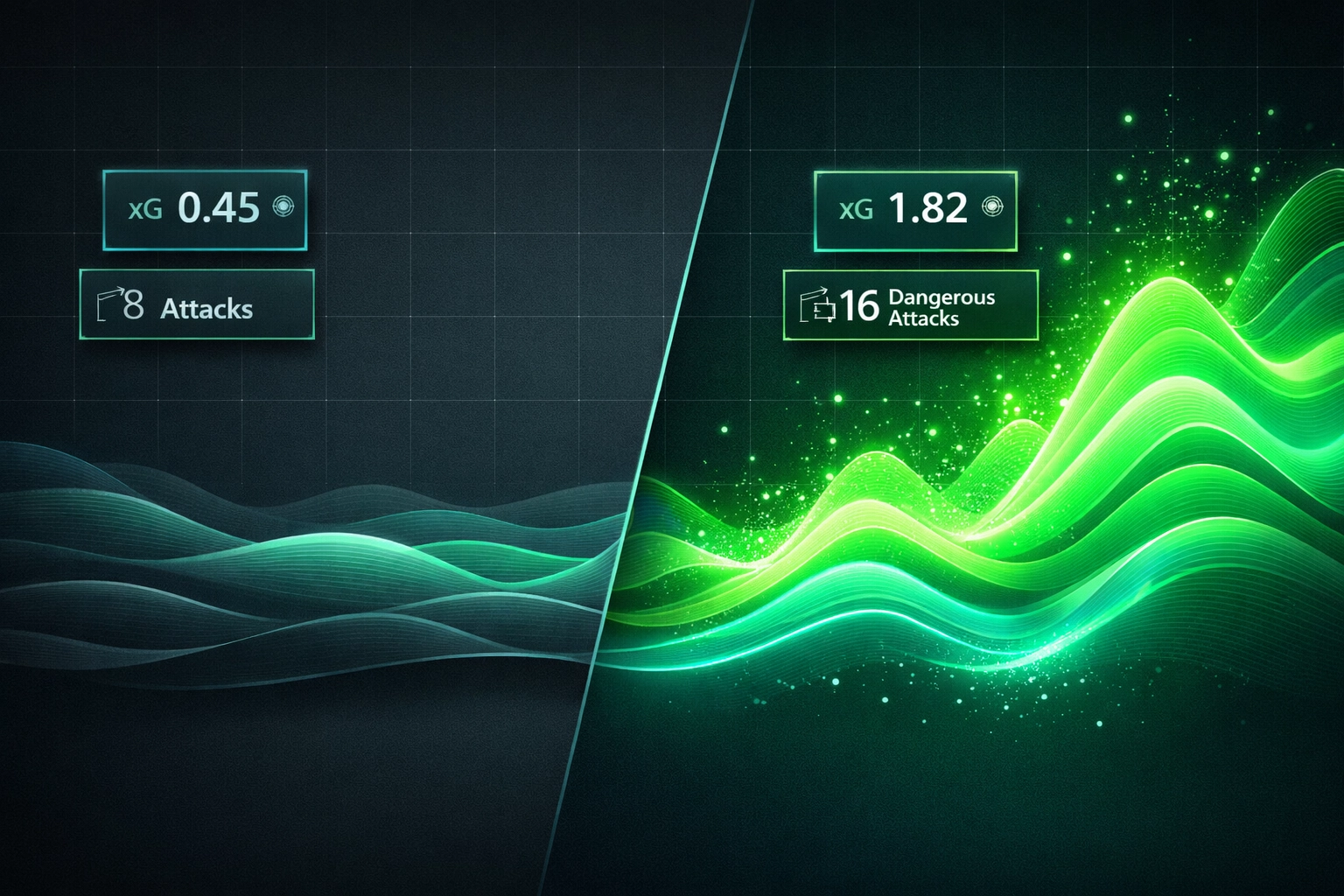
This is where xG stats become your best friend. xG doesn’t care about the highlights. it cares about the probability of a shot becoming a goal based on thousands of historical data points. If a game is 0-0 but the “Pressure Index” is spiking, the AI knows that the equilibrium is about to break.
The Half-Time Pivot: Acting on the Data
So, how do you actually turn this into a betting strategy? We call it the Half-Time Pivot.
When the players head down the tunnel, that’s your window. The market has adjusted the prices based on the 0-0 scoreline. This is often where the most significant expected value (EV) is found.
Here are three indicators Gecko Edge looks for to trigger a pivot:
1. The Discrepancy Gap
If the xG total for the match is significantly higher than the actual score (e.g., 1.8 xG but 0-0 score), the “Over” markets become incredibly attractive. The goals are “owed” to the game. It’s not a guarantee, but it’s a high-probability play.
2. The Final-Third Dominance
If one team has recorded more than 20 dangerous attacks in the first half but hasn’t scored, the defensive line of the opposition is likely redlining. Fatigue in the final 20 minutes of a match is the great equaliser. That’s when gaps appear.
3. Tactical Shifts
AI doesn’t just look at numbers; it looks at patterns. If a team known for high-pressing has stayed deep in the first half, they might be “saving their engine” for a second-half surge. Identifying these ai inplay betting triggers allows you to get in before the odds catch up.
Smarter Betting Starts with Calmness
The biggest enemy of a bettor is boredom. Boredom leads to “action betting”, placing a wager just to make the game interesting.
The seasoned bettor, the mentor-type we aim to be at Gecko Edge, knows that patience is a weapon. We wait for the quiet first half to give us the data we need. We don’t guess in the 5th minute; we analyse in the 45th and act in the 46th.
By using AI betting systems, you are essentially removing the emotion from the “boring” game. You aren’t looking for entertainment; you are looking for an edge. And often, that edge is sharpest when the rest of the world has stopped paying attention.
Why We Built Gecko Edge
We didn’t build Gecko Edge to give you “sure things.” There is no such thing in football. We built it to give you clarity.
Whether you are into in-play trading or looking for EV AI betting opportunities, the goal is to see the game for what it actually is, a series of probabilities.
A quiet first half isn’t a failure of the teams to perform. It’s a data collection phase. It’s the setup for the punchline. When you stop fearing the 0-0 and start analysing why it’s happening, you’ve taken your first step toward betting like a professional.
The Takeaway for Your Next Match
Next time you’re watching a game that feels like a stalemate, don’t change the channel. Open up your data tools. Look at the xG. Look at the pressure.
Ask yourself:
- Is the ball staying in one half?
- Are the defenders starting to look leg-heavy?
- Does the expected value suggest the market is overreacting to the lack of goals?
If the answer is yes, you’ve found your pivot.
Smarter betting isn’t about knowing who will win before the game starts. It’s about knowing how the game is changing while it’s happening. That’s the power of AI, and that’s the heart of Gecko Edge.
Stay sharp, stay analytical, and remember: the second half is where the story truly begins.
Want to see how our models handle the mid-game shift? Check out our latest insights on AI football predictions and start finding value in the quiet moments.
1 comment