



Most football bettors think they understand EV (Expected Value). They’ve memorised the formula, they know the theory, but they’re still losing money long-term. Here’s the brutal truth: the calculation isn’t the problem. It’s what you put into it.
The simple trick that separates profitable bettors from the rest? Getting your probability estimates right. Everything else is just arithmetic.
The EV Formula Everyone Knows (But Few Use Properly)
Expected Value is straightforward:
EV = (Probability of Win × Potential Profit) – (Probability of Loss × Stake)
Let’s use a real example. Manchester City are playing at home against Brighton. The bookmaker offers 1.50 odds on City to win. You stake £100.
If City win (probability = P), you make £50 profit.
If City lose (probability = 1-P), you lose £100.
So: EV = (P × £50) – ((1-P) × £100)
Simple enough. But here’s where most bettors go wrong.

Mistake #1: Ignoring the Bookmaker’s Margin
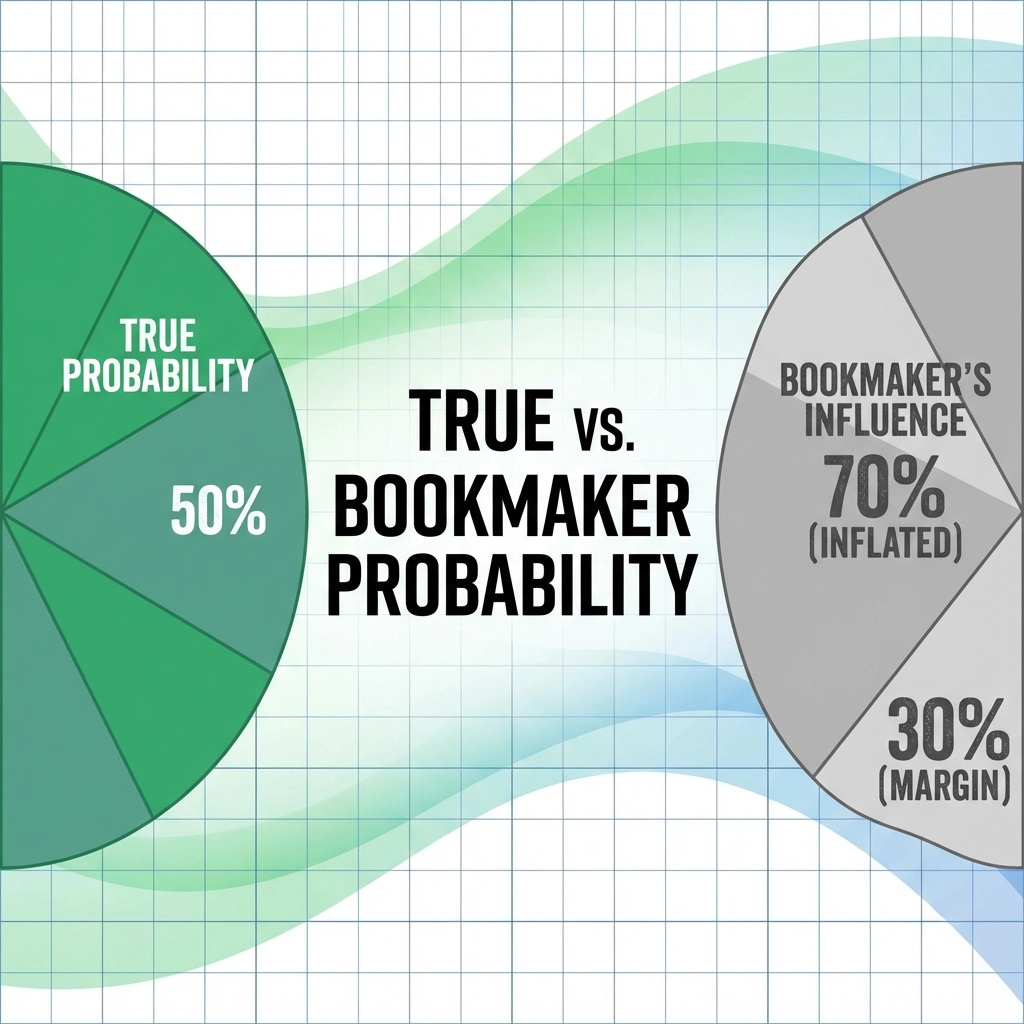
The 1.50 odds suggest City have a 66.7% chance of winning (1 ÷ 1.50). But that’s not the true probability. That’s the probability including the bookmaker’s profit margin.
Bookmakers build roughly 5-8% margin into their odds. They’re not charity shops. When you see City at 1.50, Brighton at 4.00, and the draw at 3.50, those probabilities add up to around 107%, not 100%.
Your first job is removing that margin to find the fair odds. This alone will save you from backing thousands of negative EV bets.
Mistake #2: Guessing Probabilities
“City looked good last week, so they’re probably 70% to win this.”
This isn’t analysis. It’s wishful thinking.
Proper probability estimation requires data. Form, head-to-head records, expected goals (xG), team news, motivation levels. Gecko Edge uses machine learning models that process thousands of data points to estimate true probabilities.
Human intuition is notoriously bad at probability. We overweight recent events, ignore sample sizes, and let emotions cloud judgment.
Mistake #3: Tiny Sample Sizes
“Liverpool have scored in their last 8 matches, so Both Teams to Score looks good value.”
Eight matches tells you almost nothing. Football is high variance. Teams can score in 8 straight games by luck alone.
You need hundreds of similar situations to estimate probabilities accurately. This is why systematic data analysis beats gut instinct every time.
The Right Way: Step-by-Step EV Calculation
Let’s work through a proper example using Liverpool vs Arsenal Over 2.5 Goals at odds of 1.80.
Step 1: Remove the bookmaker’s margin
Check all Over/Under odds. If they total 107%, the true fair odds for Over 2.5 are roughly 1.87, not 1.80.
Step 2: Estimate true probability using data
Look at:
- Both teams’ scoring rates this season
- Head-to-head goal averages
- Recent form (last 10 matches minimum)
- Expected goals data
- Team news and motivation
Let’s say your analysis suggests 58% probability for Over 2.5 goals.
Step 3: Calculate EV
Stake: £100
Odds: 1.80
Profit if win: £80
Probability of win: 58%
Probability of loss: 42%
EV = (0.58 × £80) – (0.42 × £100)
EV = £46.40 – £42.00
EV = +£4.40
Positive EV. Good bet.

Why Data Models Beat Intuition
Your brain wasn’t designed for probability estimation. You remember dramatic goals more than routine performances. You overrate teams you’ve watched recently.
Data models don’t have these biases. They process every touch, every shot, every defensive action. Gecko Edge’s xG models, for example, can predict goal probabilities far more accurately than traditional methods.
Consider Brighton vs Liverpool. Brighton’s underlying xG numbers might suggest they’re stronger than their league position indicates. Human analysis might focus on Liverpool’s reputation. The data tells a different story.
Real-World Applications
1X2 Markets
Use historical matchup data and current form to estimate win probabilities. Don’t just look at recent results – look at performance metrics.
Over/Under Goals
Expected goals data is crucial here. Two teams might both score regularly, but against weak defences. When they meet, the total might be lower than the market expects.
Both Teams to Score
Look at clean sheet frequencies for both teams. If Arsenal keep 40% clean sheets and Brighton score in 70% of games, BTTS probability is roughly 42%.

Common Pitfalls to Avoid
False Precision
Don’t claim you know City have exactly 73.2% chance of winning. Your estimate has uncertainty. Build in safety margins.
Betting Every Positive EV
Even with good models, estimation errors happen. Only bet when your EV calculation shows significant positive value – at least +2% is a good rule.
Ignoring Context
Team news breaks late. Players get injured during warm-up. Weather affects playing style. Your model needs to account for these factors.
Building Your EV Framework
Start simple. Pick one market type (Over/Under is good for beginners). Collect data systematically. Track your probability estimates against actual results.
You’ll quickly see where your judgment is biased. Maybe you overestimate home advantage. Maybe you underrate defensive teams. The data will show you.
Gecko Edge provides the foundation – accurate probability estimates based on comprehensive data analysis. But understanding EV calculation is still crucial for long-term success.

The Bottom Line
The simple trick isn’t really a trick at all. It’s discipline.
Most bettors get EV calculations wrong because they skip the hard part – accurate probability estimation. They use gut feeling instead of data. They ignore bookmaker margins. They trust tiny sample sizes.
Professional bettors do the opposite. They use systematic data analysis. They account for uncertainty. They only bet when the math clearly favours them.
Expected Value isn’t just a formula. It’s a mindset. Calculate properly, bet selectively, and let the numbers guide your decisions.
The formula is simple. Getting the inputs right is where the real work begins.
For more insights on data-driven betting strategies, explore our AI betting education resources or discover how our models work at Gecko Edge.