

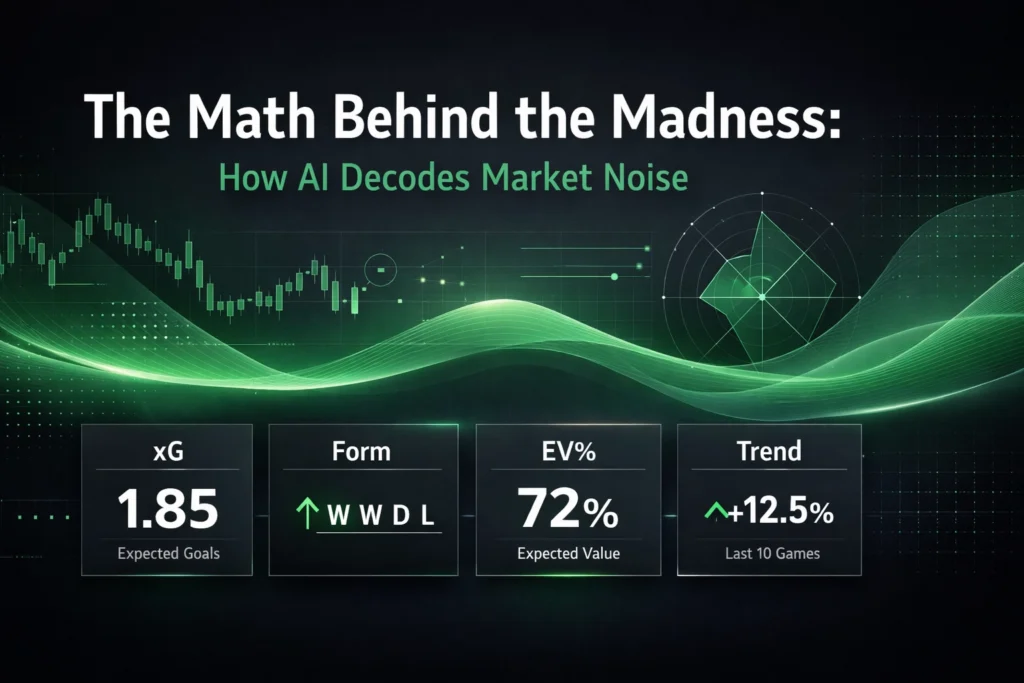
Market Noise; if you’ve spent any time in the markets, you know the feeling. It’s Saturday morning. Your feed is a mess of team news, “inside” info, and pundits shouting about why a certain striker is due a goal. It feels like information overload. But here is the reality: most of that information is just noise. It’s static. It has no value.
In the world of professional betting, the ability to distinguish between a genuine signal and random market noise is the difference between a sustainable edge and a declining bankroll. At Gecko Edge, we don’t look at the madness. We look at the math.
To find value in 2026, you can’t just work harder than the next person. You have to work smarter. You need to understand how artificial intelligence processes the chaos of the betting markets and turns it into something actionable.
The Problem with Human Intuition
Humans are hardwired to find patterns. It’s why we see shapes in clouds and why we think a team is “due” a win after three losses. In betting, this is a trap. The market is incredibly efficient at absorbing the obvious stuff. By the time you’ve read a tweet about a key midfielder’s hamstring, the price has likely already moved.
The noise is everywhere. It’s in the social media hype, the public sentiment, and even in the weight of money from casual bettors. If you follow the noise, you’re just chasing the tail of the market. To get ahead, you need to see what’s happening beneath the surface.
This is where Gecko Edge steps in. We use AI to strip away the emotion and the fluff, leaving only the data that actually moves the needle.
Vector Embeddings: Measuring the Distance Between Data
One of the most powerful tools in our arsenal is the use of vector embeddings. It sounds complex, but the concept is quite elegant. Imagine every piece of information: a news report, a tactical analysis, or a price movement: as a point in a vast, multi-dimensional space.
AI converts these data points into mathematical representations called vectors. By doing this, we can calculate the “distance” between different pieces of information.

When we see multiple sources reporting the same thing in slightly different ways, the AI measures how closely these points cluster together. If ten different “insider” accounts are saying the same thing, the linguistic distance is very small. Often, this indicates a coordinated marketing push or a viral rumour rather than an organic market signal.
By measuring this distance, Gecko Edge can identify when the market is reacting to recycled news versus when a genuinely new, high-impact signal has entered the fray. It’s about understanding the source and the intent, not just the content.
Content Clustering: Finding the Macro Trend
If you look at one data point in isolation, it’s easy to be misled. A single sharp move in the Asian Handicap market might look like a signal, but it could just be a large, uninformed bet being cleared.
To solve this, we use content clustering algorithms. Instead of analysing signals one by one, the AI groups related signals together. This reveals the macro trend. Is the market moving because of a structural shift in team strength, or is it reacting to temporary, superficial news?
Clustering allows us to see the bigger picture. It reduces thousands of daily data points down to a handful of significant movements. By recognising which market shifts consistently appear together across different sources and time periods, Gecko Edge identifies semantic relationships that a human analyst would simply miss.
For those looking to understand the fundamentals better, our knowledge base offers a deep dive into how these data structures form the backbone of modern betting.
The Scoring Framework: Why Novelty Matters
Not all data is created equal. A “leaked” starting lineup an hour before kick-off is worth significantly more than a pundit’s opinion written three days ago.
Our AI employs a rigorous scoring framework to prioritise signals. We evaluate two main dimensions:
- Industry Impact: Does this information represent a structural shift in the market?
- Intellectual Novelty: How “new” is this information?
If the AI detects information that has high novelty: meaning it hasn’t been seen before in the current data cycle: and it comes from a historically reliable source, it is weighted more heavily. Conversely, if we see the same “fact” being repeated for the fiftieth time, the AI lowers its importance score. It’s already been “baked into” the price.

This approach helps us avoid the trap of manufactured signals. In a world where PR fluff and coordinated campaigns can skew public perception, Gecko Edge keeps its focus on what is genuinely new and statistically significant.
Adaptive Filtering in Real-Time
The football market never sleeps. Prices move, news breaks, and weather conditions change. A strategy that worked at 10:00 AM might be obsolete by 2:00 PM.
This is why we use real-time adaptive systems. These systems don’t just process data; they prioritise it. Instead of treating every incoming update with the same urgency, the AI focuses on the feeds most likely to contain market-moving information: regulatory bulletins, sharp market movements, and tactical updates.
Every few minutes, the system refreshes and re-contextualises these alerts. It’s not just about telling you what happened; it’s about explaining why it matters in the current market context. This is crucial for maintaining an edge, especially when compared to traditional betting tips, which are often static and fail to account for late-breaking changes.
Beating the Closing Line
Ultimately, all this math serves one purpose: beating the closing line. The closing line is the most accurate representation of a match’s true probability. If you can consistently place bets at odds better than the closing line, you are mathematically guaranteed to be profitable in the long run.
Decoding market noise allows you to act before the rest of the world catches up. It allows you to identify when the market has overreacted to noise and when it has underreacted to a genuine signal.
By integrating these insights into your workflow, perhaps using techniques like smart adaptive staking, you move away from gambling and toward professional trading.
Smarter Betting Starts Here
The “madness” of the market is only madness if you don’t have a map. For the average bettor, the noise is overwhelming. For the Gecko Edge user, the noise is an opportunity.

We don’t promise magic. We provide clarity. We use the latest in machine learning and predictive analytics to ensure that when you place a bet, you’re doing so based on hard data, not a hunch.
The math doesn’t lie. It doesn’t get tired, and it doesn’t get biased by team loyalty or recent losses. It just decodes, calculates, and identifies value.
If you’re ready to stop listening to the shouting and start looking at the signals, you’re in the right place. Built for bettors, powered by AI. That is the Gecko Edge way.
Stay sharp.
To learn more about how we apply these principles to specific leagues, check out our AI betting tips section.